
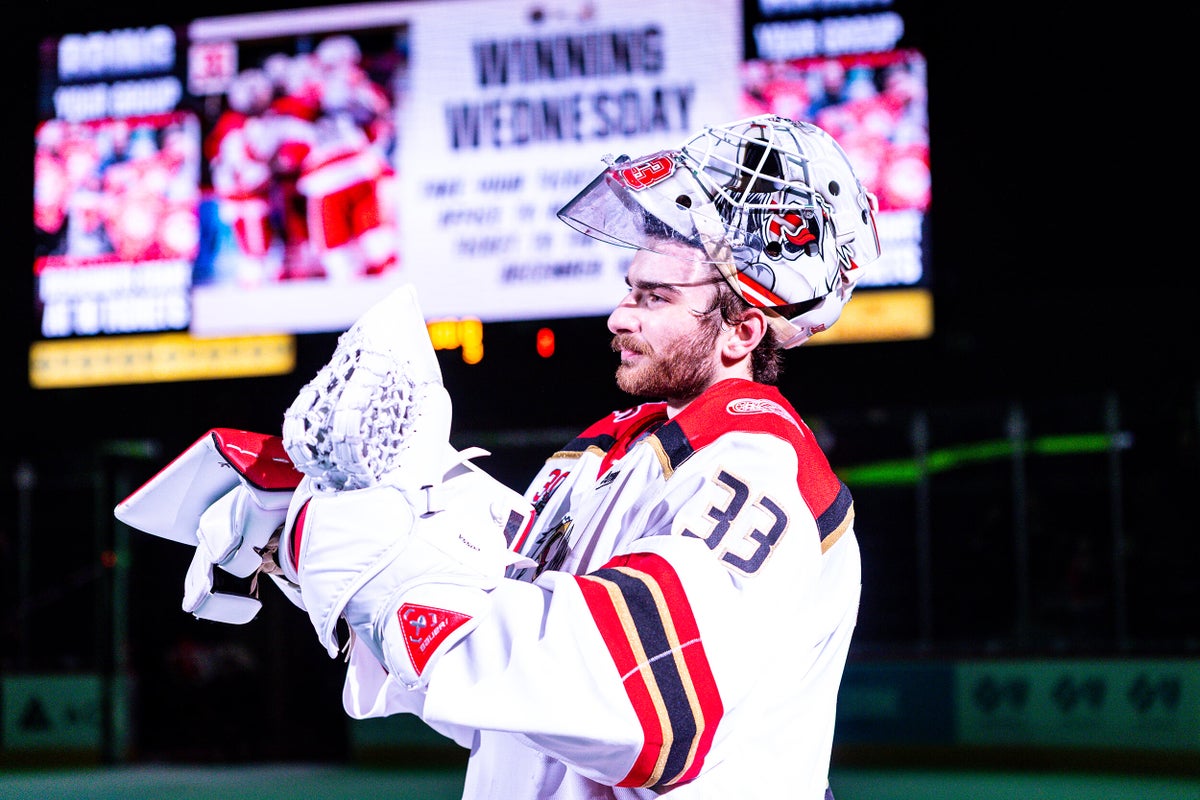
GRAND RAPIDS, Mich. — Here’s how well things are going for the Grand Rapids Griffins right now: when the team briefly let a 3-1 third period lead slip Wednesday night, 22 games into their season, defenseman Ian Mitchell called it “the first time we’ve really faced that kind of adversity in the third period.”
And he was pretty much right.
After regaining their footing Wednesday, the Griffins ended up closing out a 6-4 victory over the Milwaukee Admirals and ran their record to 20-1-0-1 — tied for the second-best mark in American Hockey League history through 22 games. The league’s history dates back 90 years, and the last team to have a start like this was the 2005-06 Wilkes-Barre Scranton Penguins, who went 20-0-2-0.
That kind of run will get anyone’s attention, and that includes the people who matter most: the Griffins’ NHL parent club Detroit Red Wings.
“There’s a lot of real positives going on down there,” Red Wings coach Todd McLellan remarked last week — and that was four wins ago.
Grand Rapids’ dominance has come in nearly every facet of the game. Griffins forward John Leonard leads the league with 18 goals in 18 games. Latvian newcomer Eduards Tralmaks is tied for fourth with 12, and Grand Rapids unsurprisingly is first in league scoring overall. The Griffins’ 43 goals against, meanwhile, are by far the fewest in the league. They have the AHL’s third-best penalty kill and sixth-best power play. Perhaps most notable to Red Wings fans: Sebastian Cossa’s .935 save percentage ranks second in the league.
So, with all of those things to consider, what exactly is the Griffins’ strength?
“I think it’s depth,” said Griffins assistant coach Brian Lashoff, “and it’s identity.”
The depth is plain to see. The roster assembled by Griffins general manager Shawn Horcoff is loaded with difference-makers at this level.
Up front, Leonard, who is 27, tied for second in AHL goals last year for Charlotte, and Tralmaks, 28, returned to North America this season after leading the Czech league in points. The team’s captain, Dominik Shine, is continuing his late-career bloom and sitting above a point per game. Behind them, the Griffins have 31-year-old veteran Sheldon Dries and 20-year-old rookie Michael Brandsegg-Nygård each threatening a point per game. Through 22 games, they already have nine forwards with double-digit points.
On defense, while the Griffins didn’t wind up getting exciting young blueliner Axel Sandin-Pellikka, who made the Red Wings out of camp, they instead wound up with both Erik Gustafsson and Justin Holl — longtime NHL players who are making huge impacts.
“Gus on the power play changed our unit for sure, “assistant coach Stéph Julien said, “and Holler on the PK too, and five-on-five, to kill plays and play against top lines.”
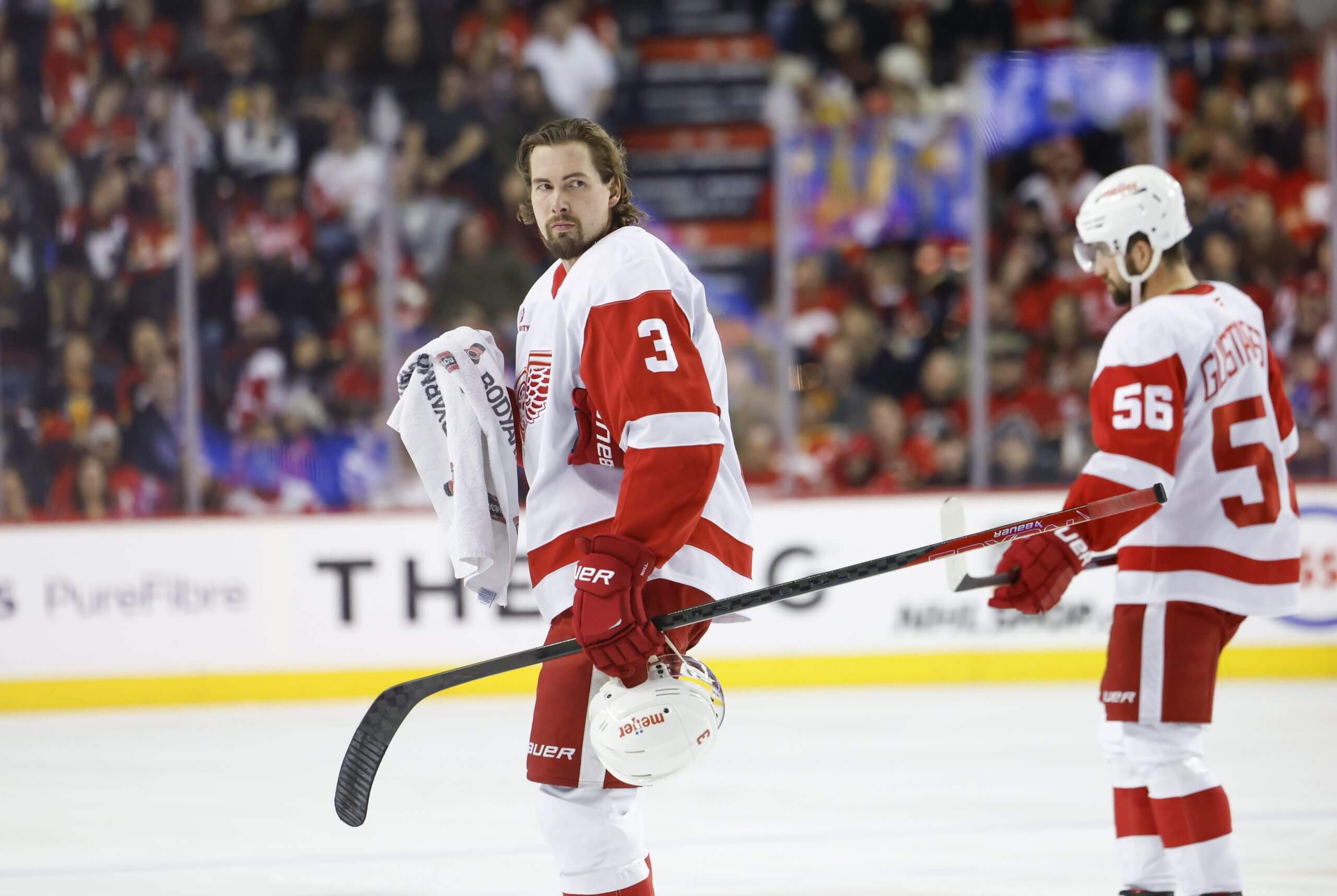
Justin Holl and Erik Gustafsson both played several hundred games in the NHL before landing on the Grand Rapids Griffins this season. (Leah Hennel / Getty Images)
Add those two to a blue line that already included relatively seasoned young players in William Wallinder and Antti Tuomisto, plus veteran AHL-NHL tweeners Ian Mitchell and William Lagesson and an under-the-radar find in Alex Kannok Leipert, and it’s an embarrassment of riches on the back end.
Too many to play on a given night, in fact.
That’s something the Griffins had to address anyway because of the AHL’s veteran rule, which stipulates that a team can only dress five skaters who have played more than 320 professional games in a given night. It’s a tricky rule for any team to navigate, but particularly when those players are of such a high level. So, the Griffins tried to keep it all equal: creating a rotation among the eight veterans on their roster, in which two would sit once every four games. And no one is exempt from it — even the league’s leading goal scorer. Wednesday, it was Holl and Austin Watson’s turn.
“We all kind of sat together, we brought it to them, talked about it,” Lashoff said. “They’re a mature group. I think that’s huge. … It can be difficult. I’ve seen it be difficult. But everybody’s kind of bought into it, and they’re happy for each other’s success, which I think is huge as well.”
Lashoff has been in that situation himself as a player, so he can certainly speak from experience on that topic. But it’s still much easier said than done. Players such as Holl and Gustafsson spent most of last season in the NHL. Shine, Mitchell, Lagesson and Watson all spent time there last season as well.
Just being in the AHL after — in some cases — long careers in the NHL can already be a hard thing for some players to accept. Being scratched once every four games is an even bigger ask.
“You don’t have to like it,” Watson said. “But your actions, your attitude around the guys — when you do play, when you don’t play — I think we’ve done a really good job with handling those situations.”
Of course, that may get tougher as the year goes on, winning gets harder and the games become more important. For that reason, it’s fair to wonder if the Griffins (and Red Wings) can really continue the rotation approach all year long, or if there may need to be a trade at some point to get all involved more opportunity, and keep some more continuity in the lineup.
But right now, the fact that those players have been willing to put their own best interests aside is part of what’s kept the momentum rolling in Grand Rapids.
Because for as much as those veterans are among the Griffins’ best players, their role also means setting an example in how to be a professional for young, impressionable prospects. And it’s safe to say that message is coming through.
“Obviously, at the end of the day, they don’t want to be (in the AHL),” Cossa said. “But I think they’ve taken the (right approach) with coming down here, working hard and joining right into the team culture, not being too good for the league. And they’re coming here, working hard every day, being great guys off the ice. They’ve fit in really well.”
That’s more team culture than team identity, but the two tend to be related in the commitment and buy-in they require.
“I think for us it starts with just our relentlessness on our forecheck,” Griffins coach Dan Watson said. “I love the way our guys skate and get up the ice. I know (Red Wings coach Todd McLellan) talks about it all the time: being direct. And that’s direct with the puck in the net, that’s direct with the puck out of our zone. Not just the puck: that’s with our bodies, making sure that we’re gapped up, making sure that we’re skating all the time. Just trying to be hard to play against.”
That was visible Wednesday, when Mitchell and Dries teamed up for a huge defensive play tracking back on the rush that led directly to what was, at the time, a go-ahead goal.
The Griffins run essentially the exact same structure as the Red Wings, Holl said, so it’s easier for players in call-up situations. But the bigger benefit to the young players Detroit is developing is what they gain from being in this winning culture, experiencing everything that comes with it.
Cossa talked about the confidence that comes with this kind of success, coming to the rink every day “knowing that if we go out and play our game plan, and we’re working hard, we’re going to come out with the upper hand.”
There’s a fine line between confidence and overconfidence, of course, and that will have to be managed throughout the season. Lashoff, a former Griffins captain himself before moving into coaching, said the team will have to “work twice as hard to keep it going, because everybody wants a piece of you.”
More challenges are certainly coming. But so far, it’s hard to argue with the results.
“I think our veterans have done a really good job of keeping everyone accountable and holding a high standard,” Cossa said. “It’s why we’ve had a good start, I think.”
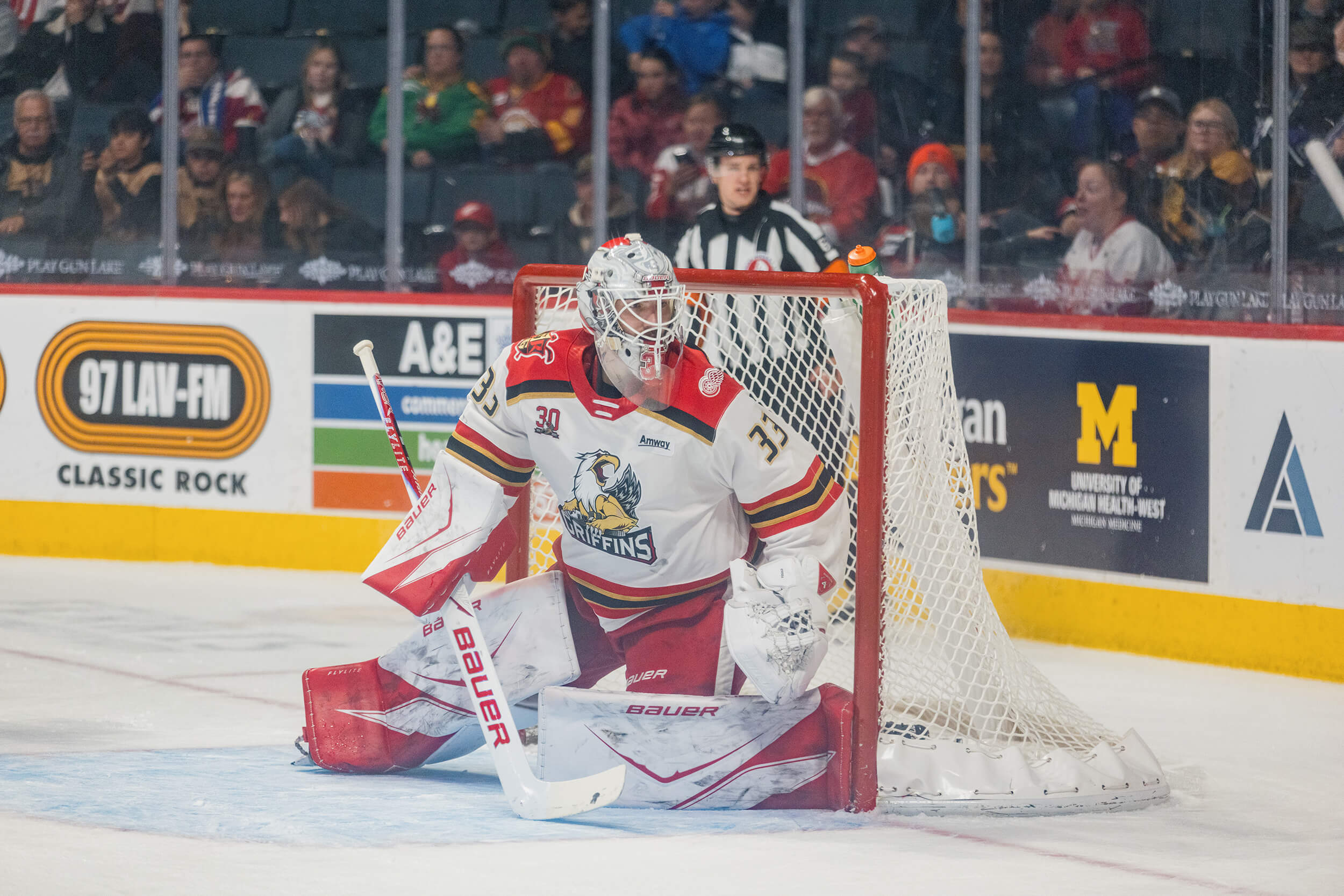
Sebastian Cossa boasts a .935 save percentage through 12 games with the Griffins this season. (Courtesy of Nicolas Carrillo / Grand Rapids Griffins)
Cossa, of course, is a central piece of this all — for the Griffins and the Red Wings. As good a team as the Griffins are, having a goalie playing at the top of the league statistically is the dream for any team. And that’s exactly what the 2021 first-round pick has done.
“Coss has played out of his mind,” Austin Watson said. “Not seemingly out of his mind, though — it’s calm, it’s comfortable. But he’s played extremely well.”
“He’s been unbelievable,” Holl added. “Couple of recent games we haven’t had great first periods, and he’s kept us in it when it could have been maybe a couple of goals down.”
He pointed to a recent game against Cleveland, when the Monsters outshot the Griffins 15-5 in the first frame, but Grand Rapids only trailed 1-0 going into the second.
“That makes a big difference in the game,” Holl said. “We’re able to come back and score a couple goals and win the game.”
For as many prospects as the Red Wings have in Grand Rapids, whether it’s a first-round winger in Brandsegg-Nygård, a rising young forward in Amadeus Lombardi (who is currently injured) or a trio of second-round defensemen in William Wallinder, Shai Buium (also injured) and Antti Tuomisto, Cossa is the prospect who could most dramatically alter the Red Wings’ trajectory if he hits. That’s the impact of the goalie position — which also just so happens to have been one of the Red Wings’ biggest weaknesses so far this season, prior to a recent uptick from John Gibson.
It’s worth noting here that the Griffins’ other goaltenders have been excellent this season, too. Michal Postava and Carter Gylander are both at or above .930 in five starts apiece for Grand Rapids, with Postava at .936, and Dustin Tokarski is at .929 in two appearances, which speaks to the favorable environment the Griffins can create for their goaltenders.
AHL success does not automatically correlate to instant success in the NHL, and for that reason, it’s best to remain cautious with expectations for Cossa. But after finishing the last two seasons at .913 and .911, respectively, the overall trend is undeniably positive.
“He looks big, plays big,” Lashoff said. “He looks confident. I think that’s the biggest thing. He knows who he is as a goalie, and (goalie coach Roope Koistinen has) done a great job with him. He looks like he’s taken another step this year. Every year he gets better and better.”
Brandsegg-Nygård’s fast success is similarly encouraging. After breaking camp in Detroit, the big-bodied forward was sent down to the AHL after posting one point in his first nine NHL games. But through 17 games, Brandsegg-Nygård is already up to five goals and nine assists with the Griffins.
While Brandsegg-Nygård’s mindset is, of course, to get back to the NHL, he’s taking the chance in the AHL to improve his game management and get more puck touches in a league that’s not quite as fast.
“He reminds me a lot of Marco (Kasper) his first year here,” Cossa said. “He’s staying on the ice extra after practice every day, wants to do 100 breakaways every day, just working really hard. Big future for sure.”
With how well both players have played for the Griffins, that future may come sooner rather than later.
But Grand Rapids is in the position it’s in mainly because the players on its roster — both young and old — have somehow managed to avoid letting that thought take up too much of their attention, staying present for what’s been a historic season.
“It’s just really cool,” Shine said. “We don’t think about it that much on a day-to-day basis, but when you take a step back and kind of see what we’re doing, it’s pretty special. So I think one thing for us, we talked about just not being satisfied, and you can kind of get caught up in seeing things or talking about things. So we just kind of take it day by day, and just keep doing what we’re doing.”