
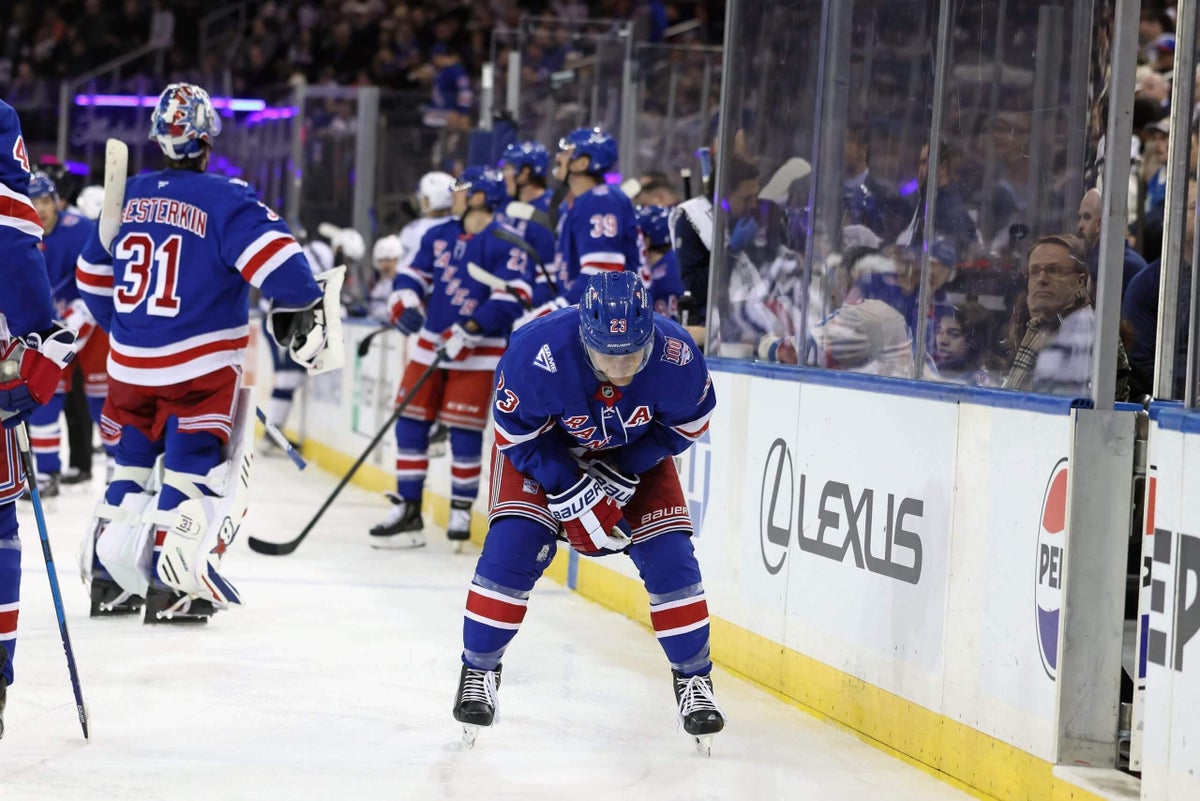
There are too many ways to get injured in the NHL. It’s the risk and reality of playing a high-speed contact sport, on an ice surface, with 90-plus mph pucks flying around, and sharp blades on everyone’s boots. And this year, that all may be exacerbated by a condensed Olympic schedule.
Whatever the reason(s), injuries are on the rise around the NHL. The best teams have to find a way through it, with a “next man up” mentality to fill lineup gaps.
Just look at the Lightning, who have been dealing with major absences this season: Ryan McDonagh, Erik Cernak, Brayden Point and Andrei Vasilevskiy have all missed time. So did Victor Hedman — 12 games, to be exact, before returning last Saturday against the Islanders. That put players such as JJ Moser to the test, and he responded with a 58 percent xG rate and helped Tampa Bay outscore opponents 12-2 in tough five-on-five minutes. When Hedman exited Tuesday’s game in Montreal early, Moser again stepped up.
The Lightning are far from the only team familiar with the injury bug this year, so let’s take a look at how some teams are navigating key absences so far this season.
Matthew Tkachuk/Aleksander Barkov, Florida Panthers
It’s impossible to have an injury conversation without the reigning champs. It’s not the first time the Panthers have come into the year short-handed — just last fall, they had to start the season without two of their top-four defensemen when Aaron Ekblad and Brandon Montour were sidelined. But this year’s hill has been a lot steeper with the team’s two best forwards, Barkov and Tkachuk, absent.
That has thrust players such as Sam Reinhart, Sam Bennett and Anton Lundell into greater roles than they generally are tasked with. The problem is, when players such as Reinhart and Bennett slip on the scoresheet — which is entirely reasonable considering the situation — it’s a lot more glaring when they are Florida’s No. 1 and 2 forwards, instead of the 3, 4 or 5.
Carter Verhaeghe, Brad Marchand and Lundell, at least, have all picked up the offensive pace recently. That’s even more promising with Tkachuk’s return on the horizon; adding a star winger back to the top of the depth chart should have a trickle-down effect on the rest of the lineup.
But there is still going to be a Barkov-sized hole the rest of the year. Florida’s team defense isn’t as stout without a player who puts up elite results against top competition, which is a pivotal part of it. So the Panthers have to find new ways to tighten up defensively, or get more goalie support, if they are going to claw their way back into playoff standing.
Jack Hughes/Brett Pesce, New Jersey Devils
The Devils were already strained when Jack Hughes was sidelined; two-way cracks had started to form a few weeks earlier when Brett Pesce went down with an injury.
At five-on-five, Pesce absorbed the toughest workload in terms of quality of competition to open the season. And while he wasn’t flashy in that time, he was a stabilizing force on both ends of the ice with the Devils giving up 0.78 fewer expected goals per 60 relative to the rest of the team. But since he has been sidelined, a few things have happened: 1) Luke Hughes, his mainstay partner, hasn’t been as strong on either end of the ice, 2) Simon Nemec has seen his minutes rise, and the process hasn’t always matched what the scoresheet shows in that time and 3) the penalty kill has struggled more.
The Hughes injury then added another massive pressure point. Nico Hischier, at least, has stepped up as the de facto 1C on the scoresheet, despite some downward trends in his two-way game (that started before Hughes left the lineup). But a lack of depth below that top line has only been exposed over the last month of play. Dawson Mercer hasn’t been as effective since shifting back to center, and the team has been outscored 9-6 without him or Hischier on the ice at five-on-five since Nov. 13. And that’s contributed to the team going 5-8-0 in the 13 games without Hughes (0.385 point percentage), after a 12-4-1 start (0.735).
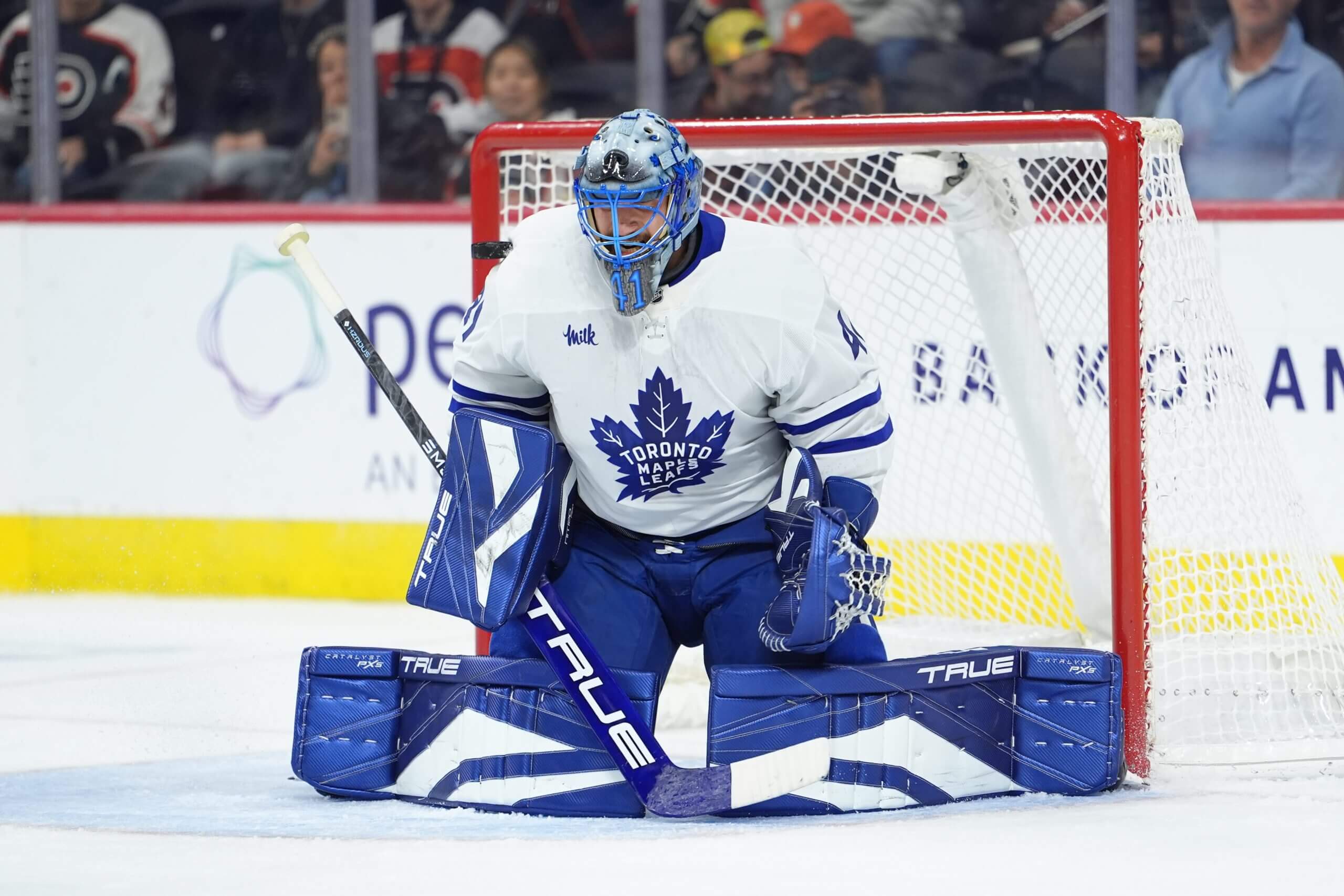
Anthony Stolarz was far from perfect in his 13 appearances before sustaining an upper-body injury. (Kyle Ross / Imagn Images)
Anthony Stolarz/Joseph Woll, Toronto Maple Leafs
At full strength, there are obvious roster holes in Toronto, which have suppressed the team’s record so far this season. The stars haven’t consistently shone bright enough. The secondary scoring, once again, lacks. And the defense has seriously slipped, especially with both Chris Tanev and Brandon Carlo injured.
And now, the team is without both of its NHL-level goalies.
Anthony Stolarz was far from perfect in his 13 appearances before sustaining an upper-body injury. But his workload was also more challenging, with the Leafs giving up more shots, chances and rushes to open the year, and that seemed to weigh on him in his last three appearances in particular.
Joseph Woll, at least, was ready for his season debut a couple of days later. He gave his team a chance to win with six quality starts in eight outings … until he also got injured.
So now it’s the Dennis Hildeby show in Toronto, and he has played a key part in the Leafs’ recent turnaround. Hildeby has earned a quality start in all of his appearances so far and has saved a collective 12 goals above expected in 11 games. As much as the team is starting to trend up in front of the blue paint, goaltending has been the difference over the last month — especially in short-handed situations, with a combined 0.949 save percentage in 12 games since Stolarz went down.
Connor Hellebuyck, Winnipeg Jets
Goaltending tends to be The Difference in Winnipeg. When Connor Hellebuyck is at his MVP-level, he can push this team far above expectations. And when he wilts in the playoffs, it crushes this group’s chances of advancing.
Hellebuyck’s efforts (and a high shooting percentage) helped mask some of the Jets’ struggles in the first month of action, while the team was without defensive stalwarts Dylan Samberg and Adam Lowry. The team stayed above .500 with an 11-7-0 record in its first 18 games. But that has plummeted since Hellebuyck had arthroscopic knee surgery. Over the last 11 games, the team has a 0.318 points percentage (and 3-7-1 record), which ranks 31st in that stretch.
Changes in goaltending obviously are a driving force behind that. Eric Comrie’s GSAx may be average through 10 games, but two stellar outings are doing a lot of the work there. Take out a combined seven goals saved above expected against the Sabres and Canadiens last week, and it exposes a GSAx of minus-6.76 in his eight other appearances.
Still, this doesn’t fall solely on Comrie’s shoulders. He doesn’t have enough goal support, and the defense has been far from perfect even after Lowry and Samberg’s returns. If anything, these last few weeks show where this team needs to improve to get back to contender status in front of their franchise goaltender.
Lukáš Dostál, Anaheim Ducks
The Ducks’ abysmal defense has made goaltending all the more important in Anaheim over the years. While this team started to improve in early November, its xG has ticked right back up over the last stretch. Through 30 games, the Ducks have given up 3.17 goals per 60, which ranks 31st in the league, ahead of only the Canucks.
While Dostál can be his team’s backbone, not everyone has the chops to play in that environment. What made this situation even trickier is that Petr Mrázek also went down with an injury a couple of games after Dostál, making Ville Husso The Guy over the last couple of weeks, when he really hasn’t had to play a starting workload at the NHL level since early in the 2023-24 season.
At least, unlike seasons past, this team gives its netminders goal support with its high-octane offense. The Ducks have scored 3.39 goals per 60 since Dostál went down, which is a key reason for their 5-3-0 record. But Husso deserves credit, too. His numbers are from perfect (0.893 save percentage, GSAx of 2.95), but he has still stepped over the last few weeks. Just take Tuesday night, when he helped steal two points against the Penguins with a dramatic overtime win.
Jaccob Slavin, Carolina Hurricanes
There has been a lot of roster turnover on the Canes’ back end in recent seasons, and the system gets a lot of credit for that plug-and-play mentality. But Jaccob Slavin also deserves a lot of credit for his consistently elite defensive play, which has helped keep that blue line stable and clicking at a high rate.
So the fact that the Hurricanes sit second in the Metropolitan Division despite Slavin’s absence in 27 or 29 games this season is truly impressive. But it’s still clear that this team misses its most valuable player, especially over the last couple of weeks in short-handed situations.
The Hurricanes are known for having one of the league’s strongest penalty kills — their strategy revolves around a stingy defense and an aggressive playing style. But over the last month, this team has allowed a higher rate of scoring chances against — 9.50 xG against per 60, to be exact. And that’s proven costly on the scoresheet, with Carolina’s goalies allowing 10.8 goals against per 60.
Slavin’s impending return should help revitalize the Hurricanes’ penalty kill and tighten up the team’s even-strength defense that has been a little leaky over the last stretch.
Charlie McAvoy, Boston Bruins
The retooling Bruins weren’t expected to be in the playoff picture this season. But the team’s three cornerstones, David Pastrnak, Jeremy Swayman and Charlie McAvoy, have helped this group exceed expectations.
After missing five games, Pastrnak returned on Tuesday night, and it was the first time the team strung together back-to-back wins since McAvoy was sidelined. So his return should give this team a real boost on the back end.
Before his injury, McAvoy was playing matchup minutes on the top pair with Nikita Zadorov. In their 131 five-on-five minutes together, Boston earned a 55.6 percent xG rate and outscored opponents 5-2. Without McAvoy, Jonathan Aspirot and Andrew Peeke have been leaned on more.
While the Bruins have outscored opponents 8-3 with the Zadorov-Aspirot pairing on, the process isn’t as smooth below the surface, with a 48 percent xG rate. Peeke in a larger role is even more concerning — his pair with Hampus Lindholm has been outscored 7-1, with a 43 percent xG rate, since McAvoy has been out.
Adam Fox, New York Rangers
Between his play on a crumbling Rangers team in 2024-25 and his showing at 4 Nations, the perception around Adam Fox’s game shifted a lot over the last year. But his play so far this season only reinforces his value as one of the top defensemen in the league.
Fox’s plus-9.9 Net Rating ranks third in the league among the position, behind only Cale Makar and Jakob Chychrun. His play in his own zone has been a key component of that; only Shea Theodore and Matt Roy rank higher in Defensive Rating. That all-around game excelled alongside Vladislav Gavrikov against top competition. Together, they earned a 59 percent xG rate and 16-11 scoring edge in 449 minutes.
Without Fox, Braden Schneider has been moved up to Gavrikov’s right, and the results have been less than stellar — the team is just below break-even in expected goals, and has been outscored 6-3.
New York doesn’t have a great way to replace Fox’s special teams’ impact, either. Without another high-end puck-mover or natural PP quarterback, the Rangers opted for a five-forward power play in Fox’s absence — but that experiment may be coming to an end after an awful showing on Wednesday night.
— Data via Evolving-Hockey, HockeyViz, HockeyStatCards, All Three Zones and Natural Stat Trick. This story relies on shot-based metrics; here is a primer on these numbers