
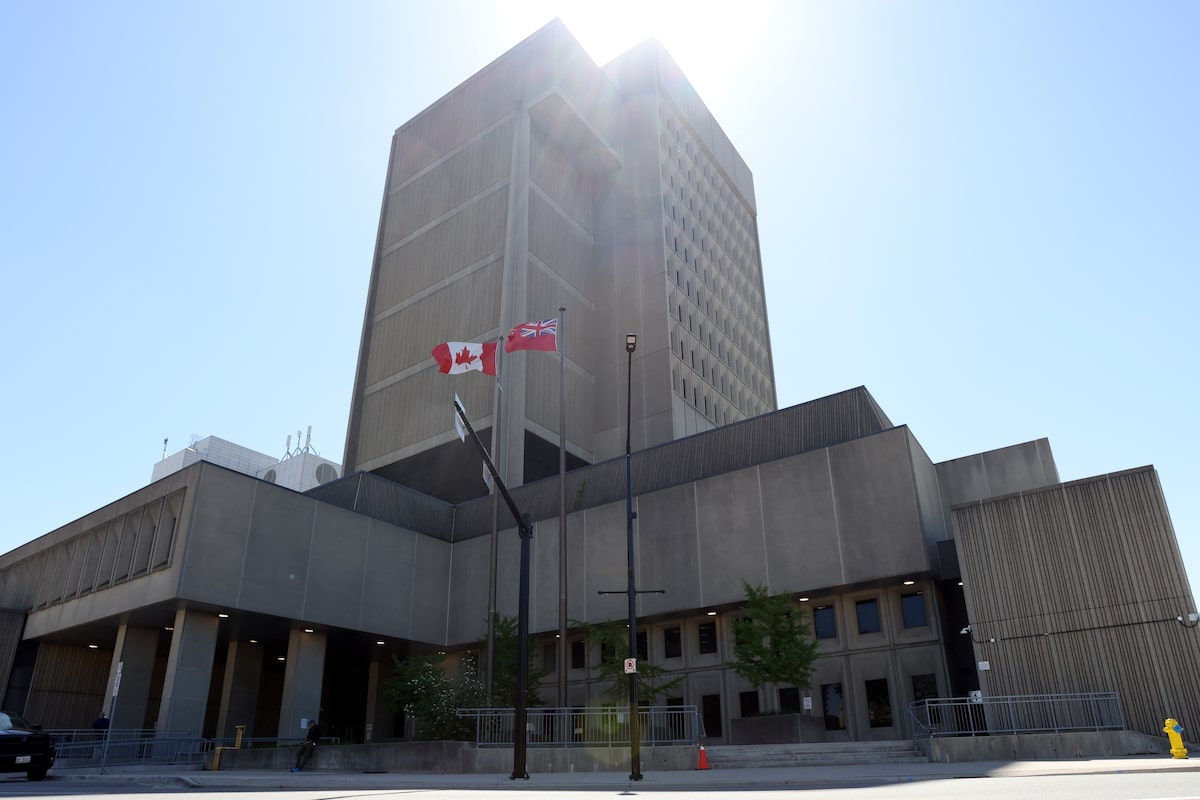
Justice Maria Carroccia dismissed the jurors of a sexual assault trial of five hockey players on Friday. The courthouse in London, Ont., on May 16.Nicole Osborne/The Globe and Mail
The judge at the sexual assault trial of five hockey players in London, Ont., took the logical step when she dismissed jurors for the second time and opted to proceed with a judge alone, legal experts say.
The latest twist in the trial of former members of Canada’s 2018 world junior hockey team came after a juror alleged that two defence lawyers – Daniel Brown and Hilary Dudding – had been laughing at them, a claim both denied. Justice Maria Carroccia then discharged the jury on Friday.
Second jury dismissed in Hockey Canada sex-assault trial, case will be heard by judge alone
It was a rare but not unprecedented situation, one that opened a window into the highly charged nature of court proceedings.
“An accused person is entitled to a fair trial by an impartial tribunal – and a jury that is convinced that the defense lawyers are acting inappropriately can‘t act impartially, or at least there would be a reasonable concern that they couldn‘t,” said Lisa Dufraimont, a professor at York University’s Osgoode Hall Law School.
“You don‘t find that happening very often, especially when you’re dealing with high profile cases of this sort. But Justice Carroccia is a very experienced jurist. I think she made the right call,” said Danardo Jones, a Windsor University law professor.
Justice Carroccia had already declared a mistrial three weeks ago after a member of a previous jury accidently crossed paths with Ms. Dudding during a lunch break. There were conflicting interpretations of the nature of the interaction between the two but the trial had just started so the judge dismissed that jury and a new panel was selected.
This time, with much evidence and testimonies already made public, “it would be very difficult to find jurors that have no opinion about the case,” Prof. Jones said. He added that relocating to another city was another option but it would have created delays.
Most crucially, if there was a new trial, the complainant, who had already been on the stand for nine days of testimony and cross-examination, would have to testify again. “That has to be factored in as well,” Prof. Jones said.
The two law scholars and two criminal lawyers interviewed by The Globe and Mail did not think that Mr. Brown and Ms. Dudding were making light of the jury.
“In a case that’s as high profile and as sensitive as this one is, the last thing that a defence lawyer would ever risk doing would be to alienate a juror,” said Chris Murphy, a criminal defence lawyer. “The defence in this case would never want to risk turning the jury against them.”
What jurors might not realize, because their window into the proceedings is narrowed to specific moments of testimony and evidence presentation, is that, despite the adversarial nature of the Canadian court system, defence lawyers, prosecutors and judges can act in a cordial manner with each other.
Lawyers can even exchange quips and pleasantries, what Mr. Murphy described as “gallows humour,” as an outlet in a high-pressure setting.
Prof. Dufraimont said it’s possible that what the jurors thought they were seeing was something else entirely.
“It’s very likely that that there was some talking back and forth between the lawyers, perhaps smiling or laughing, that sort of thing is not unusual at all, but one can see how that could be misinterpreted in this solemn environment,” she said.
Another criminal defence lawyer, Kim Schofield, said that the jury’s belief that Mr. Brown and Ms. Dudding acted inappropriately may have been a spillover of the negative perception defence counsel acquire in sexual assault cases.
Social media comments and protesters were critical of lawyers who had spent days cross-examining the complainant. “There’s certainly acrimony directed publicly at defence counsel,” Ms. Schofield said. “It becomes a very personal thing in a sexual assault case as opposed to, for example, a robbery.”
Both occasions that led to juries being discharged in this case involved the same legal team. Prof. Jones said it was unlikely to be intentional.
“It makes no sense in this case for defence counsel to have the jury disbanded. This is a case that from my viewpoint is better heard before a jury,” he said.
If a case turns on an interpretation of the law, then it would be better, tactically speaking, to be heard before a judge alone, he said, while “a case like this where it’s really, really factually dependent, it would be better if you heard the matter before a jury of your peers.”
Mr. Murphy said it would be hard to cite the switch to a trial by judge alone as a ground to appeal later because neither the Crown nor any of the defence lawyers applied for a mistrial on Friday.