
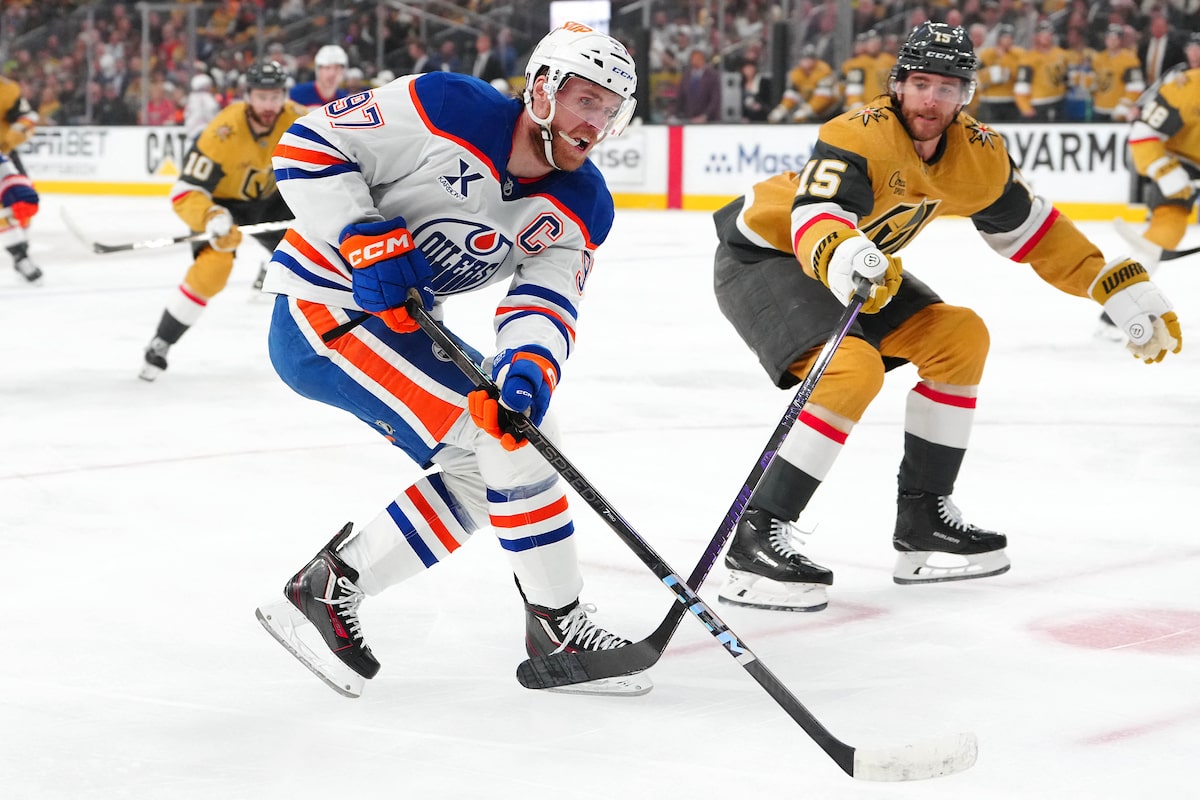
Las Vegas Golden Knights defenseman Noah Hanifin, right, defends against Edmonton Oilers center Connor McDavid during game five of the second round of the 2025 Stanley Cup Playoffs at T-Mobile Arena, in Las Vegas on May 14.Stephen R. Sylvanie/Reuters
I got off a late-night flight after covering Game 4 of the Leafs-Panthers series in one of those 12-hour travel hazes. I’d spent all day sitting in the Fort Lauderdale airport in expectation of the trip being cancelled because of torrential rain.
By the time we landed in Toronto, it was midnight and I was feeling like I’d been dipped in a light coating of oil. I walk-ran to the limo line dreading the idea that everyone would have left. There was one cab waiting there – driven by a lean, older man who, by his accent, was from somewhere in East Africa.
We gave each other the ‘You available?/Get on in’ nods, and as I opened the back door he said, “It’s alright if I leave the radio on?”
He could have been running a bandsaw in the cab for all I cared, but he felt the need to explain further.
“It’s the Oilers. They are kicking the ass of Las Vegas.”
It’s a terrible waste that this scene didn’t play out for an American, because while I had trouble believing any meeting between strangers could be this Canadian, they would not have. It would have reinforced the most lovely stereotype – hockey binds them all together.
It might also have struck this imaginary stranger that a man from Toronto was so captured by a team that’s 3,000 kilometres away.
The whole way into town, he was hitting me with Oilers stats and Oilers highlights. He had a particular soft spot for Leon Draisaitl. It hit me then that the Oilers are close to becoming ‘Everybody’s Team.’
Every sports has an Everybody’s Team, but not all the time. This is not necessarily a team everybody likes, or follows regularly, but a team they know and are closely aware of. They know who plays on the team and recognize them easily.
Were you to say the name to a sports fan anywhere in the world, whatever their preferences, they would be at least vaguely familiar with that team and who’s on it.
The Golden State Warriors were the last Everybody’s Team in the NBA. When Tom Brady was there, the New England Patriots were Everybody’s Team.
The ultimate Everybody’s Team remains Michael Jordan’s Chicago Bulls. You lived with them for a decade, and it is in the nature of basketball (five to seven guys featuring at any time) that the roster is easier to commit to memory.
Hockey hasn’t had anything close to an Everybody’s Team since the Sidney Crosby Pittsburgh Penguins were at their best. So it’s been nearly 10 years.
In order to be an Everybody’s Team, three qualities must be present. That team must have the expectation of winning a title every year, and regularly get close to doing that. They must feature one transformative figure. There must be supporting cast members of nearly equal quality, with personalities that contrast with and complement the lead actor. An Everybody’s Team doesn’t seem assembled so much as cast.
Tampa couldn’t be Everybody’s Team because they were missing the transformative figure, as well as the supporting cast. Plenty of talent, obviously, but few who could capture the imagination.
Even if they win it again, Florida can’t be Everybody’s Team. The closest thing they have to a transformative figure is the head coach, which won’t work (though a charismatic older man often features on Everybody’s Teams).
Of the teams in hockey, only Edmonton has all the necessary qualities. The Oilers have got Connor McDavid at the centre of the circle. They’ve got another hall of fame lock in Leon Draisaitl backing him up. They’ve even got ambiguous characters like Evander Kane and Corey Perry.
They’ve got history, which helps. They’ve been the very best, and then the very worst. So there is a pleasing sense of symmetry to them.
An Everybody’s Team is often from a second city. Manchester United would be the peak of the form.
You want everybody to feel that these men were assembled, Dirty Dozen-style, in some out of the way place where they could form a tight unit. They should emerge after a series of early disappointments. They should have some scars on them. They should be doubted right up until they do it.
Doesn’t this describe the Oilers? Despite coming up one game short in last year’s final, they were no one’s midseason favourite to win it this year. They may be if they end up playing Winnipeg in the conference final, but not if they play Dallas. They’ll be the underdogs until the final horn goes.
It’s why someone like Charles Barkley – who I’m pretty sure wouldn’t know which end is which on a hockey stick – is so taken by them. He never shuts up about them on TNT.
Barkley may not be a keen observer of hockey, but he is well aware of how sporting myths are created. He’s spent 40 years making one for himself. Now he’s trying to write himself a bit part in another one.
If this generation of Oilers never win, it will be an institutional failure on the part of the NHL. It won’t be anybody’s fault – that’s how sports work – but it will be the loss of enormous potential.
The league’s entering a clover phase. Its financials are rising, its rooms are full, it has growth potential through a renewed relationship with the Olympic movement. But in order to fully capitalize on those business bumps, you need a flag bearer to shove you to the front of the sports content parade.
Football has Kansas City, probably the most familiar of Everybody’s Teams. Baseball has the L.A. Dodgers. Even Major League Soccer has Lionel Messi and Inter Miami.
Hockey needs its headliner, the one who sells the movie just by being in it. Only the Edmonton Oilers are currently in a position to provide that star power.