
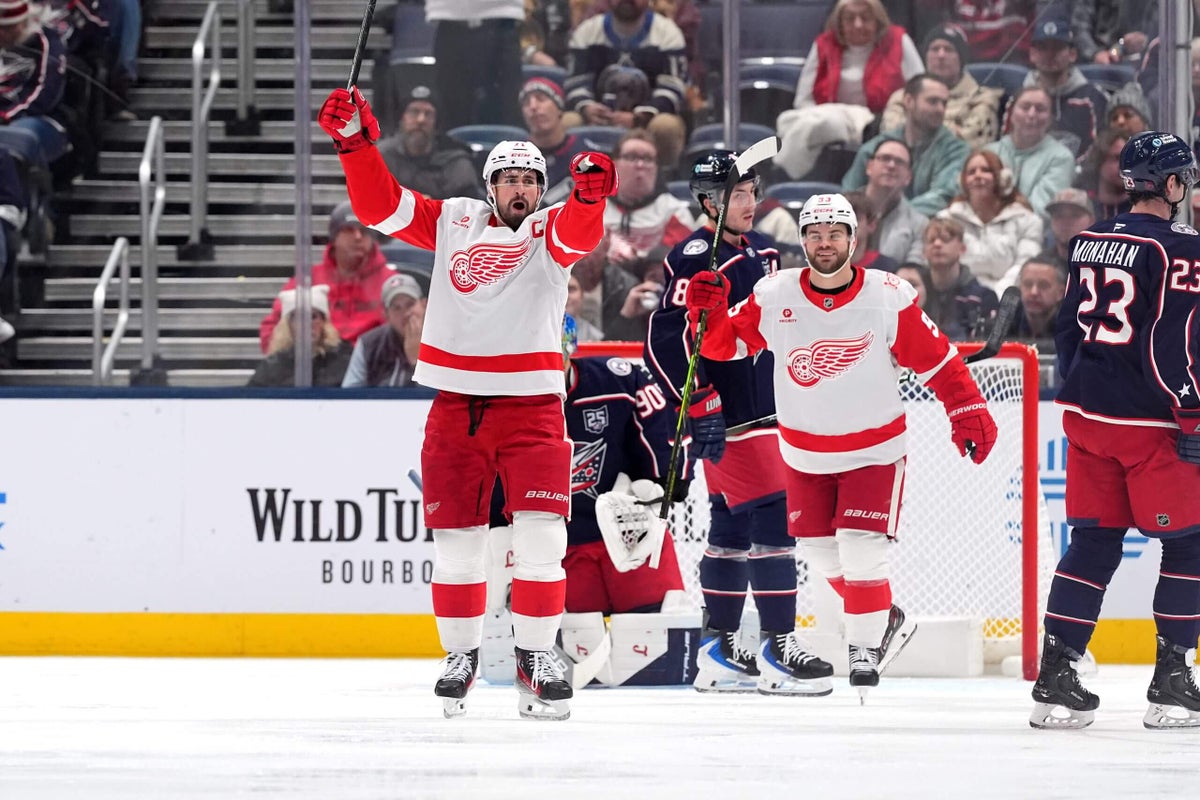
After a 4-1 loss in Edmonton on Thursday night, the Red Wings came up one game short of sweeping through Western Canada (and Seattle) for a second straight year.
But five games into their longest road trip of the season, Detroit is sitting at a 3-1-1 record with one game still to go.
Here’s what has stood out so far on the swing:
1. No one should be shocked to see the Red Wings lose the second half of a back-to-back against the two-time defending Western Conference champs.
But Detroit’s win over the Oilers in October was perhaps the Red Wings’ most impressive win of the season, so it was going to be an intriguing test. They did play Edmonton closer than the 4-1 score would suggest. One big difference this time: the Oilers having last change.
In Detroit, the Red Wings stapled Dylan Larkin to Connor McDavid, to great success. Larkin saw more than 16 5-on-5 minutes against McDavid, and delivered one of the best games of his career — shutting down the most dangerous player in the league and factoring in on all four Detroit goals in a 4-2 win.
Thursday, it was a very different story. With the Oilers in control of the matchups, the Red Wings only managed to get Larkin out there against McDavid for 5:18.
Now, I thought McDavid had a much better game in general this time. His pass to set up Zach Hyman for the Oilers’ third goal was All-World, and he did it with both Moritz Seider and Simon Edvinsson on the ice.
Hyms times 2️⃣‼️ #LetsGoOilers pic.twitter.com/LIeIRuc0eq
— Edmonton Oilers (@EdmontonOilers) December 12, 2025
And notably, the Oilers weren’t just going after one specific line with McDavid. He saw his most minutes against Detroit’s second line, of Andrew Copp, Alex DeBrincat and Patrick Kane, but not by a dramatic margin. Both of the Oilers 5-on-5 goals came with McDavid’s line out there against Detroit trios that were part-way through a line change, including some of the Red Wings’ youngest forwards: first against Nate Danielson, Elmer Söderblom and Andrew Copp, and then against Danielson, Marco Kasper and Alex DeBrincat.
2. The Red Wings’ young forwards have been one of the bright spots of this road trip, at least watching from afar. Danielson made the play on Detroit’s lone goal Thursday, and could have had an easy tally of his own off a great feed from Kasper a few minutes prior. He has three points in his last four games. Fellow rookie Axel Sandin-Pellikka had five points in his last four coming in.
And while Kasper isn’t getting rewarded for some of the good things he’s doing right now — that pass to Danielson being the latest example — I do think he’s due to snap out of his funk soon too.
That line of Kasper, Danielson and Söderblom has been a bright spot of late, and while their age could make it prone to streakiness, it would be huge for the Red Wings if that line can establish itself.
Granted, Detroit has jumbled its lines pretty often so far. But team success leads to more consistent lineups, and that can give players more time to find a rhythm — at least for a while. We’ll see how long McLellan leaves the youngsters together.
3. The most impressive Red Wings line recently has been the trio of Copp, DeBrincat and Patrick Kane. The three worked well together last season, too, before Copp was lost for the season to injury after the 4 Nations break, but they were really clicking coming into the Edmonton game.
Copp’s size enables him to be a presence around the net and down low for the two smaller wingers, but the bigger key is his smarts, which allows him to really play in flow with them. After a quiet offensive start, he had six points in four games entering Thursday, including a great play on DeBrincat’s second goal in a 4-3 win over Calgary Wednesday, when Copp forced a turnover on the forecheck, then found DeBrincat in the slot.
Despite their success together last season, it took Red Wings coach Todd McLellan a while to re-unite the trio this year. I wonder if he now wishes he’d gone to that look sooner, because to my eye it’s been highly effective.
4. The biggest question for the Red Wings right now is whether their improved goaltending over the last week is legit or not.
Their rocky team save percentage (which entered Thursday as the league’s fifth lowest at .884) is in part due to glaring defensive breakdowns and turnovers. And Thursday, the Oilers’ second goal came when defenseman Albert Johansson accidentally screened Cam Talbot on a Mattias Ekholm point shot. That’s the kind of avoidable mistake the Red Wings have seen too often.
But their goaltenders haven’t bailed them out often enough either, and that’s why it was so significant to see much-maligned John Gibson post a 39-save shutout Monday in Vancouver, and then another 34-save effort Wednesday in the win over Calgary. Gibson actually had a chance at a shutout in that one, too, with a clean sheet after two periods — but after allowing a penalty shot goal, he gave up two more in short succession.
Still, with 34 saves on 37 shots that night, Detroit will take the upward trend from Gibson, who they’re really banking on stabilizing their crease. Even if he’s not the goalie he was in his prime, they need more nights where he elevates them. And for as rough as things looked early, it’s at least encouraging to see how he’s fared on this trip.
5. The Red Wings will close out this trip in Chicago on Saturday, and if Thursday always stood out as a potential stumbling block on this trip, Saturday will be similar.
Detroit will at least be able to rest some tomorrow, but coming off a back-to-back the last two nights and changing time zones at the end of a long trip, they’ll face a tough test in a fast, young Chicago team with strong goaltending.
It’s the kind of game most of the recent Red Wings teams would lose. But you can bet Todd McLellan won’t let his team make any excuses for itself, and it’ll be a good test for them in those circumstances.