
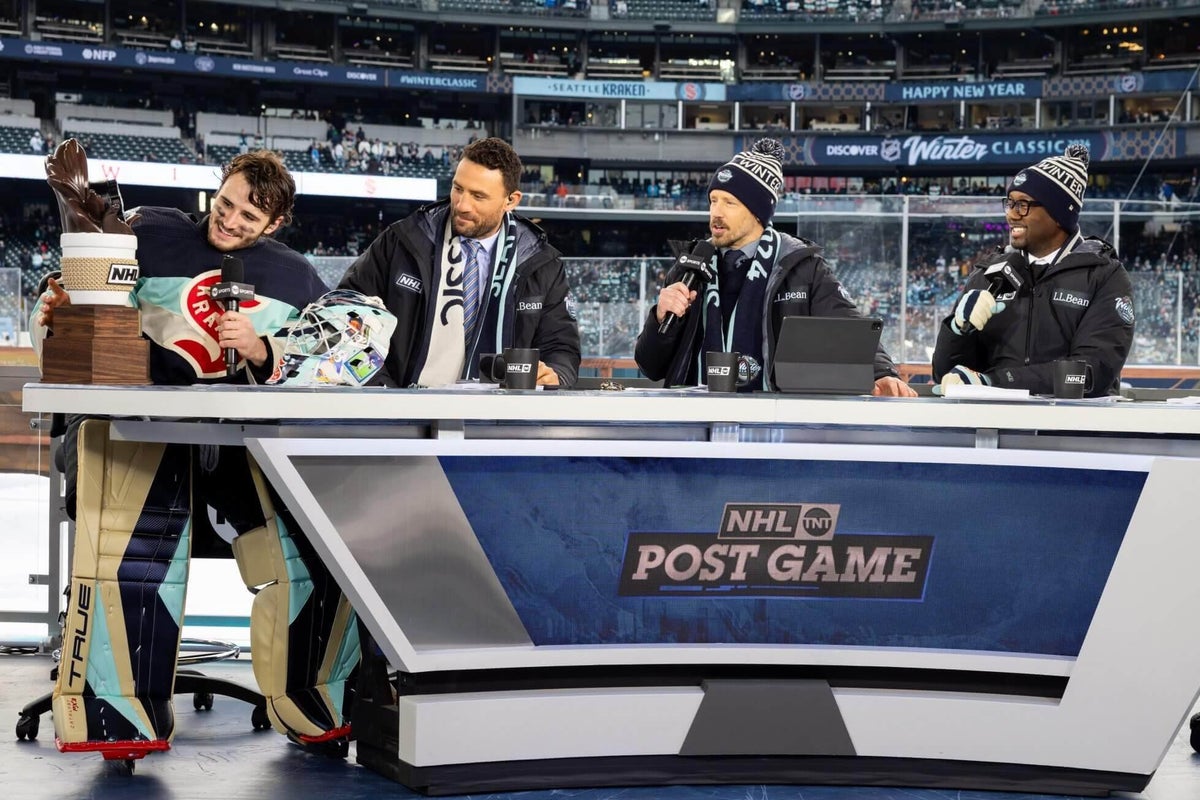
Four men inside an Atlanta television studio. A hockey player inside a rink. Viewers watching from anywhere. They’re all probably thinking the same thing: What is happening?
It’s just another night for the “NHL on TNT.”
On Tuesday, three former NHL players — Paul Bissonnette, Anson Carter and Henrik Lundqvist — and host Liam McHugh sat in the Turner studio and interviewed Nashville Predators goalie Juuse Saros, who sat on the Bridgestone Arena bench after his team’s dramatic victory over the league-leading Colorado Avalanche. Behind Saros, separated by tempered glass partitions, was a small gathering of Predators fans.
As Saros dutifully answered questions from the panel, one fan in the background continuously made gestures with his hands. He appears to be tapping along to a beat — let’s call it air conducting — or orchestrating a race of shadow puppets.
Anybody’s guess, really.
Juuse Saros talks to the crew after a HUGE win vs the Avs and about the interesting moves of the guy on the glass behind him during it 😭 pic.twitter.com/jUzm9fHbpM
— NHLonTNT (@NHL_On_TNT) December 10, 2025
It was impossible to ignore. And three minutes into the five-minute segment, Bissonnette addressed the elephant behind the bench.
“That guy behind you is driving me crazy,” Bissonnette said to Saros. “I think he’s a member of The Sticky Bandits (from the movie “Home Alone”).”
Saros, seemingly unaware of the goings-on behind him, glanced over his left shoulder.
“He just wanted you to wave or something like that,” Bissonnette said, before pausing. “Nope, he’s still doing the hand gesture. Maybe give him a wave or something.”
Saros’ laughter and willingness to go along with Bissonnette’s roughly half-minute of ad-libbing ensured that this segment would join many others that have stood out during the nearly 450 broadcasts of NHL games on TNT or TBS during Turner Sports’ four-year partnership with the NHL. By Wednesday morning, the interview clip had gone viral on social media.
Other than hardcore fans of the Predators or Avalanche, there’s a strong chance that nobody who viewed the Saros interview knew much about what happened in the game that preceded it. For every member of the crew — from the four men in front of the camera to the dozens working behind the scenes in various production, communication and social-media jobs — the interview was the equivalent of a forward scoring a natural hat trick or a goalie posting a shutout.
The “NHL on TNT” player interview segment — specifically the longer ones after games — has become the signature non-game element of the network’s hockey programming. It’s a whirlwind of Xs and Os, friendly ribbing and off-topic and often hilarious give-and-take. These segments would seem to fit in better inside a sports bar after a game, in contrast to the more staid, cliche-driven ones that American viewers have come to expect from their hockey coverage over the years.
Perhaps most intriguing for everyone involved is that the interviews regularly accomplish what so many NHL broadcast partners have tried and failed to do for going on four decades: To get hockey players to show their personalities.
“I’ve seen so many of these interviews, especially the ones done on-ice, and it’s always, ‘Get pucks deep, skate hard, forecheck, make sure your shifts are short’ — and it’s all so cookie-cutter,” McHugh said.
“I’ve heard for so long that hockey players don’t have personalities, and it’s just not true. I think the comfort level is what makes this work for us, and I’d like to think it’s helped chip away at that false narrative that hockey players can be boring.
“Watch one of our interviews; they’re not boring.”
At its inception, the studio show portion of the TNT broadcasts strived to borrow the vibe of the network’s award-winning NBA big brother, “Inside the NBA.” There was a successful formula to follow: Surround a pliable host with former players who might not otherwise hang out together to watch a game, because of their different personalities and varied careers, and then see what transpires.
“Inside the NBA” became appointment television — even more than the games. Turner Sports executives didn’t have quite as high a hope for the NHL studio show, but they wanted to get as close as possible.
“Hockey, in particular, the players have tons of personality — they just don’t get to show it,” said John O’Connor, Turner Sports vice president and executive producer. “They’re the most down-to-earth athletes. What we wanted to tap into was their personalities.
“And it worked pretty much immediately with the players. They liked having fun.”
What has separated Turner’s efforts from the league’s past American broadcast partners is perhaps an aptitude for toning down the seriousness while turning up the fun during its studio shows, which also include Major League Baseball, college football and basketball, and soccer. In Year 1 of the NHL partnership, the over-the-top parts of Bissonnette’s personality didn’t win favor with traditional fans and some high-ranking NHL executives. But everyone at Turner Sports recognized by the end of that first season that Bissonnette’s unapologetic, anything-goes traits turned what could have been staid player interviews into not only compelling TV, but also buzzworthy social clips.
“Love him or not, Biz brings something out of guys,” said Rick Tocchet, who spent time working as a studio analyst for Turner before taking coaching jobs with the Vancouver Canucks and Philadelphia Flyers.
“I don’t just mean the players. He did that for us in the studio. And, hey, you know what, maybe that’s what we all needed, not just that crew but everybody in hockey — maybe we were all guilty of being too serious because that’s the fabric of our game.”
Turner’s studio show has even brought more looseness out of the usually reserved Lundqvist and Wayne Gretzky, the latter of whom joins the group for big events and playoff games. Tocchet credited McHugh, who joined Turner after helming NBC Sports’ NHL coverage, “letting segments breathe, and pulling everybody back when it gets a little loose.”
This season alone, Lundqvist has taken friendly fire from all-time goal scorer Alex Ovechkin and rookie sensation Matthew Schaefer. Ovechkin joked that his favorite goals were those scored against Lundqvist, while Schaefer playfully took issue with a former New York Ranger getting the first question with the New York Islanders’ No. 1 draft pick. During another interview, Tampa Bay Lightning coach Jon Cooper, a former lawyer, flipped the script and had questions ready for the studio crew. Cooper delighted in making them squirm.
Jon Cooper FLIPPED THE SCRIPT and asked Hank, Biz, Ace and Liam the TOUGHEST questions ever asked on TNT (and subtly ROASTED the boys in the process) 😭 pic.twitter.com/7boGOZIxjS
— NHLonTNT (@NHL_On_TNT) October 30, 2025
In each example — and with the Saros interview on Tuesday — Turner Sports’ team of social media staffers cut clips of the highlights to post on various platforms. The aim is to expose non-viewers to the interviews and also allow fans who saw the interviews live to discuss them online. The network can’t control whether its game on a particular night is competitive or compelling, but it does strive to turn each player interview into a moment.
McHugh said he would “consider it the highest compliment” if the interviews were viewed by fans as favorably as those on Hockey Night in Canada’s “After Hours” segments, in which players conduct a sit-down at the rink. The difference, though, is that the Turner interviews occasionally feature players who clearly want nothing to do with either the interview or the questions, and sometimes with Bissonnette.
“You’ve got to bring it out of hockey players, but you’ve also got to let them be them,” McHugh said. “Whether that’s fun or funny, or whether they’re dismissive of our questions, it works either way.
“Even if a player has had enough of our nonsense, I think we’re able to laugh at ourselves — take that and make it part of our show.”
An early example was an interview with the Edmonton Oilers’ Leon Draisaitl, who clearly wanted little to do with Bissonnette. Draisaitl referred to Bissonnette as “Wiz,” which replaced “Biz” as Bissonnette’s on-air nickname for a couple of months.
McHugh said he examines the broadcast schedule one week out and, while consulting with the network analysts, offers potential names from both teams for interviews. It’s not as simple as getting a team’s most popular or best player to agree to the interview.
Last month, McHugh said Chicago Blackhawks captain Nick Foligno was the choice because “he would probably be more comfortable speaking about Connor Bedard than Connor Bedard would be speaking about himself.” It helped that Foligno had been the subject of previous interviews with the TNT crew. Without betraying any trust or breaking any so-called teammates’ codes, Foligno provided insight into Bedard that the burgeoning star had not shared about himself during his three seasons.
A player’s familiarity with the TNT interview format is always a bonus. Still, Bisonnette said the secret sauce to the segment is a conversational tone and McHugh’s insistence on limiting the number of notes used by those conducting the interview.
“Nothing feels forced because it isn’t — it’s just four or five people talking about kind of whatever we want,” Bissonnette said. “It’s not that we don’t prepare. We do. But we don’t want it to come off like that same studio interview fans have been getting for years.
“We’re not trying to lead guys in any direction. Wherever the segment goes, we roll with it.”
That vibe is the appeal for a lot of the interview subjects.
“It’s almost like I’m just in the room with my buddies,” Florida Panthers forward Brad Marchand said. “You’re just having fun. It’s light-hearted, enjoyable banter.”
Perhaps no player has benefitted more from the experience than Marchand, at least from a public relations perspective. Marchand said his interviews while with the Boston Bruins and Florida Panthers “definitely showed a different part” of himself.
Cast as a villain for much of his career, Marchand’s give-and-take during the TNT interviews, especially during the most recent playoffs, added depth to his public perception. Marchand has transitioned from full-on bad guy to antihero, and he conceded that the TNT interviews played a significant role in that transformation.
“You definitely see a different side of guys, if guys want to open up,” he said. “Not everybody does. Some guys just want to get back, focus on the game or move on.
“But it’s definitely an opportunity for guys to show a side that not everybody sees. It has been for me.”