

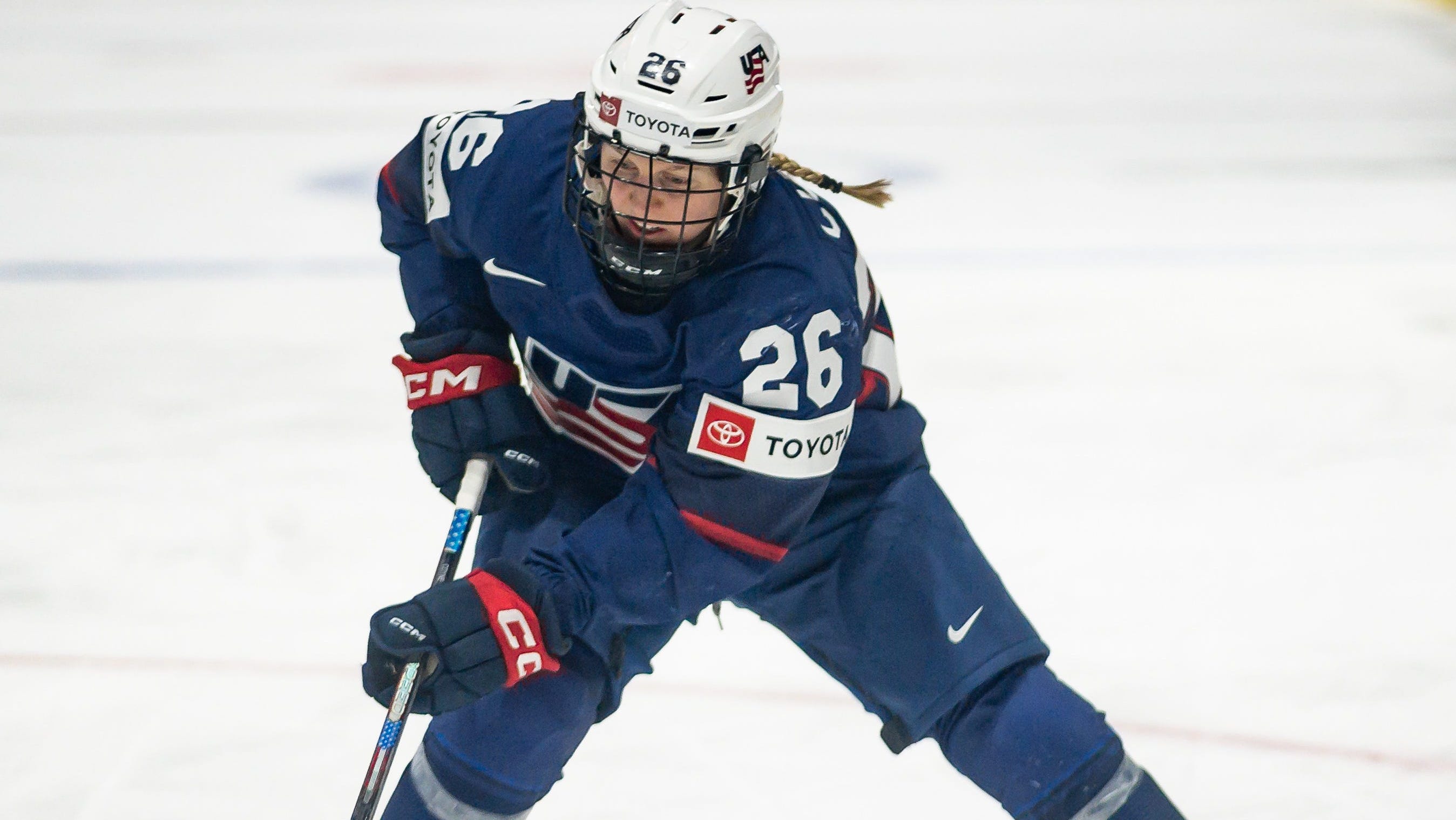

CCM’s Hockey gear for women is a game changer
Team USA’s Kendall Coyne Schofield and Taylor Heise talk about how CCM hockey equipment made specifically for women has positively affect their game.
Sports Seriously
One coach called it “laughable” and another said it was “an absolute joke.” But when it comes to differing opinions on what constitutes a hand pass in the NHL, the most frequent reaction appears to be confusion.
“I don’t think anybody in the league knows any more where it comes from,” Buffalo Sabres coach Lindy Ruff told reporters this week.
That’s strange, because with all the hand-pass goal reviews that have been called lately, you’d think we’d all be experts by now.
So far this season, the NHL has had five hand-pass goal reviews. Four have been called in a seven-day span already this month. And yet, based on the wildly inconsistent outcomes, we’re nowhere near coming to a consensus on what is and what isn’t a hand pass.
Part of the reason, said former NHL referee Bryan Lewis, is because Rule 79.1 relies heavily on “the opinion of the on-ice officials” to determine not only whether a player “directed the puck to a teammate” but also whether it “allowed his team to gain an advantage.”
“That’s a big long sentence,” said Lewis, who retired in 2000 after working more than 1,000 games and nine Stanley Cup Finals, “but there’s a lot of information in that sentence. It’s not a big deal if a puck hits my hand and I’m on my butt. But if it leads to a breakaway, it is a big deal.
“The key word is opinion. The referee has a judgement call to make.”
That subjectivity is why there has been so much controversy surrounding hand-pass calls this season. As we’ve recently seen, no two calls are the same. In other words, every referee — as well as player, coach and fan — is going to view a call differently.
In a Dec. 4 game between Tampa Bay and Pittsburgh, a goal was disallowed late in the third period because Brandon Hagel had reached up and prevented a puck from hitting him in the face. In the process, he directed the puck to his teammate, who then scored.
As Lightning coach Jon Cooper told reporters, “If I threw this microphone at you right now, would you put your hand up to stop it? Hell yeah, you would.”
Two nights later, Florida’s Brad Marchand tried to catch a puck behind the Columbus net, only to accidentally re-direct it to his teammate. Unlike the Tampa Bay non-goal, this time the goal was allowed.
A different result occurred on Tuesday, when Buffalo had a goal disallowed after a rebound bounced off Alex Tuch’s hands, despite the fact that Tuch had both hands on his stick at the time.
“There’s no explanation,” Ruff told reporters after the game. “I mean, I’ve watched every hand pass, from the Marchand one to the ones that are called hand passes. There are two hands on his stick … it boggles me. Somebody had to explain it to me. How that one is, and the one in Florida I watched isn’t — no explanation.”
One night later, Chicago’s Colton Dach was lying on the ice when he stopped a loose puck with his hand and then tried to shovel it to his teammate for a goal against the New York Rangers. The goal was disallowed. And for the first time, both teams agreed — somewhat surprisingly — that the right call was made.
“I thought that one was pretty clear-cut, but given the circumstances around the league there’s a little ambiguity there,” Rangers coach Mike Sullivan told reporters.
Therein lies the problem with hand-pass reviews. There are plenty of rules in the NHL’s rule book that are black-and-white. The hand-pass rule does not happen to be one of them. It requires a judgement call from the officials.
And it also requires a level of consideration from coaches, players and fans.
“I’m not beating up on anybody, but sometimes we have a lot of people who played the game who really don’t understand how it’s played,” said Lewis. “To me, whoever is doing the barking doesn’t understand the rule book.
“You don’t have to like the ruling. You just have to live with it.”