
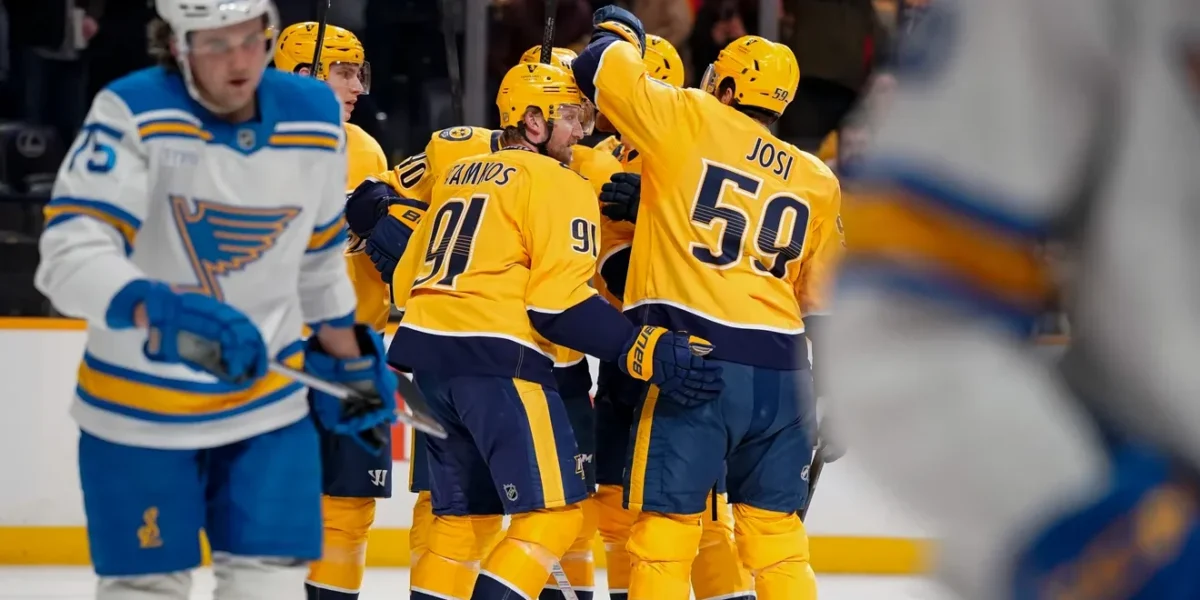
Thursday night in Nashville was a disaster from the first puck drop. The Blues were behind the play before it even began, struggling to contain Nashville’s speed and physicality. Every defensive misstep led directly to another goal, and offensive chances went nowhere as the team looked flat-footed and uncoordinated. By the final buzzer, the 7-2 scoreline felt almost generous, a harsh reflection of a team completely out of sync.
Defensive Breakdown
St. Louis’ defense was overwhelmed from the start. Steven Stamkos scored four goals. Filip Forsberg and Ryan O’Reilly each found the net, and Michael Bunting finished the scoring with the seventh Predators’ goal. Jordan Binnington faced 25 shots and allowed six goals before Joel Hofer replaced him, but the collapse extended far beyond goaltending.
The Blues repeatedly left opponents open in front of the net. They failed to challenge rebounds and were often out of position. Oskar Sundqvist, Logan Mailloux, and Justin Faulk struggled to keep up with the Predators’ forwards, and Cam Fowler and Colton Parayko reacted too slowly on critical plays.
Injuries to Nathan Walker and Alexey Toropchenko forced the team to rely on call-ups such as Hugh McGing and Aleksanteri Kaskimaki. Even with fresh players, the Blues lacked urgency, structure, and physicality, allowing Nashville’s forwards to dictate the pace of the game.
Fabbri Brings Energy
Robby Fabbri was one of the few players to stand out. He assisted on McGing’s first NHL goal, battled along the boards, and created chaos in front of the net. His energy sharply contrasted with the rest of the lineup, which often appeared passive and disorganized.
Hugh McGing and Robert Thomas also made contributions on offense, but beyond those moments, St. Louis offered very little resistance. Fabbri’s effort showed what the team could look like when players commit fully, though he was largely alone in driving momentum.
Offensive Struggles
Even when the Blues created scoring opportunities, they struggled to convert them. St. Louis has scored 81 goals this season while allowing 114, a gap that underscores their inability to stay competitive. The Blues managed to cut the score to 2-1 early in the second period, but Nashville quickly regained control.
The top line struggled to maintain pressure, and too many players failed to make an impact when it mattered most. Offensive chances rarely developed into sustained attacks, leaving the Blues constantly chasing the game.
A Team-Wide Reset Needed
Thursday’s loss is not an isolated incident. The Blues have struggled to play with the kind of physicality and focus that wins games. Defensive mistakes have become predictable, and too often the team looks disconnected, leaving the net exposed and opportunities for opponents to run wild.
Skill alone has not been enough to carry them through, and on nights like this, it is painfully clear that effort and commitment are missing from too many players. To compete, the Blues have to stay engaged from the first whistle to the last, fight for every loose puck, and play with the intensity needed to match their opponents.
The Blues return home to face the Chicago Blackhawks, a chance to regroup. Fabbri’s energy and McGing’s milestone goal offered rare positives, but the rest of the team must elevate its performance. Without improved focus and effort, blowouts like Thursday’s will continue to highlight just how far the Blues are from performing at the level they are capable of.
Discover more from Inside The Rink
Subscribe to get the latest posts sent to your email.