
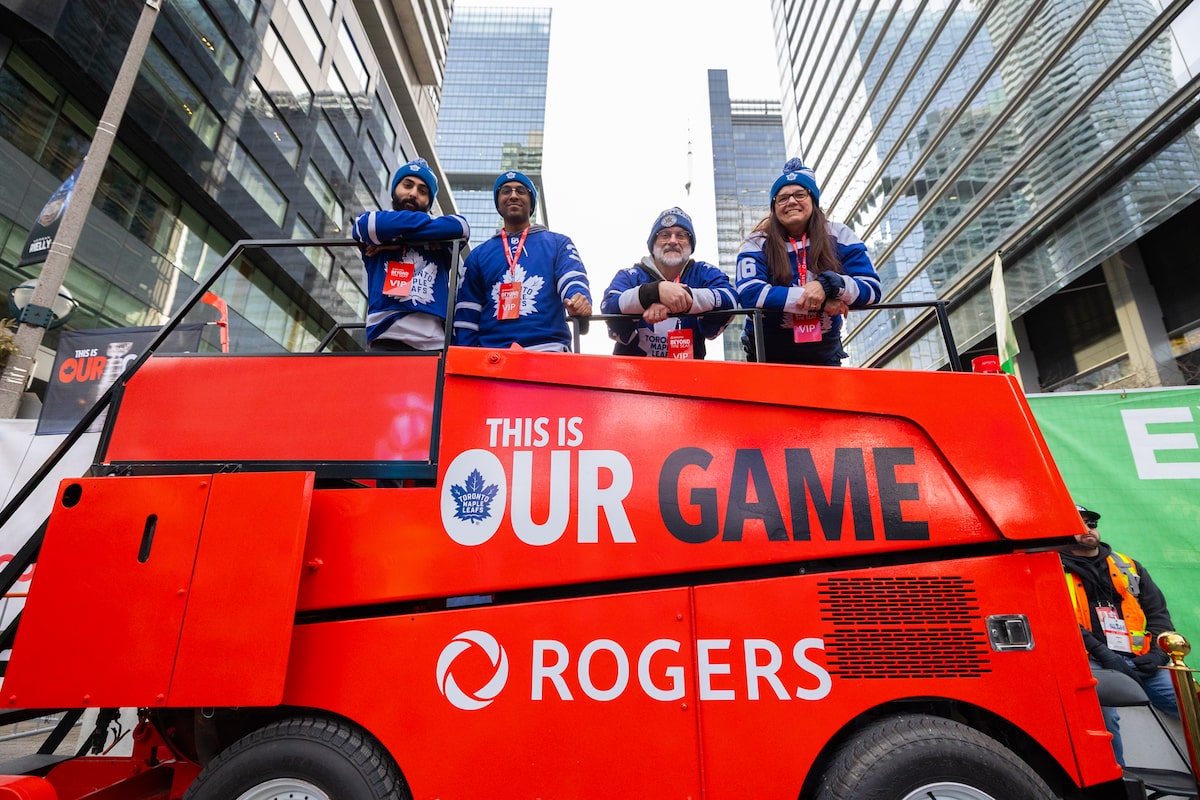
Toronto Maple Leafs fans stands atop Rogers Communications Inc’s ‘This Is Our Game’ Zamboni outside Scotiabank Arena.Supplied
Over the past few years, millions of Canadians have begun betting on sports, but it seems likely that few have gambled as much on the outcome of the Stanley Cup playoffs as James Kawalecki, the vice-president of marketing for Boston Pizza International.
When the postseason kicked off last month, the Toronto-based sports bar and casual dining chain unveiled an ad campaign urging Canadians, who have endured 32 years without a home team winning the Stanley Cup, to throw caution to the wind and just start manifesting victory by planning a parade. The campaign’s website? www.IfWePlanItWeWillWin.ca.
The company didn’t specify which team fans should get behind, because when the fan base of an entire country has known only pain for three decades, it’s probably best to not get bogged down in details. As a blithely upbeat spokesperson declares at the conclusion of the campaign’s first 30-second spot: “Yes, this year we are planning the parade. It will happen in Canada, ‘cause this is our game, and we’re not giving it back.”
As it happens, that very same proclamation – “This is our game” – is also the centrepiece of a high-profile campaign from Rogers Communications Inc. that’s blanketing the playoff airwaves.
In an unusual moment of concern about threats to Canada’s sovereignty, both brands are tapping into swelling national pride and the belief that hockey is embedded in the Canadian soul. If the move carries some big risks, research suggests a growing number of Canadians are willing to jump aboard a patriotic bandwagon in pursuit of the Stanley Cup being recaptured by a team from this country for the first time in more than a generation.
Rogers and Boston Pizza aren’t the only companies flying the flag during the playoffs. A number of brands are using the nightly broadcasts on Rogers‘s Sportsnet network to play up their Canadian bona fides and to reflect the country’s quiet strength back to itself.
Molson has been running a chest-thumping bit of nostalgia, set to Rush’s Closer to the Heart, that pokes fun at clichés about Canadians being quiet and boring. Real Canadian Superstore, too, has pulled from Rush’s catalogue, setting one of its commercials, in which employees wearing shirts with a ‘Proudly Canadian’ logo labour through the early morning hours, to the opening strains of The Spirit of Radio.
The grocer is also airing perhaps the most earnest ad of the season, a quietly affecting 60-second spot that opens with a long shot of a Canadian flag fluttering in the breeze. A voiceover from Michael J. Fox says it reminds us “that the best way to stand for something is to stand together.”
Not so long ago standing together, in the form of cheering for a rival’s team, was a sacrilege among hockey fans. Last year, when Boston Pizza ran its first campaign calling on fans to “Team Up For The Win,” with an ad urging Canadians to recognize it was time to “cheer with the fans we’ve always cheered against,” the company got some pushback.
“We had a ton of social chatter and discussion – and a lot of disagreement, frankly, on social media,” said Kawalecki, during a recent interview. “Fans saying, ‘That’s something I can never do’ – which we understand.” Still, he pointed out that a survey by Ipsos conducted on the eve of last year‘s Stanley Cup final found that 68 per cent of Canadians who identified as fans of other teams were cheering for the Oilers to win it all.
“We knew by the end of last year that it was the right thing to do, as the sentiment shifted, and so we were ready to pick up the banner again.”
Edmonton Oilers fans with the first, middle, or last name of Stanley fill a suite at Rogers Place in Edmonton during Game 3 of the Oilers-Kings matchup in Round 1.Supplied
This year, that brothers-in-arms (or, for Toronto Maple Leafs fans, perhaps, that misery-loves-company) sentiment seems to be growing in the face of threats from the U.S. A poll conducted last month by the Angus Reid Institute found that 71 per cent of Canadians said they wanted “Canada’s teams to succeed,” so would cheer for other Canadian NHL teams if their own were eliminated. That’s up from 64 per cent last year and 57 per cent in 2016.
Even so, Kawalecki admits, it can be a little nerve-wracking to green light an expensive marketing effort whose success depends in part on the sometimes fickle gods of sport.
“It doesn’t come without a massive amount of risk,” he said. “There is a scenario where, after Round 1, you’re kind of left with nothing. And we were prepared for that, but with all the time and passion that gets invested, to have a campaign that lasts for a couple of weeks really would have been not the best result.”
With those fears largely allayed by at least one Canadian team making it into the third round, the company can focus on keeping the vibe positive. The Round 2 ad introduced Colonel Chris Hadfield as the driver of the Boston Pizza parade bus.
“The pro-Canada sentiment is high right now,” Kawalecki noted. “So, to be able to wrap the brand in the flag behind this common cause of bringing a championship to the country is definitely well-timed.”
Rogers‘s Stanley Cup campaign is an evolution of the one the company used during the 4 Nations Face-Off in February, when its ads evoked the 150-year history of organized hockey in the country and declared that “We’re not here to play a game, we’re here to play our game.”
On the day of that tournament’s championship game, Rogers published a survey it had commissioned that found 75 per cent of Canadians believe “Canada’s national pride is deeply intertwined with the sport.”
After signing a 12-year renewal to its agreement with the NHL for national rights last month, Rogers is heavily promoting its status as “the home of hockey” across the country. The company has long-term strategic partnerships with the Edmonton Oilers, Vancouver Canucks and the Toronto Maple Leafs, and is in the process of doubling its ownership stake in the Leafs’ parent company, Maple Leaf Sports and Entertainment, to 75 per cent.
“We want to be the No. 1 brand associated with hockey,” said Terrie Tweddle, the chief brand and communications officer for Rogers Communications, in an interview.
With more Canadian teams in the playoffs this year, Tweddle said, the challenge was: “How do we capitalize on that excitement and enthusiasm?”
The most prominent execution of that is a 30-second TV spot, set to a soundtrack of the earworm Lay It On the Line by the classic Canadian rockers Triumph, that features a tantalizing glimpse of the Stanley Cup, rabid fans and resolute players from the Canadian teams in the hunt for the Cup, and the exhortation: “This Is Our Game.”
The ad is recut after each round to include only those Canadian teams that are still standing.
Speaking on Wednesday morning of this week – which is to say, before that evening’s disastrous Leafs effort against the Florida Panthers in Game 5 or the results of Friday night’s Game 6 were known – Tweddle acknowledged it would be awesome to be able to run an ad going into the final round that includes two Canadian teams, celebrating an all-Canadian Stanley Cup final matchup.
“We’d be thrilled. It would be very, very exciting for the entire country, and I think you would get fans who don’t necessarily watch the sport that much, really engaged and excited,” she said. “It would just be great for our country and for fans.”
And if a Canadian team won the Stanley Cup, could Rogers arrange for Triumph to play at the parade?
“Anything’s possible,” she replied.