
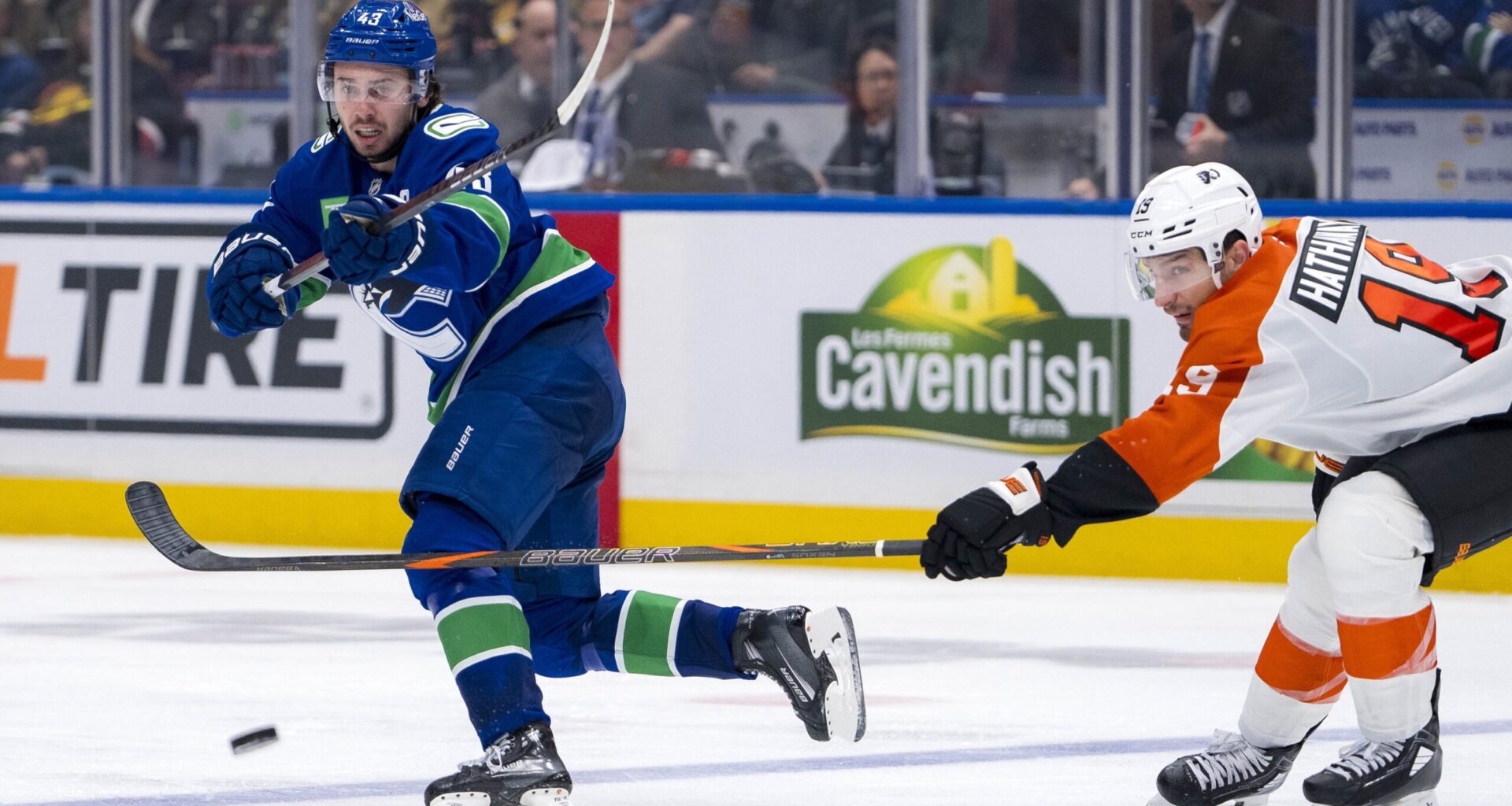
There were a few teams in the running for Vancouver defenseman Quinn Hughes, including a few in the Eastern Conference. Washington was mentioned, New Jersey was tossed around given the sibling connection, and Philadelphia was briefly thrown into the mix. However, trading Hughes to Minnesota for a rather good package of young prospects, a draft pick, and an established center was a decent return for Hughes.
While the Flyers struck out on this current transaction to land the coveted world-class blueliner, there are a few silver linings from this trade to Minnesota.
No Hughes in the Metro
The fact Quinn Hughes may only torture the Flyers a few times a season versus being with one of the teams in the Metropolitan Division is a huge asset. Seeing him in a Capitals or Devils uniform for this season and next would’ve made things a tad tougher for Philadelphia to get themselves into the playoffs or nail down a wild card spot. But by knowing Hughes is in the Central Division, the only nightmare scenario would be the Flyers getting to the Stanley Cup Final and facing the Wild with Kirill Kaprizov and Hughes in the way.
As it stands now, Minnesota will be facing the Flyers one more time in the 2025-26 season when the Wild host the Flyers on March 12. But other than that, the Flyers shouldn’t really be too concerned with Quinn Hughes this season or next.
Package heading back way too costly
As it was speculated in the days and weeks leading up to the eventual trade, the Flyers would probably had to part with pieces of their future they were simply unwilling to part with. When a first-round pick, Noah Cates, a competent blueliner (Jamie Drysdale? Cam York?) and one of either Matvei Michkov or Porter Martone was the possible asking price, it was far too high to pay. Yes, Hughes is one of the better puck-possession defensemen around, and can alter a team or a game at a moment’s notice. However, the Flyers endured too much pain and showed too much patience in recent seasons to see blue chip prospects like Martone or Michkov go out the window to land a 26-year-old defender. Not to mention any other pieces that were involved.
By standing pat and not doing anything for the time being, the Flyers have more of a window to see what they have in Michkov, Martone, and Drysdale for starters. And of course holding onto the first-round pick that would’ve been shipped to Vancouver. Given how the Flyers have been one of the better teams in terms of their draft selections in recent years, losing three or four first-round picks to land Hughes would’ve been a mistake. It might have sped things up in terms of seeing a better product on the ice, but it would’ve shortened the window for contention also.
Summer of 2027? Maybe
What remains to be seen from the Hughes deal is how sold he is in playing with the Wild. Minnesota have this season to prove to him they are legitimate contenders. That might be a slightly tougher sell considering just how stacked the Central Division is with Winnipeg (struggling lately but getting Connor Hellebuyck back soon), Dallas, and that somewhat decent team called the Avalanche this season. There’s no guarantee Minnesota gets to the Conference Finals and a better than 50/50 chance the first round might be their only playoff round.
So, if Hughes isn’t sold on Minnesota, and Wild general manager Bill Guerin can’t work his magic in signing him to an extension on July 1, 2026, things become more enticing for teams that kicked the tires on him in the last few weeks. Should the Flyers get into the playoffs this year and possibly upset somebody in the first round, that’s a good starting point to make Hughes or his agent consider Philadelphia. As well, 2026-27 should see Martone suiting up, giving the Flyers another piece alongside Michkov, Tyson Foerster (we hope, fingers crossed for health), and Trevor Zegras (we hope, fingers crossed for an extension). Flyers general manager Danny Briere has some housekeeping to do with restricted free agents and possibly locking up Michkov long-term. But it would be a huge coup to land Hughes in the summer of 2027 for nothing more than cap space.
For now, the Quinn Hughes speculation has come to an end. Should the Wild’s season go a bit pear-shaped due to injuries or just poor play, the noise will begin again about Hughes leaving Minnesota for greener pastures. And with the Flyers having some promising high-end talent waiting in the wings, it might be for the best that, for now, Quinn Hughes isn’t calling the City of Brotherly Love home.