
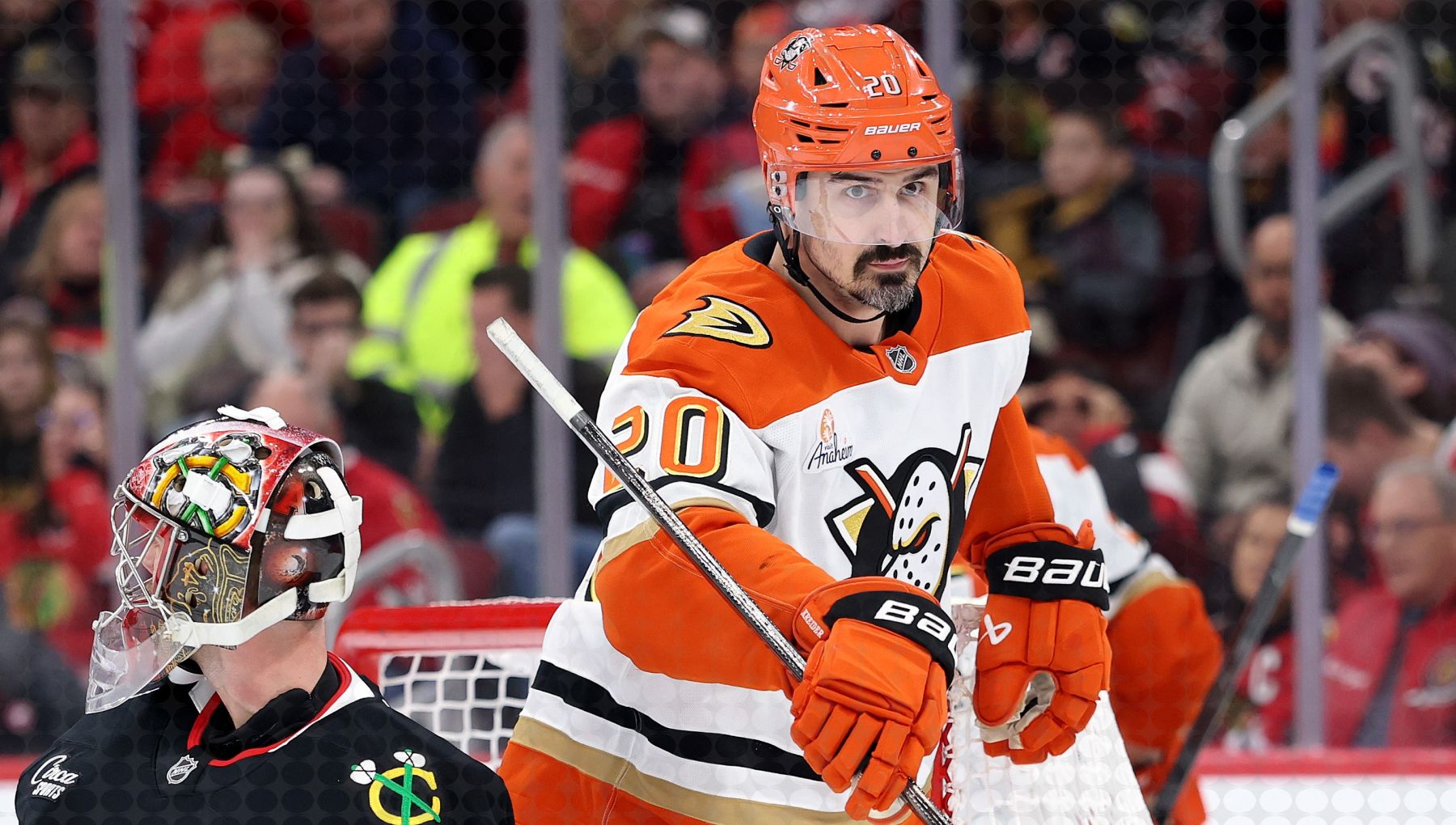
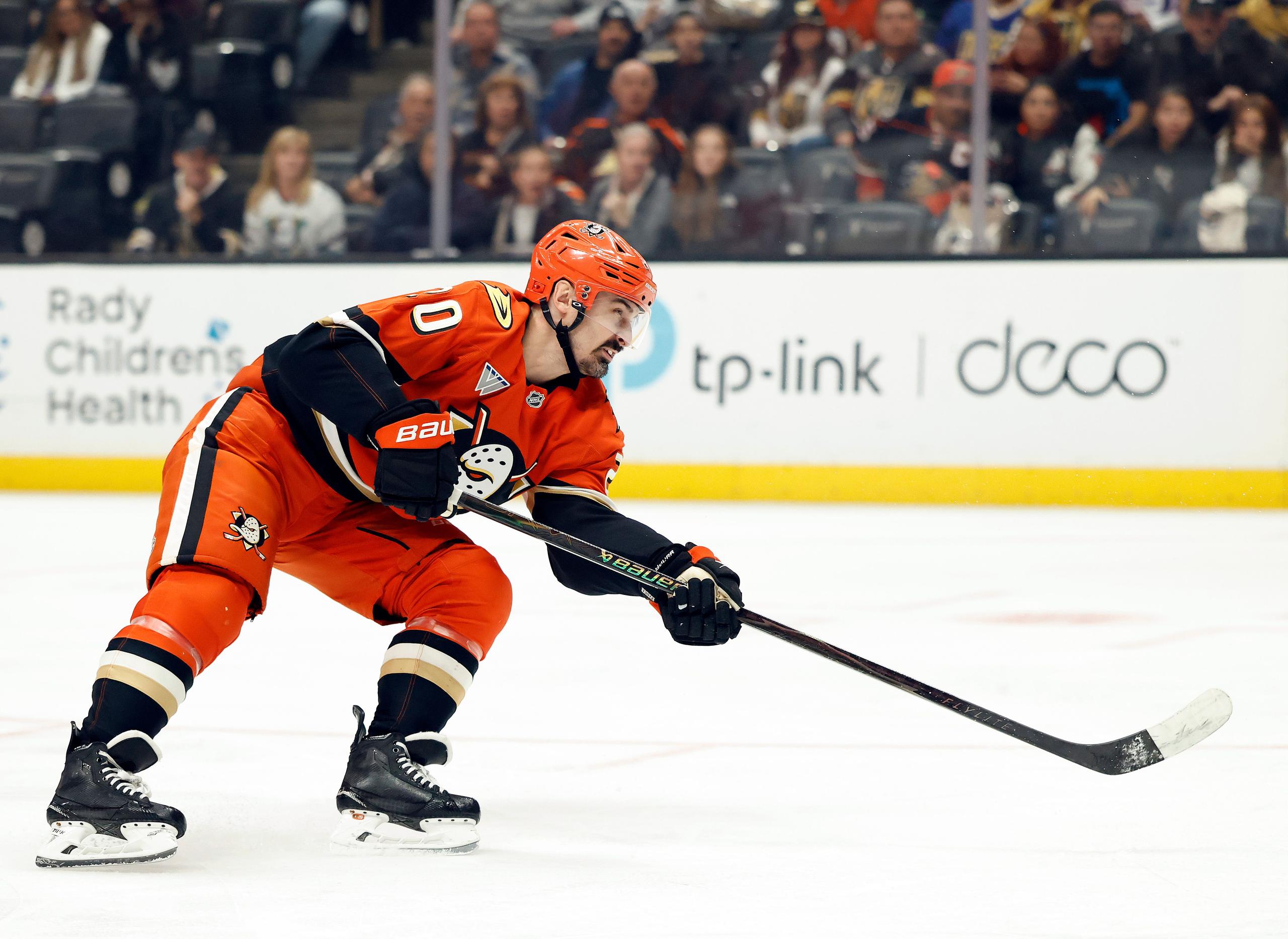
Chris Kreider (Photo by Ronald Martinez/Getty Images)
Chris Kreider will stroll through the Madison Garden entrance on Monday as an Anaheim Duck, but he never left the century-old New York Rangers’ franchise leaderboards.
You’d never hear about it from Kreider, who deflects credit with the same aplomb he deflects pucks, redistributing the plaudits to his teammates, coaches and family, but he’s tied for first in power-play goals, ranks second in game-winning goals and places third in overall goals by a Ranger.
He also had as many goals not only as any Ranger, but as any player in NHL history when facing elimination, tied with another franchise icon, the great Mark Messier.
One could imagine Kreider’s disappointment last November, when his name along with that of captain Jacob Trouba was in a leaguewide memo announcing that the Blue Shirts were open for business, mere months after making the conference finals. Kreider played out the season –– persisting through back issues, a broken hand and more for both the Rangers and Team USA at the 4 Nations Face-Off –– but knew his days in New York were numbered.
He was sent to Anaheim over the summer, where he has reemerged as a force. In advance of his return to the historic arena where he played in a Stanley Cup Final and three conference finals as well as the city where he matured into a man across nearly a decade and half, Kreider spoke exclusively with RG Media.
Interview with Chris Kreider
– The Rangers haven’t fared so well since the memo, but the Ducks are in second place in the Pacific Division. Where do you think your new club is at as the schedule gets thick? How have you and your family settled in?
– We talked about getting off to a good start as a group, and I think we did that, so now it’s about building, right? We’re kind of in the nitty-gritty, one third into the season, a lot of hockey’s been played but there’s even more to be played. Teams are kind of settling in, getting comfortable with their systems and rosters. For us, it’s about continuing to build as a group. We’ve done a good job responding when we haven’t put our best foot forward, but we want to continue to stack positive games on top of positive games. In terms of settling in, the organization has been so welcoming, the staff, coaches, management, everyone. It’s been as smooth of a transition as I could hope for.
– You alluded to this a bit, in 20 of 32 games, the Ducks have allowed the first goal. They’re still around .500 in those contests (9-10-1), and all but unblemished in the other 12 (10-2-0). Do you feel like as someone with so much experience and success facing elimination and in other big situations, you’re in a unique position to contribute to this group and help the younger players in those spots?
– I just think it’s a resilient group, a group that trusts in our ability to generate offense and play fast. I don’t think we ever really feel like we’re out of games.
We would like to have some better starts on occasion, but, I mean, there are teams that have started well and then kind of teetered off too. Every team in the league is trying to play a full 60 [minutes], right? So if we didn’t have, you know, we’re talking about our starts, we’d be talking about our second periods or whatever. No one’s played a perfect, full 60 right up to the one-third mark, right? So you’re always gonna be something that you want to improve on.
– You and Leo Carlsson seem to feed off each other, with him assisting on nine of your 13 goals so far. How do you think you create space and synergy together?
– Oh, I think there’s still some meat on the bone, to be honest. I think that we’re still getting comfortable with each other. He’s the type of player who would be good with whoever he plays with, and I just happen to be on his left wing right now. We’re just trying to get him the puck right now, me and Troy [Terry], they’re both incredible players in their own right. I just think, for me personally, it’s simple, right? It’s moving the puck, moving my feet, getting to the inside, staying on the inside, and I think that’s what allows me to create space for my linemates and allows us to have depth as a line. Leo’s the kind of player who’s not going to have any trouble developing chemistry or synergy with any player he plays with. For us, it’s about continuing to build and communicate as a line to get on the same page, it’s not something that happens overnight.
– Before all the injuries and turmoil last year, you had the three biggest goal-scoring seasons of your career. That started with a 52-goal outburst, the second most in a single season during the Rangers’ long history. It seemed like some of your success on redirections and tips bled into your shooting, was that intentional and, if so, how did you go about it?
– I went to [former Rangers goalie] Stephen Valiquette, and we did kind of a deep dive into how goalies approach the game. I got to understand the goalie perspective on what the hardest chances were for them to stop. It was a matter of playing the percentages, trying to get myself more exhibitions and getting the puck off in under half a second when it crosses those midlines, it was kind of a “Money Ball” approach (‘Kind of like applied analytics?,’ RG asked) Yeah, in a way.
– What did your parents do, if you don’t mind me asking? I remember when you went back and graduated from Boston College, they were very proud and seemed committed to you being a well-rounded person.
– They’re retired (proud pause). Yeah, my mom was a CPA, and then she worked as the vice president at a company. Then my father was in food science, research and development (“He can’t read,” teammate Jansen Harkins chided the trilingual Kreider, who is known as a voracious reader and responded “That was never part of the question, Jansen”).
– How central were they to your career?
– They were the biggest role models and mentors for me, emphasizing education and work ethic. They both drove into and out of Boston on a daily basis. If you grew up on the North Shore, that’s a lot of traffic, so they were incredibly hard workers. They gave me and my sister fantastic opportunities in school and in athletics. The way we were brought up, to not put your best foot forward in school or in athletics, was dishonoring the work ethic they displayed on a daily basis. I also had some unbelievable coaches throughout my career, starting in mites. It really does take a village. I just had positive experience after positive experience playing hockey. There are a lot of rinks in New England and a lot of rinks on the North Shore, but if you grew up playing hockey, you were still driving all over the place, to Saturday morning and Sunday morning practices. I could sit here for hours and talk about my parents and how important they were, and still are, to me.
– How do you anticipate walking through the Madison Square Garden doors again will feel and who are you most looking forward to catching up with?
– Yeah, I don’t know. I don’t know how it’s gonna feel. I’ll let you know, I guess. I’m looking forward to seeing my parents, they’ll be in town. I look forward to seeing some former teammates, Mika [Zibanejad] in particular, I played for such a long time with him. I look forward to seeing a lot of the staff, too, some of the medical staff, and equipment managers. Even some of the management. Everyone, if you’re there long enough, you develop relationships. We have to remember that it’s an important game for us and an important two points. So, once the dog-and-pony show is done, hopefully we can get down to playing a little hockey.
– In speaking to people in and around the Rangers, they pointed to different developments leading up to the memo and the jettisoning of talent. Some mentioned executive Glen Sather retiring, or trainer Jim Ramsay’s dismissal, while others pointed to broader cultural issues. What do you think was the turning point or tipping point that took you guys from conference finals to fire sale so quickly?
– I don’t think about it. I don’t reflect on it. I think there’s been enough conversation about it. Obviously, we still get asked about it pretty frequently, and I don’t fault you for asking. But, at the same time, I think it’s a fruitless exercise. I just want to face forward. I’m trying to build and get better with this group [in Anaheim].
– At the same time, one thing I am sure you do reflect on was your work with charities like the Garden of Dreams Foundation, the Shoulder Check initiative to promote mental health and so forth. Are you involved in any new endeavors out here in California?
– [I’d like to get involved in] everything through the team, the Samuelis [Ducks owners Henry and Susan Samueli] are incredibly philanthropic. There’s some stuff that I would like to continue doing here. I’ve talked a little bit with the team about doing some special-needs hockey stuff, like I got to do (back East) with the Connecticut Storm. I got to do that more frequently during the COVID seasons because we were practicing on Sundays up in the Bridgeport area, so that was something that I got to do pretty frequently. There’s a bunch of opportunities, especially around the holidays right now. The long and short of it is that I’m amazed –– not surprised, but super impressed –– after hearing all these things about the Samueli family and just how philanthropic they are. It’s really great to see. My experience at the Garden of Dreams, it was the most important thing we do as professional athletes.
– Lastly, coming off 4 Nations last year, I’m sure Milan and the Olympics are in your sights. Points can get players paid in the NHL, but national team GMs look for a little more profundity. Is a selection process like that where you get the payoff for developing a deep game with layers to it?
– Yeah, I’m not going to venture to guess as to what they’re thinking. But at the end of the day, you can talk to every single American player, Canadian, Czech, [whatever nationality]. It’s a dream come true, representing your country. So, if that opportunity arises, it’d be unbelievable.
Score extra with Bet99 Sportsbook this week — 30% SGP Boost (EDM vs TOR highlighted) for December 13, Bet $25, Get $5 (ROC only) for December 14, 30% SGP Boost (OTT vs WPG) for December 15.