
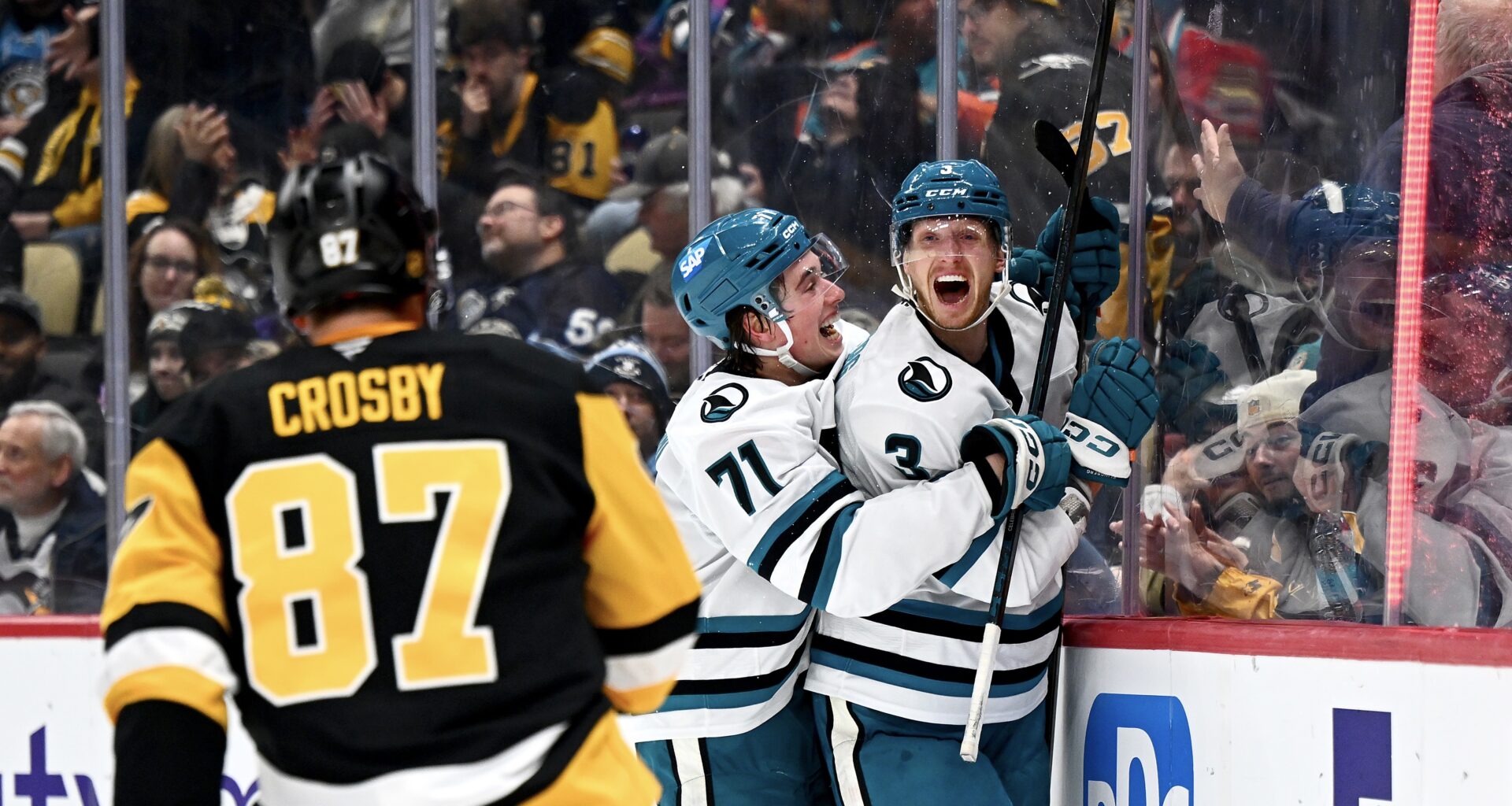
Bryan Rust was sitting in his locker stall in full gear, staring straight ahead long after the Penguins’ 6-5 overtime loss to the Sharks at PPG Paints Arena on Saturday night. Most of his teammates had long ago left the room, and Rust still sat there as mad as I’ve ever seen him.
“We got on our heels,” he told me, shaking his head. “We didn’t respond the right way.”
The Penguins aren’t new to third-period collapses. They’ve now led in the third period and lost on seven different occasions per Bob Grove, squandering nine total points in the process with two regulation losses and five overtime or shootout losses from blown third-period leads. Earning even five of those points would have them in first place in the Metropolitan Division.
Instead, they now find themselves out of a playoff spot, bumped out of the two wild card spots by the Devils and Flyers.
This loss was by far the worst of those blown leads.
At one point the Penguins held a 5-1 lead over the Sharks 5:25 into the third period, after goals from Sidney Crosby, Rutger McGroarty, Kevin Hayes, Bryan Rust and Anthony Mantha, and outshooting their opponents by a massive 38-15 margin.
“We did a lot very well,” Rust said of those first 45 minutes. “Dominating possession. Our power play was great. Getting a lot of chances. Five-on-five was great. It just unraveled.”
I asked Dan Muse what he thought the Penguins did well to that point, and he praised similar things — the power play, offensive zone time, “keeping plays alive, keeping pucks in” and overall control of the play. But he stopped himself then, clearly frustrated.
“We shouldn’t be having the talk we are right now,” he said. “This shouldn’t be the conversation. It’s too many games in a row that’s happening. It’s … yeah.”
That’s because over a period of just 10:49, the Sharks managed to tie the game and force overtime, setting the stage for John Klingberg’s winner 2:57 into overtime.
Over that last 14:35 of regulation, the Penguins were outshot 16-4. The Sharks started to get real momentum after Erik Karlsson took a penalty for playing with a broken stick, and Klingberg scored on the ensuing power play, cutting the Penguins’ lead to 5-2:

SportsNet Pittsburgh
Arturs Silovs was absolutely part of all that good in the first 45:25 of the game. He wasn’t tested too heavily in terms of workload, given how good the Penguins were at limiting shots, some of the shots he did face resulted in some pretty big saves, including a pair of breakaway saves — first on Will Smith out of the penalty box, and then a partial breakaway from Barclay Goodrow.
But just as the Penguins’ defense fell apart and they stopped pushing for shots, Silovs, too, caught whatever bug suddenly caused the rest of the team to collapse in front of him. Four of the Sharks’ last five shots beat Silovs, including Klingberg getting the Sharks’ lone shot in overtime:

NBC Sports California
“It felt like they were all over us,” Silovs said of what changed. “It was hard to defend. We can’t blow the lead like that.”
Crosby was asked how he explains the collapse.
“I mean, how do you, really?” Crosby asked back. “I don’t think you can, really.”
He’s right. It’s inexplicable, and that’s a worrying pattern.
Of the Penguins’ seven blown third-period leads, it’s hard to find any real trends. Is it the goaltending? Well, Tristan Jarry was in net for two of those collapses. Sergei Murashov was in net for two. Silovs was in net for three, counting this one. Sometimes the opponent gets a power-play goal, sometimes not. Sometimes the Penguins really fail at preventing 6-on-5 goals, like tonight, when the Sharks capitalized on two such opportunities … and sometimes that’s not the case.
Most of those third-period leads were close, losing one-goal leads. This loss and the three-goal lead in Toronto that Jarry and the Penguins saw become a 4-3 regulation loss were the only two multi-goal third-period leads.
Some of the collapses start pretty early in the third, like this one. Others, like the one the Penguins just suffered against Anaheim, happened as late as the final tenth of a second.
Because it’s not any one person, any one facet of the game, it’s hard to pinpoint any one way to solve it.
“You can go back, not just this recent stretch, but other games over the year, obviously we have to be better at those kinds of games,” Muse said. “That doesn’t need to be stated. I think it’s something different every time. I don’t think it’s always the exact same thing.”
The common threads, Muse said, are that the Penguins play “great” for almost all of the game first, and then they get away from whatever they were doing that worked.
“Sometimes, it’s a little structurally,” he said. “We get away from what works. Sometimes, we just put ourselves in bad positions. Sometimes, we take poor penalties at inopportune times, giving them momentum, and we haven’t done nearly a good enough job of gaining that momentum back. We then look like a different team.”
Muse said that the responsibility for solving the issue falls on everyone, himself included.
“We have to be better with it on the ice,” he said. “I have to clearly be better, because it’s happened a number of times now. And we’ll find a way to. It’s just costing us too many points already, and obviously, it has to stop. And there’s not one thing other than the way we fall away from what works at those critical points.”
Momentum swings are inevitable. Penalties happen. If a team is trailing in the third period, they’re going to push. But the Penguins need to be better at handling those swings.
“You’ve got to play harder and simplify,” Rust said. “Keep the puck out of the zone. Make sure everyone’s doing their job.”
It’s easier said than done, obviously. It’s not a revelation that the Penguins need to play hard and stay out of their own end. How do they actually do that, though?
If they don’t figure it out soon, the gap in a tight Eastern Conference will be insurmountable.