
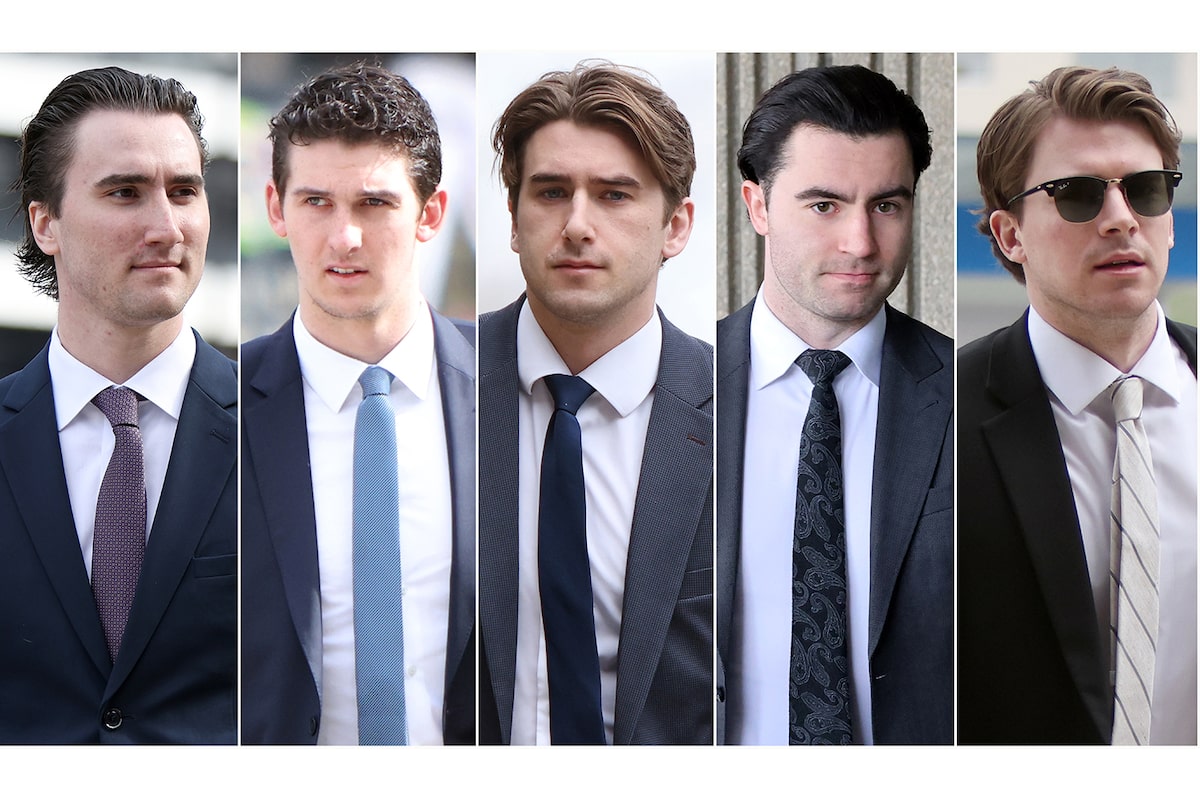
Former members of Canada’s 2018 World Juniors hockey team, left to right, Alex Formenton, Cal Foote, Michael McLeod, Dillon Dube and Carter Hart as they individually arrived to court in London, Ont., on April 30.Nicole Osborne/The Canadian Press
The sexual assault trial of five former members of Canada’s 2018 world junior hockey team, which has already been upended by a mistrial, was again disrupted on Friday after the judge dismissed a jury for the second time in three weeks.
The trial will continue and be heard by a judge alone rather than appointing a new jury and starting over – a decision that means the complainant, a woman known only as E.M. due to a publication ban, won’t have to testify again.
The abrupt change came after one of the jurors claimed to the judge a day earlier that two defence lawyers – Daniel Brown and Hilary Dudding – had been laughing at them during the trial. Those lawyers, who represent one of the accused players, Alex Formenton, categorically denied the accusation.
The same legal team was involved in the incident that led the judge to declare a mistrial in late April and restart the proceedings with a new jury – a fact that could not be reported by media until the judge took over the case on Friday.
The jury’s dismissal is the latest chapter in a saga that has stretched on for seven years and forced a national reckoning for Canada’s beloved game, including a change of leadership and reforms at Hockey Canada, while raising larger questions about how amateur sports organizations should deal with allegations involving sexual assault.
Mr. Formenton, along with Michael McLeod, Carter Hart, Dillon Dubé and Cal Foote are accused of sexually assaulting a woman in a downtown London, Ont., hotel room after a Hockey Canada gala in June, 2018. Each has been charged with sexual assault, while Mr. McLeod faces a second charge of being a party to sexual assault.
The men have pleaded not guilty.
On Friday, Justice Maria Carroccia told the court that while she had not witnessed any inappropriate conduct by the two lawyers, it was clear to her that a real possibility existed that several members of the jury harboured negative feelings toward the defence.
“It is with reluctance that I have determined that the fairness of this trial has been compromised. In the circumstances, I must discharge the jury to protect trial fairness,” Justice Carroccia said.
Daniel Brown, centre, lawyer of Alex Formenton, arrives at the London Courthouse in London, Ont., on May 16.Nicole Osborne/The Globe and Mail
Faced with the prospect of a second mistrial, Crown lawyer Meaghan Cunningham reluctantly accepted a proposal from the five defence teams to move forward with a judge-alone trial, rather than start over again with a third jury. She raised concerns that the Crown has already presented much of its evidence and the prosecution’s case would have been handled differently if they had known it was judge alone.
On Thursday, juror 11 handed Justice Carroccia a note that read: “Multiple jury members feel we are being judged and made fun of by lawyers Brown and Hilary Dudding. Every day when we enter the courtroom they observe us, whisper to each other and turn to each other and laugh as if they are discussing our appearance. This is unprofessional and unacceptable.”
What the jury didn’t hear at the Hockey Canada sex-assault trial
After Justice Carroccia made her ruling, Mr. Brown released a statement in which he called the allegations against him and Ms. Dudding an “unfortunate misinterpretation.”
He said, “no defence counsel would risk alienating a juror, and nothing could be further from the truth in this instance” and that while it is true co-counsel will often speak to each other from time to time during a trial, “the very idea of counsel making light of a juror is illogical and runs directly counter to our purpose and function.”
The trial began with the initial jury on April 23.
After a morning of technical glitches, Crown attorney Heather Donkers made the prosecution‘s opening remarks.
But when court resumed after the noon break – before the jurors were called into the room – the judge revealed that a juror had complained about an interaction between the juror and Ms. Dudding at the Covent Garden Market, a popular lunchtime spot located a few blocks from the courthouse.
The judge sent the jurors home for the day, explaining: “Something happened over the lunch hour that I need to think about and to discuss with the lawyers.”
At that time, a standard publication ban that covers anything said outside the presence of the jury prevented the media from reporting on what happened, but that ban was lifted on Friday.
Court heard in April that Ms. Dudding and the juror ended up in the same line at one of the vendors at Covent Garden Market. What happened next is disputed.
The juror, who had been warned not to speak to anyone from the court, including the lawyers, had made a complaint to the court sheriff about the interaction, which was relayed to the judge.
Justice Carroccia then brought the juror into court alone to explain what happened.
In the woman’s telling, Ms. Dudding had turned to her in line and said: “There was a lot of head shaking going on this morning.” The juror told the judge she understood she wasn‘t supposed to say anything so she closed her mouth and nodded.
Hilary Dudding, left, lawyer of Alex Formenton, arrives at the London Courthouse in London, Ont., on May 16.Nicole Osborne/The Globe and Mail
Ms. Dudding, who is an experienced trial litigator, denied this account. Instead, she said she was standing in line and realized a juror was standing closely behind her. In a reflexive reaction, she told the court she said something to the affect of “Oops, I’m sorry” and “It’s awkward.”
The juror told another juror at the food court, who was also called into court to talk to the judge.
Court then heard that, after leaving the market, the jurors returned to court and soon everyone on the jury was aware of what had transpired.
Defence lawyer Megan Savard, who spoke for the lawyers representing the accused players, said there was no way that court could move forward. Ms. Savard stated that while she believed Ms. Dudding’s version of events, it didn‘t matter because there was now a credibility contest between the juror and a defence lawyer.
Ms. Savard also argued that the juror’s account – and apparent propensity to gossip – raised questions about their ability to hear and consider facts.
Justice Carroccia found that she had no choice but to declare a mistrial.
After the jury’s dismissal Friday, the trial picked up where it left off and defence attorneys spent much of the day cross-examining Crown witness Tyler Steenbergen, another former world junior player who was in the room that night but who is not accused of any wrongdoing.
The sexual assault allegations became public in 2022, when TSN revealed that Hockey Canada, had quietly settled a multimillion-dollar lawsuit filed by E.M. against the national sport governing body and eight unnamed members of the junior team, for an undisclosed sum. This was done without the knowledge of the players, who were identified as John Doe.
Shortly after, The Globe and Mail then exposed the existence of the National Equity Fund, a special multimillion-dollar fund built through player registration fees that Hockey Canada has used to settle sexual-assault lawsuits.
The ensuing scandal triggered parliamentary hearings and resignations at the highest levels within Hockey Canada. Ottawa froze federal funding for the sports body and sponsors such as Tim Hortons, Canadian Tire and Bauer withdrew their support.
It was in the midst of this public uproar that London police reopened their investigation.