
Much to the chagrin of fans, the 2025-26 PWHL season is now paused 16 games in for the international break. This serves as a break for the majority of coaching staffs and players, while the rest go to Europe to play in the Four Nations or go to Edmonton to play in the Canada/USA Rivalry Series. And while this may be irritating for many fans – especially those supporting teams that have only played three games – the break provides a valuable opportunity for coaches to reflect and regroup.
If there were no break and the season were continuing as normal, coaches would be at the mercy of their travel schedule. It’s difficult to make changes in-season when you’re on the road and practice time is minimal or reduced to just morning skates with some video session before a game. Being on a home stand usually means more opportunities for practice and therefore adjustments.
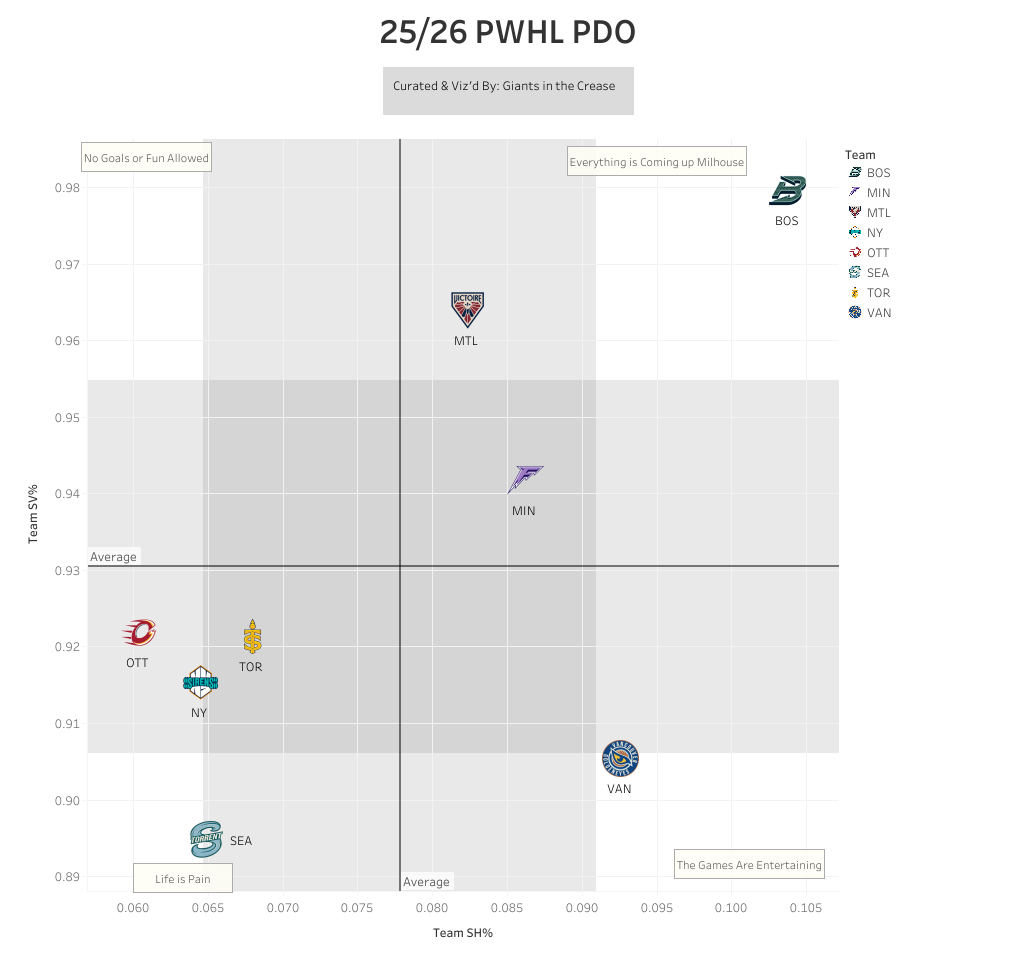
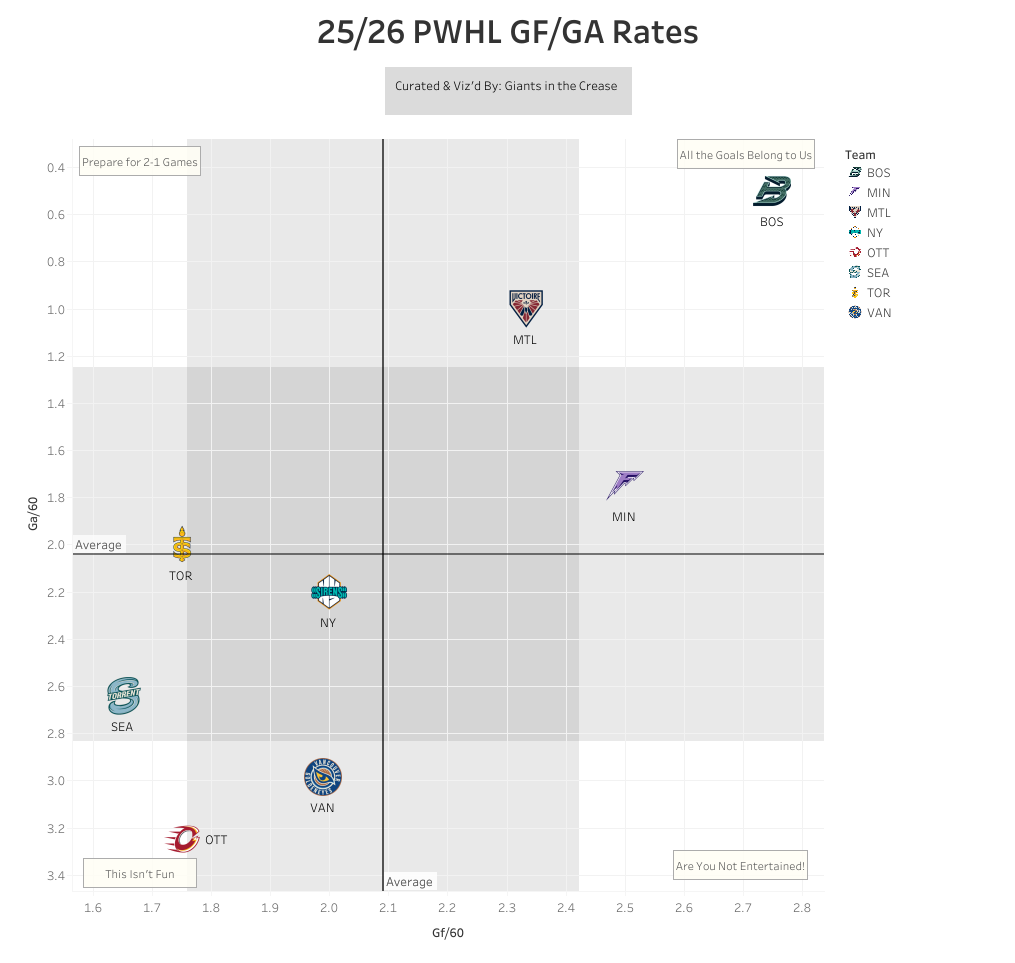
Being at home isn’t the cure to all ails; games are still being played. If you were to talk to coaches, they love themselves some uninterrupted days of just practice. Every team could stand to make some adjustments after the start of the season except the red-hot Boston Fleet. Right now, teams across the league are facing a strange reality: if you allow more than two goals in a game, you are going to lose.
Most teams just endured an expansion process that took a bite out of their core. That’s going to cause some disruption and time needed for teams to work on their chemistry. There are other factors, too. Perhaps the most obvious is how outstanding goaltending is in the PWHL. You could feasibly argue that every team or almost every team has two goalies that could handle a number one goalie’s workload. It also appears that most coaches prioritise defence first and turn aside one-dimensional offensive threats. As a result, we see a decrease in the pure offensive talents, such as Loren Gabel, making an impact.
As I mentioned earlier, PWHL games have turned into a race to score two goals. You score two goals, and it’s game over for the opposing team. I can say this with confidence because, in the 15 to 16 games to start the current season, the losing team has scored one or zero goals. In the 2024 season, which was chaotic in its own way, there were only six games where the losing team scored a single goal or failed in the first 16 games of the season.
The goalies are winning.
I think you could fairly argue that the 2024 season had more going against it in terms of offensive production. General managers and their staff had about two weeks to make their initial signings, then draft the majority of their inaugural teams. No one knew what the league would look like with the advent of re-adding body checking into the North American women’s game or how an amalgamation of PWHPA/PHF players would look on the ice together. Teams couldn’t have been more blind and prone to the extremes of hockey statistical variance than the 2024 inaugural teams yet we still saw 79 goals, with 10 of the 16 games to start the season seeing losing teams put up a fight by scoring two or more goals.
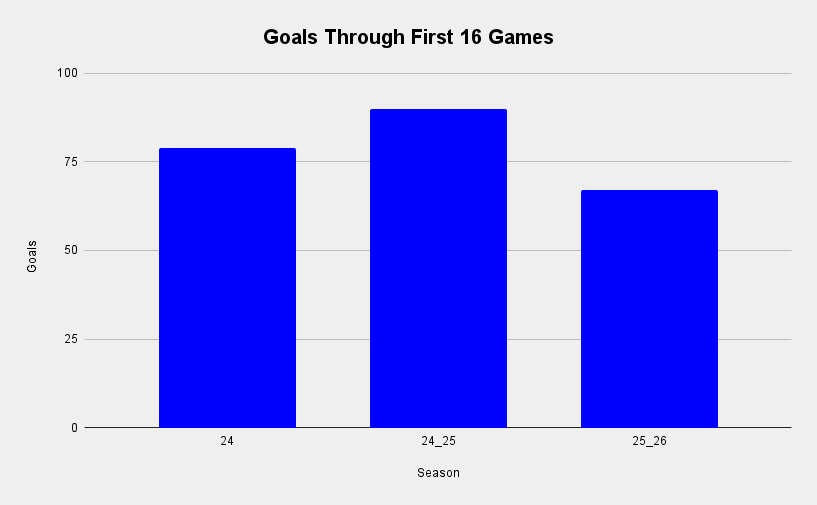
There is an argument to be made that the offensive talent is spread thinner in the league right now, in 2025-26, than it was in 2024, especially on the backend. One counterpoint to that would be the league average SV%. In the 2024 season, it was 0.920, whereas this season, it’s a 0.930 league average SV%. We’ve also seen more goals being scored in the first 16 games of 2024, with 79 goals compared to the 67 goals we’ve seen in the first 16 games of this current season.
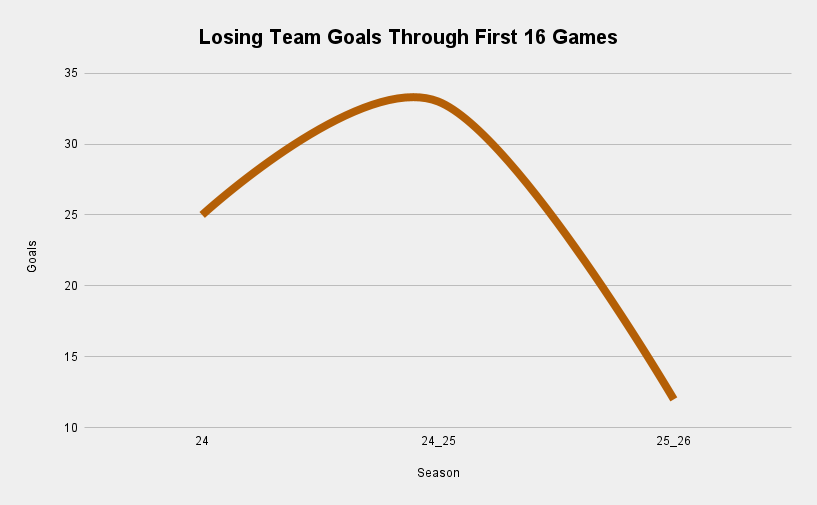
Well, if the goals have decreased, doesn’t that prove the idea that it’s mostly a chemistry issue or the offensive talent is spread too thin? I’d believe that if we saw goal scoring down for both the winning and losing teams. The odd part about all of this is that the winning team through the first 16 games of the season has scored 55 goals in total, which is one goal more than the 2024 season (54 goals) at this point and only two goals fewer than the 24/25 season (57 goals). This goes back to the burden of lack of goals being put on the losing teams. Losing teams this season have scored a combined 12 goals, which is less than half of the 2024 season (25 goals) and almost a third of the 24/25 season (33 goals).
All of this results in a goals per game of 4.19, which is noticeably behind 2024 at 4.94 goals per game and 2024-25 at 5.63 goals per game. In the first two seasons of play, the goals per game dropped by the end of the season. In 2024, the goals scored in a game dipped from 4.94 to 4.74. Last season, it went from 5.63 to 4.97 goals per game. So, a five-goal game was standard fare for PWHL fans. In 2025-26, in this sample size, we are seeing games decided in four goals.
You can imagine how frustrating this must be for coaches. When a team wins, they’re averaging 3.44 goals per game, and in half the games so far, teams have scored over four goals. That’s two fewer +4 goal games in 24-25 and three more than 2024. What we’re seeing right now is teams winning games more definitively.
If we dive just a bit more into the numbers, maybe we’ll get some answers.
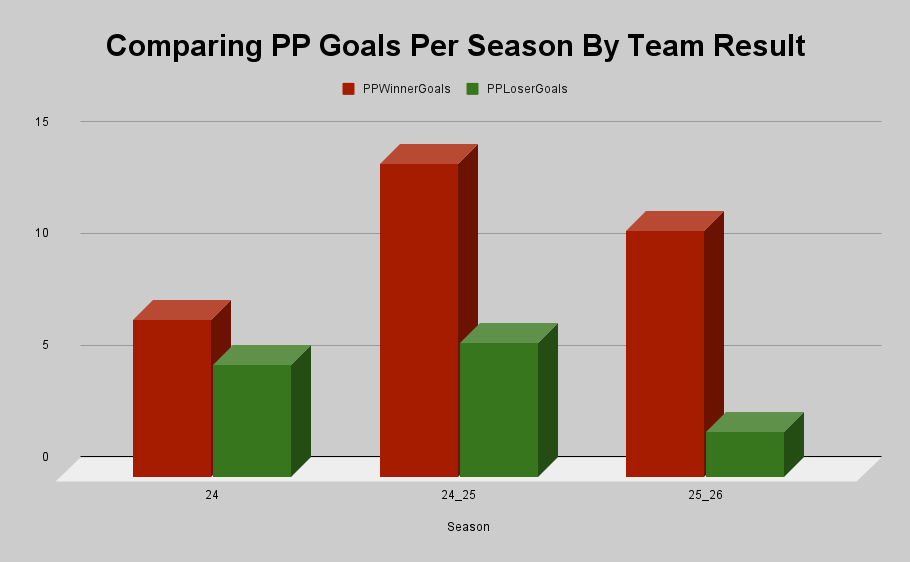
What if the issue is on special teams? Can the difference in goals be explained in that maybe teams have yet to find chemistry on the power play, resulting in so few goals? We’ve seen 13 power play goals this season, which is ahead of 2024 by a single goal (12) and noticeably behind 24-25 (20). When we split the power play goals based on whether a team won or lost, things begin to come into focus. In 55 power play opportunities this season, the losing team has scored two goals. Now it’s not as though they were blown out of the water by the two previous seasons in terms of goals scored, as the difference is either three goals or four goals.
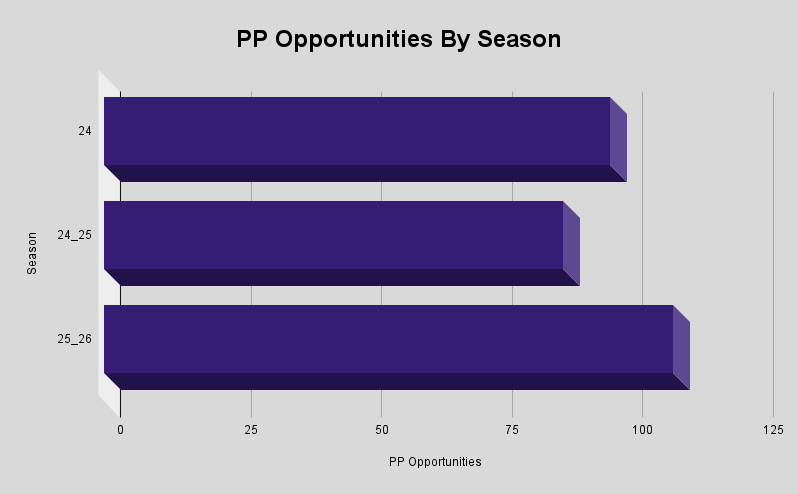
You’ll also notice that we’ve hit a record amount of power play opportunities through the first 16 games of a season. We have already seen 109 play advantages. That also means less time at even-strength, and if you can’t score on the power play, then that’s two minutes or more wasted.
Teams who have lost have seen 55 play opportunities, which is a lot higher than 24-25 (38) but lower than 2024 (59). When it comes to the power play opportunities of teams who win, we’ve seen an increase year over year from 38 to 50 to now 54. So, the winning teams have been in the driver’s seat, seeing more player advantages, and that means less opportunity for trailing teams to get back in a game.
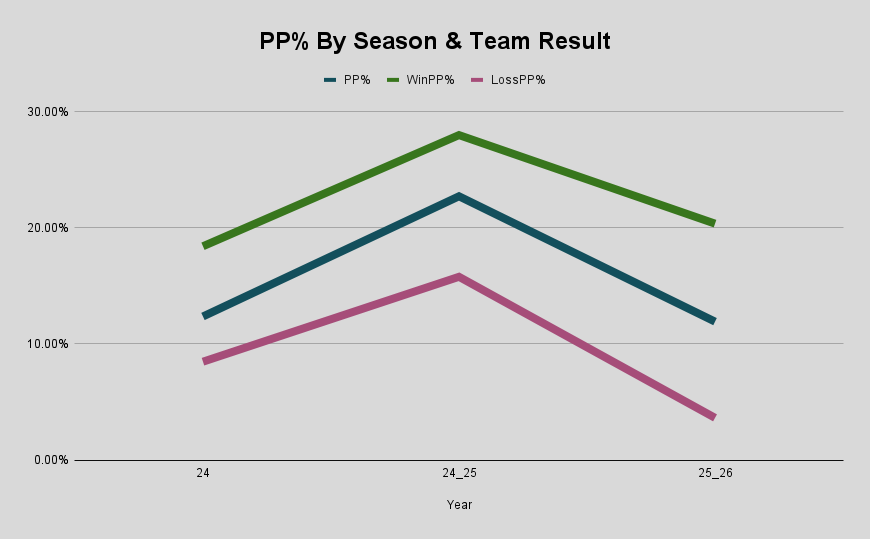
Losing teams have still had 55 power play opportunities to score this year but have only converted on 3.64% of them – which is down from 24-25 (15.8%) and 2024 (8.47%). What did we just see from the Ottawa Charge going from Gold Plan contender to Walter Cup contender? They nearly perfected a heavy shot suppression style of hockey that stymied everyone sans the Minnesota Frost. Still, each Cup Final game was a 2-1 final that went into overtime. Why wouldn’t you want to copy that?
I think there is a chance that teams took notes on Ottawa’s successful style of play and how it very nearly won them a Cup.
There’s been a focus on shot suppression through puck possession and just generally good defensive play. A trend you’ll notice in the PWHL is that it’s rare to find a player who can’t skate very well or can’t defend at least moderately well. It makes it easier for coaches to play that kind of hockey when you have the players up and down the line-up capable of it.
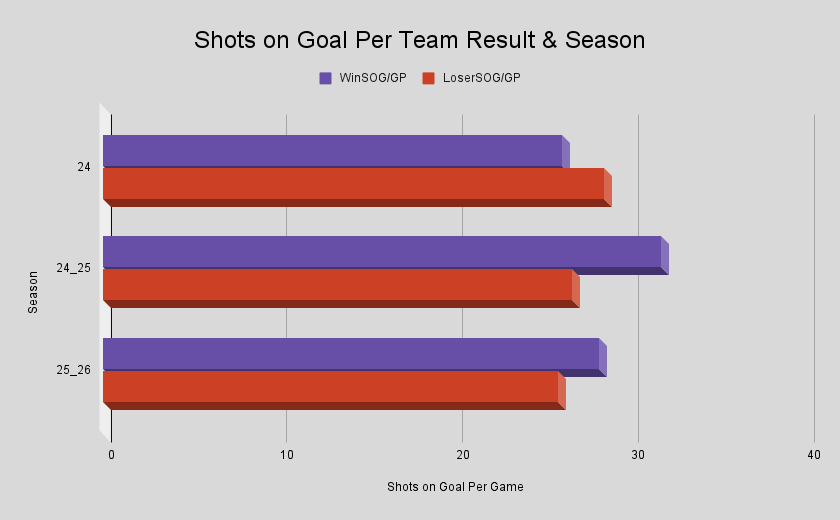
Where I believe we see further proof of this is in shots on goal (SOG) stats. Of course, shot attempts would be more revealing, but that data is not available.
Overall, we’ve seen a drop in shot volume from 24/25 (935) and 2024 (905). Curiously, while the shot volume for teams who win dropped from 24/25 with 508 SOG to the current 452 SOG, we did see an increase from the 2024 season of 418 SOG. Interestingly, the losing team’s shot volume has decreased with each season. Teams are snuffing out their opponents’ ability to score that second goal impressively. I don’t think losing teams will shoot at 2.9% forever and that number will regress closer to the 5.48% of 2024, however this will be something to keep an eye on.
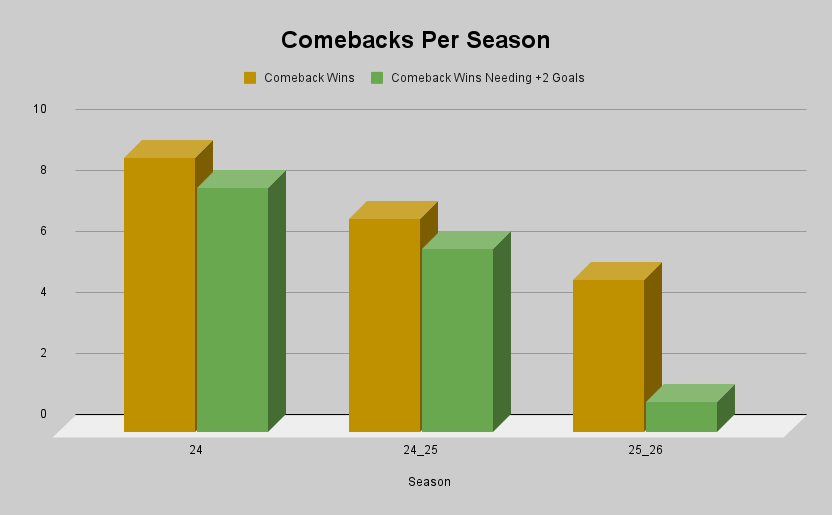
Without dragging this out too much further, there’s one last piece of evidence I want to go to – comebacks.
The number of comeback wins has decreased season after season. Only five comebacks in 16 games is eyebrow-raising. Looking at how many comebacks required the winning team to score more than two goals puts a nail in this theory. Looking at 2024 and 24-25, if you wanted to pull off the comeback win, you had to score more than two goals. No easy comebacks there. This season, only once did a team pull off a comeback needing more than two goals. Comebacks still require work, but a lot less work if all you’re overcoming is the first goal of the game.
Bringing us full circle, this is what PWHL coaches have seen and need to confront at this international break. It’s clear the league has, for the most part, figured out the defensive side of the game in terms of shot suppression. Now it’s time to figure out how to break through that shot suppression. Teams becoming more consistent on the power play, taking fewer penalties, allowing the even-strength play to get into a rhythm, and some extra puck luck will see the league take a sharp turn from where it stands now. Chemistry will build, passes will get crisper, and youngsters will find more confidence when action resumes. That should mean we will soon see an end to the race to score two goals to win a PWHL hockey game.