

The Anaheim Ducks weren’t supposed to be here. Not yet, anyway.
If you said in October that by mid-December, Anaheim would be sitting second in the Pacific Division with a 20–12–1 record, most people would have given you a sideways glance. The Pacific is a meat grinder. The Ducks were supposed to be in the “promising but raw” phase of their rebuild—the part where you endure 5–2 losses while patting yourself on the back because the prospect pool looks deep on Elite Prospects.
Instead, we are watching one of the most fascinating experiments in the league. The Ducks haven’t just taken a step forward; they are running at full speed, and they are doing it playing a brand of hockey that is both exhilarating and a little bit terrifying.
The Carlsson-Gauthier Engine
Let’s start with the obvious: the kids are elite.
We knew Leo Carlsson had the toolkit. The size, the vision, the silky hands that make NHL defensemen look like traffic cones. But this season, the 20-year-old has put it all together. Leading the team with 41 points in 33 games isn’t just “good for a kid”; that is an All-Star pace. He is controlling the neutral zone with a maturity that usually takes centers 300 games to develop. When the puck is on his stick, the game slows down for him and speeds up for everyone else.
 Leo Carlsson, Anaheim Ducks (Jess Starr/The Hockey Writers)
Then there is Cutter Gauthier. If Carlsson is the architect, Gauthier is the demolition crew. With 36 points, he is the perfect trigger man. His release has always been his calling card, but his off-puck movement has improved drastically. He’s finding soft ice in the slot, and Carlsson is finding him. This duo isn’t just driving the bus; they are drifting it around corners.
All Gas, No Brakes
The underlying numbers paint a picture of a team that has made a conscious decision to trade safety for volume. Reports are calling it “high-event hockey,” which is the polite analyst term for absolute chaos.
Related – Cutter Gauthier Was Smart to Demand Trade from Flyers
Anaheim currently ranks second in the league in goals scored. They are generating high-danger chances at a rate we haven’t seen in Orange County since the Ryan Getzlaf-Corey Perry prime years. They are attacking off the rush, pinching their defensemen aggressively, and turning 50/50 pucks into footraces.
But here is the catch: they are also 23rd in goals against.
 Cutter Gauthier, Anaheim Ducks (Jess Starr/The Hockey Writers)
Usually, when you see a discrepancy like that—top-tier offense, bottom-tier defense—it screams “regression.” Conventional wisdom says you can’t outscore your defensive problems forever. Eventually, the bounces stop going your way, the shooting percentage cools off, and you slide back to the mean.
But that’s not the whole story here.
The Defensive Dilemma (Or Is It?)
The defensive struggles are real, but they seem to be a feature, not a bug. The Ducks aren’t bad defensively because they are slow or lazy; they are leaking chances because their system demands aggressive positioning.
Related – Ducks Week Ahead: Schedule & Storylines – High-Event Hockey, Return to MSG and More
When you send your blueliners deep into the offensive zone to keep plays alive, you leave your goalie exposed to odd-man rushes. It’s a calculated risk. The coaching staff seems to have wagered that their young core has enough firepower to win a 5–4 matchup more often than they lose it.
So far, the math is working.
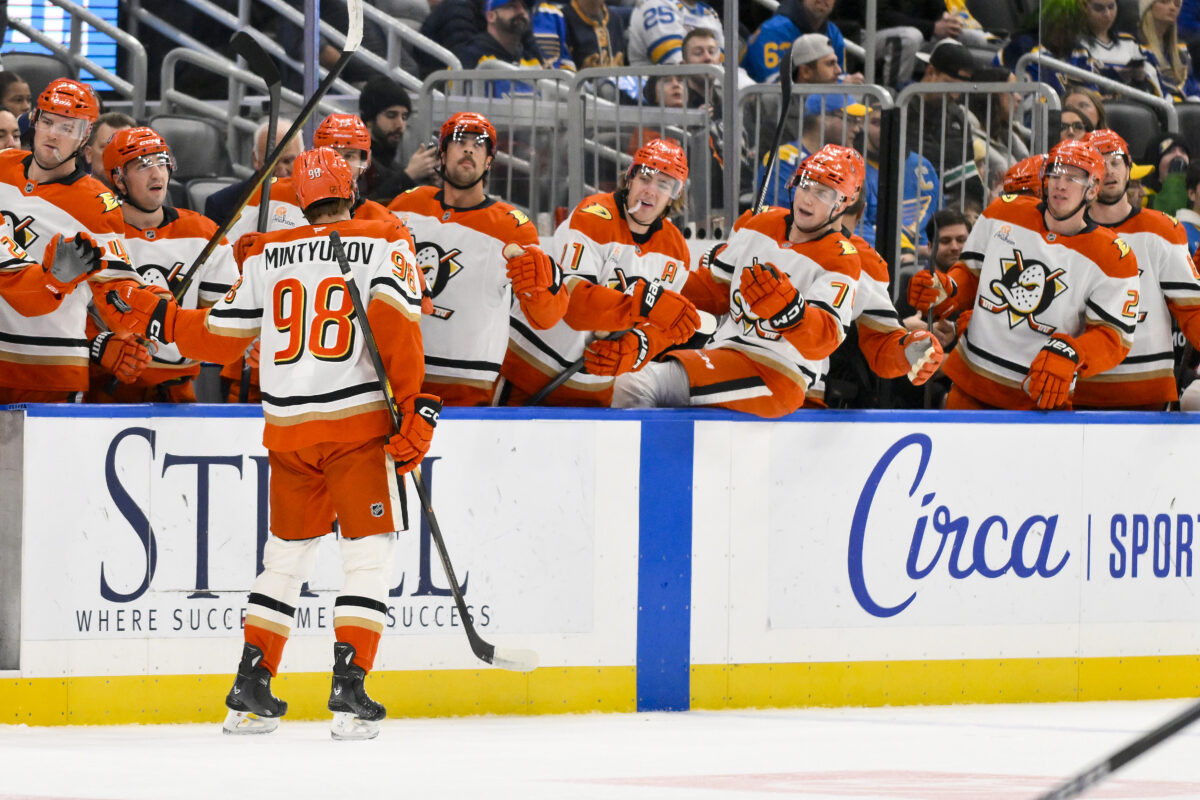 Anaheim Ducks defenseman Pavel Mintyukov is congratulated by teammates after scoring against the St. Louis Blues (Jeff Curry-Imagn Images)
However, recent road struggles suggest teams are starting to figure out the counter-punch. If you can clog up the neutral zone and force Anaheim to dump and chase—negating their transition speed—they look mortal. The last few away games have shown that when the game grinds down to a cycle battle, the Ducks’ defensive inexperience starts to show.
Can It Last?
The big question for the second half of the season is sustainability. Can Carlsson maintain a 100-point pace? Can the goaltending hold up under the siege of high-danger chances they face every night?
History tells us that “high-event” teams often hit a wall in February, when the game tightens up, and whistles are swallowed. Playoff hockey is rarely a track meet. But for now, the Ducks are banking points, building confidence, and playing the most entertaining hockey on the West Coast.
They might not be a finished product, but for the first time in years, they are a problem for the rest of the Pacific.
AI tools were used to support the creation or distribution of this content, however, it has been carefully edited and fact-checked by a member of The Hockey Writers editorial team. For more information on our use of AI, please visit our Editorial Standards page.
