
Not everybody has been playing nicely in the sandbox.
There were hints of it when, in early September, the CHL announced that it would stop issuing scout passes to NCAA coaches. Then came word in early November that the NHL had gathered the different sides — the CHL, NCAA, USHL, Hockey Canada and USA Hockey — for a bit of a therapy session, the league looking to keep infighting over their now-shared talent pool to a minimum.
Getting them all on the same page — two national federations, six Division I college hockey conferences and four Tier I junior leagues — was always going to be easier said than done, but it’s a worthy pursuit for the NHL, whose focus has to be on the health and sustainability of its pipelines.
The CHL’s September decision came after the first summer of college hockey programs aggressively recruiting out of its three member leagues, the OHL, WHL and QMJHL, when major junior players became eligible for the NCAA.
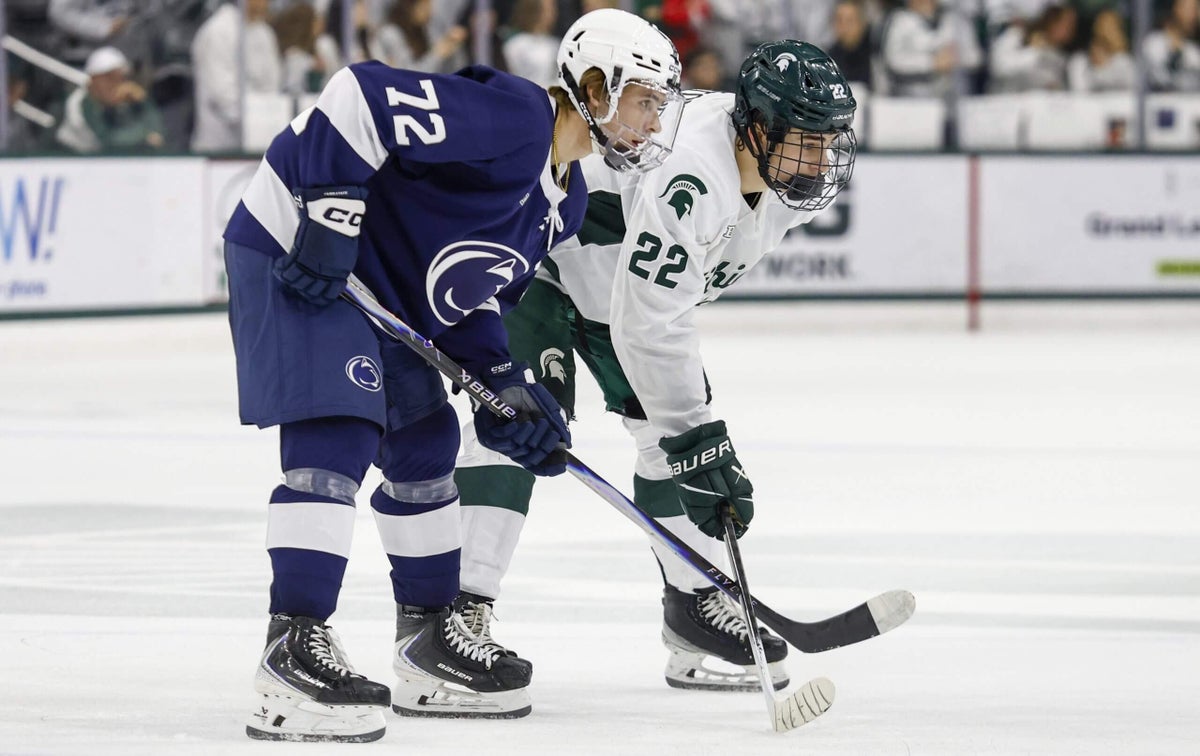
It lingers over the marquee of the upcoming World Juniors, too. Canada will play its games out of the University of Minnesota’s 3M Arena at Mariucci, home of the Golden Gophers, with a roster that should include Penn State’s Gavin McKenna, North Dakota’s Keaton Verhoeff and Michigan State’s Porter Martone — products of the CHL, stars of the NCAA.
Over the last several months, The Athletic spoke with NCAA and CHL coaches and executives about the current dynamic, granting them anonymity in order to solicit candid answers about what’s happened behind the scenes.
In his season-opening news conference, OHL commissioner Bryan Crawford said the change, which would require NCAA programs go through CHL teams on a per-game basis for access, was actually “to create a more collaborative relationship between CHL teams and the NCAA programs.”
They didn’t want it to be a “free-for-all,” he said. There needed to be “structure, and order, and relationships to manage so that it doesn’t cause harm or damage to our leagues,” he added. “We are by no means shutting them out or anything,” Crawford suggested. The reality, he said, was that the CHL was going to be a pathway for the NCAA “following their graduation from our leagues.”
“Following their graduation,” being a carefully selected phrase.
But ask an NCAA coach about the open borders that now exist between college and major junior, and they all say their only choice is this: Go.
“I know there are some guys that aren’t happy. I’ve read some of the comments about how we’ve kind of gone about things. I think that’s going to change, but I don’t know when. But at the end of the day, it’s not going to change the way that we operate,” said a Hockey East coach. “We’re gonna recruit the players. It’s not like they can build a bubble around these players. It’s like, ‘Oh, well, we’re gonna keep them out of the rinks.’ Their whole thing right now is ‘we want more information about who everybody’s recruiting.’ Then don’t close the doors. The players have agents, advisers, parents, cell phone numbers. So, I guess I don’t understand what their goal is here.”
In that race to “go,” though, they recognize that last summer’s recruiting war ran rampant, and bridges were burned. Multiple NCAA recruiters said they believe it’ll take years for some of the relationships to mend.
For example, an OHL executive complained to The Athletic that earlier this year, a recruiter pulled his players off the ice one by one, some 15 or 16 and in their first weeks in the league, with no adults around, during a charity skate.
“Like, what are we doing? Wait 10 minutes until they’re off the ice,” the executive said. “It’s tough because they have a job to do and I understand it, but I’m a little frustrated at the way some schools — some — have gone about it.”
And that’s a problem as soon as the best interests of the players get caught in the middle of this larger conflict.
“There’s teams that want to get these players and not give them up. That’s the hardest part,” said a Big Ten coach.
One NCAA coach said that over the last year, junior players have been “scared to announce their aspirations to go to college until it’s late.” Another added that it was because “of what would happen to them if they just came out and were honest.”
“I think there’s just some teams really struggling to understand what this means for them long-term,” said another Big Ten coach. “I know some CHL teams were not pumped about it last year, but … the players are fearful, and I don’t think that’s healthy. Hopefully, more and more CHL teams want to work together because we want to work together with them.”
Multiple NCAA coaches interviewed for this story said they think the relationship is “moving in a good direction,” that they’ve been issued passes without trouble and that they haven’t had any issues with any of the teams that already have their committed players. One coach said that he has reached out to the home GM for every CHL game he’s attended and that “for the most part, every single GM has been awesome to work with.” Another said he’s trying to be forthcoming if the player and family are OK with it, and that he let one OHL GM know of a player his team was interested in recruiting.
NCAA coaches hope that as more of their already-committed recruits end up scattered across the CHL at 16 or 17, they’ll organically begin to build better relationships with GMs around the CHL because they’ll be able to pick up the phone and properly introduce themselves, and it won’t feel like they’re just trying to recruit uncommitted players away from them.
Commits are also seeking advice from schools on where they should play pre-college (one coach said he has had seven or eight recruits come to him with the “What should I do?” question).
“It’s not saying that we are better or worse than the CHL. I think we’re just the next step in the development process, where we’re an in-between junior hockey and pro hockey. I just think that’s what it can look like. And some kids can bypass college hockey, and some kids can bypass minor midget with exceptional status,” said a third Big Ten coach. “That’s how we look at it, and we’re hoping that the CHL looks at it the same way. We’re optimistic. It’s going to take some time, but that’s what we hope happens.”
Those within the CHL do feel like that’s the NCAA saying they’re better, though.
“Some look down on you like you’re the farm system and they can do whatever they want around here, and that bothers me,” said an OHL GM. “And there are other schools that want to go about it the right way.”
Not all NCAA coaches agree with the way some have gone about it, either, so it isn’t just CHL folks lobbing the criticisms.
“I hope that it becomes less of a transactional business than where it got to. The best part of being a college coach is you get to recruit families, coach them, understand what their hopes and dreams are, help them try to reach them, and then see them move on and go chase those things. And I think the way that NCAA hockey is operating right now is kind of the opposite of that right now, and I hope it gets back to it,” said an NCHC coach. “It’s still a people business.”
When a school calls about an overager, every CHL team The Athletic spoke to said they’re happy to pick up those calls and even set up introductions or dinners. Some even said the same about younger players. But many also expressed frustration at the constant hounding of 16-year-olds in-season now.
“Some guys call me, and they’re like, ‘I really like (Player X), can you give me a rundown of his game?’ And I’m like, ‘I’m not calling you back about that. He’s 16 years old.’ I’m not calling back every school that wants to talk to him when I also have to call back NHL scouts,” said the OHL GM. “I always respond, ‘Please contact his agent.’ If that’s the way he wants to go, I’m not going to stop him. But that’s not coming from the GM of his OHL team.”
While NCAA schools continue to pitch the idea that the grass can be greener on the other side for everyone, many in the CHL are still holding out hope that players will learn that the jump is hard at 17 or 18, and that more will begin to wait before making the move.
“If we don’t start stealing each other’s players, kids could really, really benefit from it,” said one QMJHL GM. “The development path would be unreal playing CHL until 19. You get four good years of hockey, and then those guys could play in a competitive environment until they’re 23-24 years old now.”
However, others think that’s wishful thinking now, and are already building their teams differently and working to up their offerings.
“The teams that provide their players with the best experience and development opportunity will be able to retain,” said another QMJHL GM.
The Hockey East coach pointed to what Moncton Wildcats GM Taylor MacDougall has done as the model, crediting MacDougall for, after winning a QMJHL championship last season, restocking his roster through relationships within new U.S. pipelines.
“Taylor MacDougall’s trying to win a championship every year, and until the rules change, Taylor’s going to go out and try to find the best players possible,” the coach said.
“And it’s the same thing for us.”
Just as it’s go-time for NCAA recruiters, it’s go-time for the CHL, as an OHL GM put it, to continue to prove what they all believe: That “it’s the best development league in the world.”
How long will this uneasy alliance last, though? That’s anybody’s guess.
“The hard part to me,” said a WHL GM, “is that neither side knows what ramifications will be and how it will affect the current landscape.”