
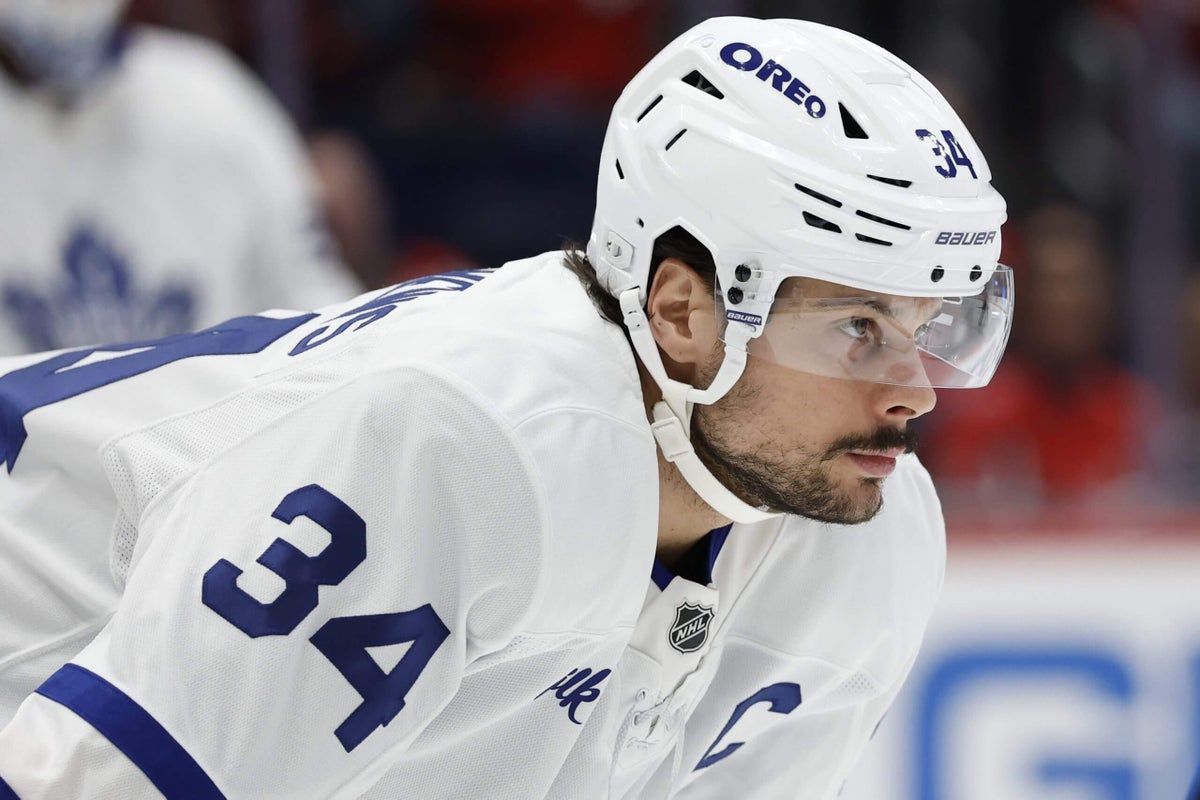
The numbers are almost too low to be believed.
Auston Matthews, the NHL’s leading goal scorer since he entered the league in 2016, isn’t scoring anymore. Thirty-five games into the season, the Toronto Maple Leafs captain sits tied for 29th in goals per game and 97th in points per game, with only 14 goals, nine assists and 23 points in 30 games.
On the season, Matthews is on pace for just 36 goals and 59 points despite being only 20 months removed from a historic 69-goal, 107-point season.
So what happened? How did one of the most dominant players in the sport over the past 20 years fall off this dramatically and what is the root cause?
More importantly for the Leafs — currently on pace to miss the playoffs for the first time since drafting Matthews first overall a decade ago — is it fixable?
After an extensive deep dive into the statistics behind his drop-off and talking to multiple league sources, what follows is our examination of the five possible reasons behind Matthews’ struggles, with evidence for and against each theory.
Theory 1: He’s injured
Matthews played the entirety of last season at less than 100 percent after suffering a significant injury early in the campaign.
He was in considerable pain and discomfort for months and quite clearly wasn’t skating or shooting the way he had previously. Matthews ultimately missed 15 games and went to Germany for unspecified medical treatment. His production dipped by 36 goals and 29 points from career highs in 2023-24.
Entering this season, however, multiple league sources said Matthews was back to basically full health and that what was believed to be a back injury was fully behind him. While he missed five games due to injury last month, we are told that was not related to last year’s injury and was not a lingering issue.
But his lack of production has continued. In fact, it’s become more pronounced this season.
Matthews is notoriously private about his health — including when he contracted COVID-19 during the pandemic — and it’s possible that’s why no one is willing to say his play is due to continued injury issues. It’s also possible his injury history has left him unable to reach his previous heady highs, despite the fact he had a full offseason to recover.
What’s clear is his skating and shooting still don’t appear to be at the level they were two years ago. According to the NHL’s Edge data, Matthews’ hardest shot this season (86.8 miles per hour) is only in the 71st percentile and his max skating speed (21.6 miles per hour) is below the 50th percentile. Those figures are notably down from the 88th and 65th percentile three years ago.
A lingering injury would explain, at least in part, why that’s happening. But it’s not the only possibility.
Theory 2: He’s past his peak
Matthews turned 28 years old in September, which puts him at the exact age of the average forward in the NHL this season.
While he’s not old, historical league data shows that star players tend to peak between the ages of 23 and 26, and even the game’s best players have typically had their production dip as they approach 30 years old.
Before Matthews’ era there were four players whose projected Net Rating was higher than plus-20 at their peaks: Sidney Crosby, Alex Ovechkin, Evgeni Malkin and Jonathan Toews. While all four were still great players until age 30, they were all noticeably less effective than at their peaks. The higher a player climbs, the more room there is to fall.
On average, those four players’ projected Net Rating fell 9.5 goals at age 28 relative to their peaks. In that respect, Matthews is right on schedule.

That said, the NHL scoring leaders list right now is filled with Matthews’ peers — many of whom are older and many of whom are outproducing him dramatically this season. Avalanche star Nathan MacKinnon, for example, is 30 and is having a career year. Oilers captain Connor McDavid isn’t far behind MacKinnon and he’s a few weeks from his 29th birthday.
Even older stars like Nikita Kucherov (32), Brad Marchand (37), Sidney Crosby (38) and Artemi Panarin (34) are all significantly outproducing Matthews as the season approaches the halfway mark.
So while an age-related decline — especially in light of an injury history that includes missing 45 more games than McDavid since 2017-18, Matthews’ second season — is possible, it can’t fully explain just how dramatic Matthews’ fall-off has been.
In that sense, Ovechkin’s trajectory at the same age might offer a clue. Player decline isn’t always related to age; sometimes it’s how a player is being used. Ovechkin’s bounce-backs in his Net Rating per 82 at 27 and 29 years old each coincided with a change behind the bench.

Which brings us to…
Theory 3: The system is bad
This season, the Leafs are the NHL’s second-worst possession team (45.2 percent), ahead of only the San Jose Sharks. They spend a considerable amount of time in their own end and are a poor team in just about every defensive metric available.
Head coach Craig Berube preaches an old-school, dump-and-chase system which is a significant departure from the Leafs’ previous structure, and combined with Toronto’s lack of puck-moving defensemen, it does not always lend itself to skill players getting quality looks on offense.
There has been an increased priority on making plays through traffic, net-front battles and using the defense to thread shots through from the point, none of which play to Matthews’ strengths as a pure sniper who needs time and space to score.
Spacing was a priority in former coach Sheldon Keefe’s offense, and it was meant to maximize Toronto’s best weapon. This is evident when comparing Matthews’ 69-goal season to the last two under Berube.
Last year the NHL released goal visualizations for every goal using their puck-and-player tracking, and we pored through every five-on-five goal scored by Matthews over the last three seasons. The aim? Measure exactly how much space Matthews had at the time of receiving a pass during in-zone offense (i.e. no rush goals) and how often he scored with space.
The difference was significant.
During Matthews’ 69-goal season, he scored 38 goals at five-on-five, 24 of which can be categorized as in-zone goals. In the last two seasons, Matthews in-zone goal pace has dropped to 8.6 per 82 last season and 8.9 per 82 this season. That 15-goal drop per 82 games is the difference between Matthews’ current pace of 41 goals and a much more normal (for him) 56.
Some of that likely stems from a lack of space. On average, Matthews had 12.6 feet of space on goals he scored uncovered in 2023-24. That shrunk to 11.7 feet over the last two seasons — a big deal for a scorer.
The even bigger issue, though, is the lack of frequency.
Of the 24 in-zone goals Matthews scored in 2023-24, 17 came with at least five feet of space and 10 came with at least 10 feet of space. Over 96 games with Berube as his coach, Matthews is at seven and four respectively. While part of that is a result of last season, his pace this year is still off: 8.5 goals per 82 with five feet of space and 5.7 with 10 feet of space.
If you compare that to what Matthews still does on the rush, it’s clear where Matthews is losing the most goals at five-on-five. It’s in-zone, and it’s with space. At five-on-five, he’s barely affected otherwise.

Some will point to the loss of Mitch Marner here and we’ll get to him, but that’s not the whole story. Goals with space assisted by Marner featured an extra two feet of separation for Matthews during the 2023-24 season. But 10 of Matthews’ 17 goals in space that season featured a primary assist from someone other than Marner — not to mention Marner was there all of last season when those plays just didn’t materialize as often.
The two big shifts in structure are fewer goal-line-to-slot plays and fewer high-zone plays. Under Keefe, Matthews scored six goals from the slot from a goal-line pass, five of which came with space. The reason for that is how often he’d play in the high zone and sneak in after, a play that doesn’t transpire much these days with a big focus on getting pucks to the point. Matthews has just two goal-line-to-slot goals under Berube. Matthews also had five goals that came directly from a pass to him in the high zone under Keefe, where he had an average of 17.5 feet of space. He has one goal of that nature under Berube.
It’s possible Matthews is struggling to find the same space he used to due to lesser foot speed, or because defenses have figured him out. It’s also possible the high-zone play isn’t as effective with lesser shot speed. Without any data on all of Matthews’ shot attempts, it’s also tough to know for sure whether he’s still getting the opportunities and just not burying them. But visually, it sure seems like he’s not getting the same looks he once was. Given all of this, it feels more likely the Leafs are neutering their best weapon’s best weapon by placing him in the wrong spaces.
Theory 4: He’s being used defensively
Offensively isn’t the only area where the way Berube is using Matthews should draw scrutiny. It’s also his defensive usage. At five-on-five, only two forwards since 2016-17 have faced tougher opponents relative to the rest of their team than Matthews has this season: Sean Couturier in 2020-21 and Nico Hischier in 2021-22. That makes a massive difference that often goes underappreciated.
Matthews is no stranger to the shutdown role; his line has played matchup minutes for the last six seasons. But there’s a difference between the 82nd percentile of competition quality he averaged from 2020-21 to 2022-23 and the 91st percentile he was at during the 2023-24 season. And there’s a big difference between that and the 99th percentile difficulty he’s been tasked with this season — especially when being paired with defensively irresponsible right wingers to do so.
From 2020-21 to 2022-23, the Leafs allowed 0.05 fewer xGA/60 with Matthews on the ice for a 2.29 xGA/60 pace — both great numbers given the role. Both numbers have steadily climbed as Matthews’ usage began to ramp up to this year’s conclusion: the Leafs give up 0.27 more xGA/60 with Matthews on the ice for a 3.07 xGA/60 pace. Both are career lows.
That hasn’t affected the Leafs on the scoresheet yet — they don’t allow a lot of goals with Matthews on the ice — but is this really the best use of Matthews’ ability? Does it really make sense to bury their captain defensively like he’s Couturier? It’s especially fair to wonder when the Leafs are giving up so many chances in Matthews’ minutes to begin with.
Whatever Matthews adds defensively by sheltering the rest of the team from that usage can’t be worth the offensive dropoff that’s usually attached to that burden. What made Matthews so effective in the past was that his defensive play was a bonus on top of being one of the game’s strongest offensive players. Right now, his defensive game is being treated as the focal point.
At the same time, as difficult as his usage has been, it is something he’s handled better in the past. Even if it’s ramped up, usage alone doesn’t explain Matthews being less effective to this degree. Accounting for it brings Matthews’ Net Rating per 82 from plus-10 to plus-12; in the previous six seasons, he averaged plus-28 and was never under plus-22.
Unless there’s a breaking point at the current extreme Matthews is at where more offense is being sacrificed than measured, usage is probably only a small chunk of the pie. So the difference between Matthews being an ordinary first-liner and one of the five best players in the world likely falls elsewhere.
Theory 5: He misses Marner
Intertwined with Theories 3 and 4 is the Marner of it all.
One reason star players work better in pairs is gravity — the defensive orbit from other teams is shared, creating space for both to work their magic. Marner, one of the league’s most gifted players at creating space, no longer being available puts more defensive emphasis on Matthews. That’s something we already noted with the average space Matthews had per pass in 2023-24. But it’s especially true this season where Matthews has often been split from William Nylander; as good as Matthew Knies can be, he doesn’t have the required gravitational pull.
It’s a similar concept on defense, where Marner and Matthews shared a heavy burden. Nylander, a notoriously poor defensive player, isn’t ideal in that role; the Leafs opting often for Domi instead is even worse. That’s taxing for Matthews as one of the team’s few defensive stalwarts, a significant responsibility his superstar peers don’t really have to deal with. The more he has to do defensively (with minimal help), the less he can really do on offense.
Matthews and Marner fed off each other well at both ends of the ice, playing together a ton in their first nine seasons in the league. Over their final five seasons together, they both finished in the top 10 in NHL scoring, with Marner sitting seventh and Matthews eighth. They were also both Selke finalists during that time.
It’s not just Matthews missing Marner — it goes the other way, too. Marner is on pace for his least productive offensive season since 2017-18, and while he’s been strong defensively, it should be noted he’s in a secondary role matchups-wise behind Jack Eichel. Matthews-Marner created a strong on-ice bond that’s hard to untangle.
While there is data that shows Matthews remained productive at even strength whether he was on a line with Marner or other wingers, what’s indisputable is that he now misses Marner’s presence in one key area: the power play.
Matthews has always been a prolific even-strength scorer, but over the past five seasons, 28 percent of his goals and points have come on the man advantage. With the Leafs’ power play currently a total disaster this season — sitting tied for last at 14 percent — Matthews’ point totals there have cratered dramatically.
He currently has just four power-play points all season, which projects to 12 on the season, or a drop of more than 40 percent from what he had typically produced in an 82-game season during his peak years. Up to half of Matthews’ missing production overall, in other words, could be solely due to Toronto’s struggles on the man advantage.
Matthews is, of course, contributing to those issues by being a focal point of the top PP unit and not producing, but that stat also suggests it’s possible a systemic turnaround of the team’s power play would significantly boost his overall offensive totals.
That may be possible by actually treating Matthews like a focal point of the unit. Over the previous four years, Matthews earned 26 percent of Toronto’s power play expected goals while he was on the ice. This year that’s down to 19 percent. Matthews’ brief shift to the point, a spot occupied by Marner last season, was especially baffling.
On the whole, Marner’s absence definitely plays a role in Matthews’ decline. His job is harder on offense and defense without him and there’s even less space in a space-less system without Marner’s gravitational pull aiding Matthews. But to place all of Matthews’ decline on Marner’s absence would be far too reductive given the myriad other factors at play.
There’s truth and fiction to all five theories here, so it’s just a matter of figuring out just how much truth each one holds. The mystery of Matthews’ decline is that it seems to be an entire toxic cocktail that has tanked his effectiveness all at once. Part injury, part decline, part system, part usage, part Marner.
Maybe some parts hold more weight, and it’s impossible to know for sure which one has been the most damaging. The more important matter is whether or not it can be fixed, something that’s harder to do when there’s so many things affecting Matthews.
A new coach can plausibly fix the system and Matthews’ usage, but it doesn’t help if he’s injured, less effective due to age and doesn’t have an elite weapon next to him. Even if time off might be able to help Matthews get healthy, he still may never be the same elite player again and will still be playing without Marner.
Help by his side would be significant, but it may not matter if Matthews is a slower player with a less lethal shot and still being asked to play against his strengths in heavy defensive minutes with weak two-way linemates.
What we do know is that trying something to fix Matthews is better than what the Leafs are currently doing about it: nothing.