
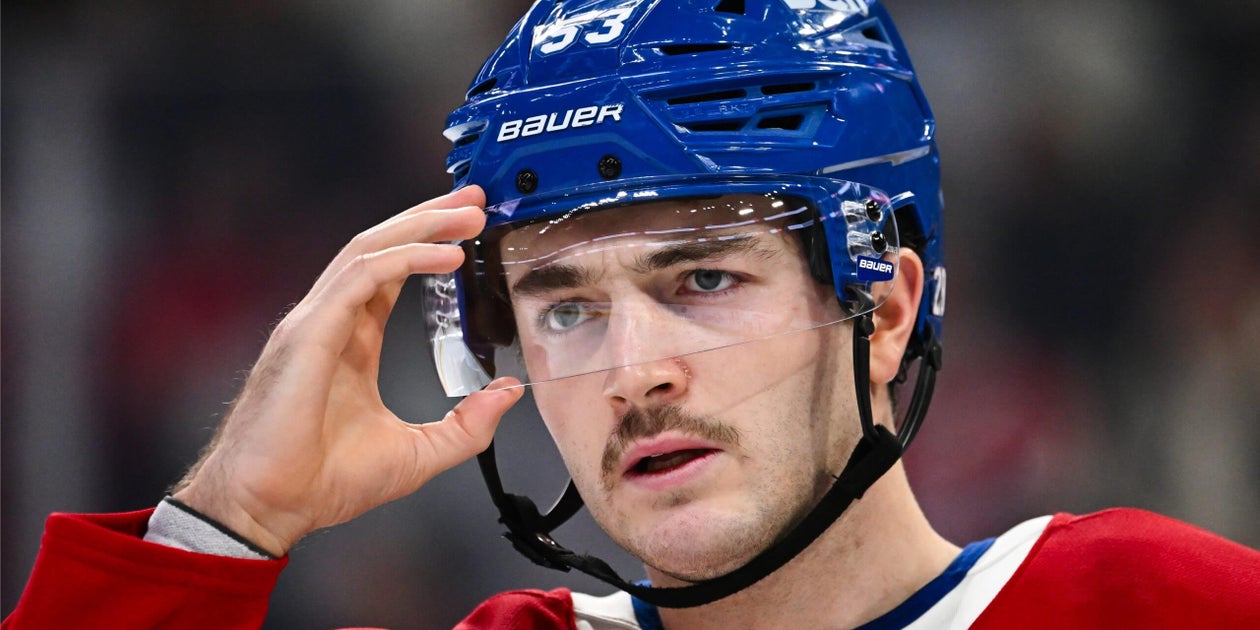
In NHL history, only 15 players born in Prince Edward Island have played at least 100 games. Home to just 150,000 people, Canada’s smallest province is connected to the mainland only by bridge or ferry. That isolation makes the path to the league especially difficult, as elite-level competition is harder to come by.
This is where Montreal Canadiens defenceman Noah Dobson came into his own as a person and player. In many ways, the Island has shaped him.
Since earning a full-time role with the New York Islanders in 2021-22, Dobson has ranked among the NHL’s elite scoring defencemen. Such heights can feel unreachable for a PEI native, but from a young age, Dobson proved he would not be limited by his geography.
Quite the contrary.
“I was fortunate in minor hockey; it was great,” Dobson said. “We had a lot of great players, maybe not the NHL level, but a lot of major junior Québec league guys, university guys from PEI. Obviously, the level’s not the same compared to Ontario or Québec or some of the bigger provinces, but we had a lot of great players.”
One event in particular showed where Dobson stood off the island.
As a 12-year-old in 2012, Dobson played for the PEI Rocket in the Québec International Pee-Wee Tournament. Coming from Summerside, a town of roughly 16,000, he suddenly found himself playing in front of 10,000 fans in the tournament’s second division at Colisée de Québec, the former home of the Québec Nordiques.
The team was coached by Rodney MacArthur, the father of one of Dobson’s lifelong best friends and a neighbor from just around the corner. MacArthur led the team from a tiny corner of the hockey universe to the world’s most prestigious pee-wee tournament in Québec City.
In a scene straight out of “Hoosiers,” they won the whole thing. Dobson was named the division’s top defenceman, a feat that came as no surprise to MacArthur.
“From my perspective,” MacArthur said, “he was just different.”
The 2015 Canada Games highlighted the vast gulf between Dobson’s environment and other parts of the country. Earlier that year, MacArthur had watched his son and Dobson play against a London, Ont., team led by Nick Suzuki. Suzuki was dominant, yet when the Canada Games arrived, MacArthur was stunned to learn Suzuki had initially been cut from his team.
“He would have been our best player, and here he was cut from Ontario,” MacArthur said. “That’s the difference. That’s how big they are compared to us.”
Suzuki was eventually named to Team Ontario as an injury replacement, but MacArthur’s point remains. That’s how momentous the Québec pee-wee tournament was. All of PEI was following along from home.
Dobson’s team arrived in Québec City undefeated and maintained its perfection, beating teams from Montreal, Colorado, Ohio and Austria to claim the title.
Will always remember the 6 games we played here on our way to the 2012 Peewee Int Chship #Caps #Colisee #Beliveau pic.twitter.com/cJ8OX3b9fU
— Rodney MacArthur (@PWcapscoach) June 1, 2015
No PEI team had ever won the Québec International Pee-Wee Hockey Tournament, and none has since. A 12-year-old thriving in front of 10,000 people — more than 60 percent of his hometown’s population — was a sign of things to come. But MacArthur had already seen the signs years earlier.
“From the time he was 5, he was always a good athlete,” he said. “He had a drive in him that was just different.”
When Dobson was in 9- and 10-year-old Atom hockey, he was often on the ice with 13- and 14-year-old Bantam players. And at the end of practice, Dobson would go up to those older players to try to test himself.
“He’d always be challenging them to one-on-ones,” MacArthur said. “And whether he beat them or not, he would do it again and again.”
That mindset would become a vital asset in his professional career — especially in a Montreal market where relentless scrutiny is a way of life.
“It really stood out as a kid that he wasn’t scared to fail,” MacArthur said. “It was unique.”
Dobson’s selection by Acadie-Bathurst with the No. 6 pick in the 2016 QMJHL draft carried deep personal weight. His parents, Andrew and Jenny, were born and raised in Bathurst, a place Dobson had visited throughout his childhood and where he would eventually live with his paternal grandparents while playing there.
When Dobson was 4, his maternal grandfather, David Leblanc, died of multiple sclerosis at 53. As an homage to his late grandfather, Dobson took No. 53 to start his major-junior career — a number he still wears in the NHL.
“That was the first time I wore it,” Dobson said. “I think it was my dad that mentioned it. … I thought it was a cool way to honour him.”

Dobson was a dominant junior defenceman playing in Bathurst, N.B., where both his parents were born and raised. (Francois Laplante/FreestylePhoto/Getty Images)
Dobson had a prolific junior career. He became one of the best defencemen in the country, and he remains one of the best defencemen to come out of the QMJHL in decades. In his final year in 2018-19, Dobson played for Canada at the World Junior Championships alongside Suzuki. It did not end so well for him.
In overtime of the quarterfinals against Finland, Dobson’s stick exploded on a shot attempt, allowing Finland to come down and score and eliminate Canada from the tournament. Intense heat was cast upon Dobson for something that was completely out of his control.
“That was tough, honestly,” Dobson said. “It was just on such a big stage where everyone saw it, and just how passionate Canadian fans were. Like, the whole country. I was getting messages on social media, fans were just so mad over it.”
How he handled that was another chance to unknowingly prepare himself to one day play in Montreal.
“Things aren’t always going to go your way,” he said. “You can’t let that deteriorate how you feel about your game.”
Not long after those World Juniors, Dobson was traded to the Rouyn-Noranda Huskies, whom he helped lead to the QMJHL title — his second in a row. The championship coincided with the 15th anniversary of his grandfather’s death.
Well what can I say so proud of #53 today marks anniversary of his Grandfathers death where he past away at the age of 53 of MS why he wears #53 pic.twitter.com/ZejsW8cP6N
— Andrew K Dobson (@andrewkdobson) May 11, 2019
That victory set up a confrontation with Suzuki and his Guelph Storm in the Memorial Cup. Guelph beat Rouyn-Noranda in the round robin, but in the semifinal, Dobson’s Huskies came out on top en route to winning the Memorial Cup.
In that tournament, the Huskies were dealing with an injury on the back end, which forced Dobson, by his own estimate, to play upwards of 35 or 40 minutes a night. So, when Dobson and the Huskies faced Suzuki and the Storm, the two saw a lot of each other.
“We went head-to-head in that tournament,” Dobson said with a little grin. “He doesn’t like to talk about it.”
When asked if I should question Suzuki on it, his smile grew wider.
“You should definitely go ask him,” he said.
So, I did.
“It definitely felt like he was on the ice the whole game, and he could still skate around in the third period like it was nothing,” Suzuki said. “It doesn’t really challenge him physically just because he’s so smart getting around the ice.”
That tournament was the end of Suzuki and Dobson’s junior careers. They were in the NHL the following season.
When Dobson arrived on Long Island at age 19, he had to unlearn some of his junior-hockey survival tactics born out of the sheer amount of minutes he spent on the ice.
“When you come in the league from junior, obviously, I was highly offensive,” Dobson said. “I played a lot of minutes in junior, almost too much, where bad habits can creep in defensively, just little things that at this level you can’t have. I think coming in, I really tried to put an onus on defending and finding ways at this level of what’s effective for me and the type of player I am to defend.”
When Dobson made the Islanders, he moved in with the family of Dennis Seidenberg, a longtime NHL defensive defenceman. His defence partner in his first year was Johnny Boychuk. Then it was Andy Greene. Then it was Zdeno Chara.
Dobson, in other words, had immediate access to mentors.
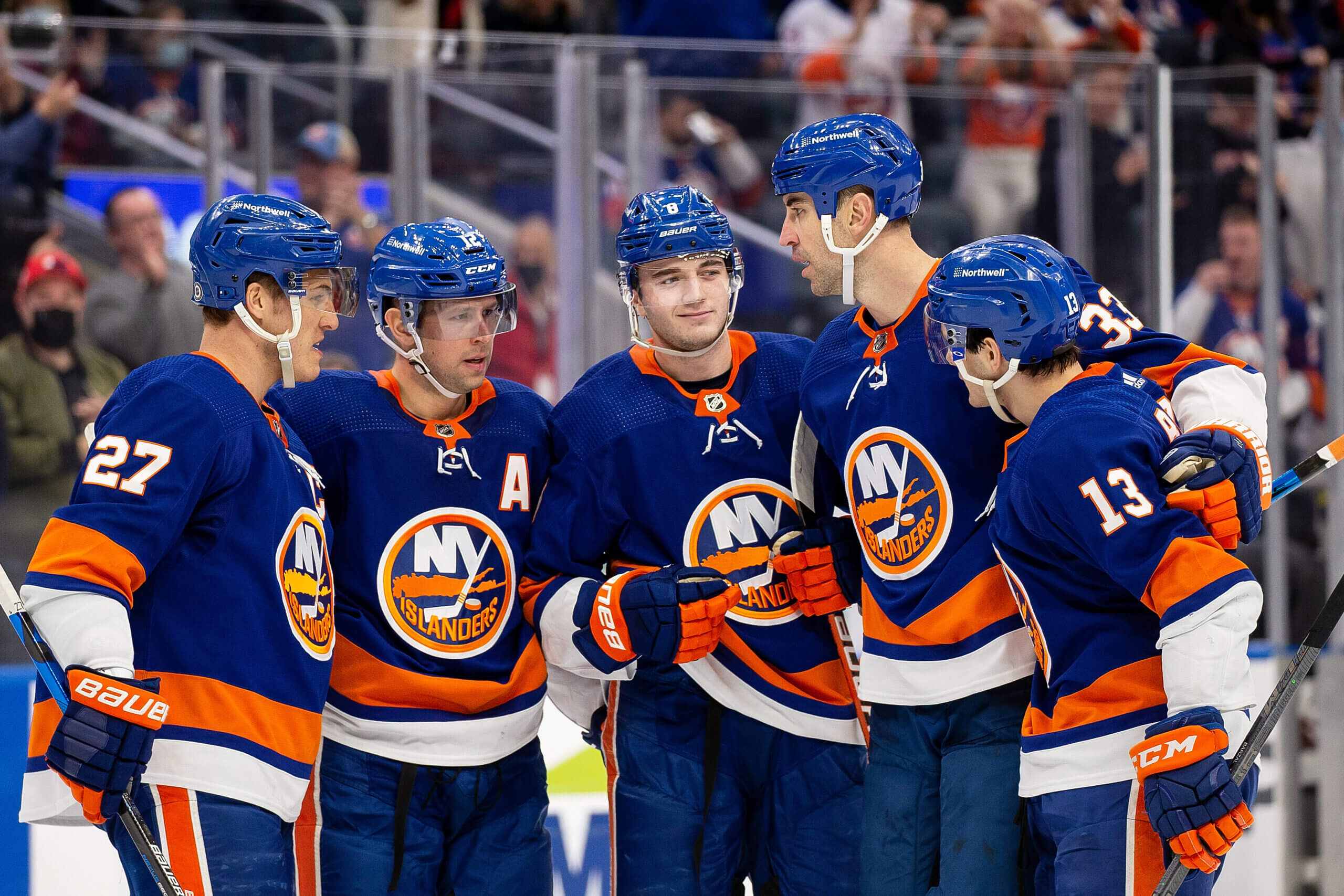
Dobson learned a lot from mentors like Zdeno Chara on Long Island (Michelle Farsi/NHLI via Getty Images)
“Credit to him, he embraced that side of the game when he first came up,” said Seattle Kraken coach Lane Lambert, who was an associate coach with the Islanders when Dobson arrived. “He had some great mentors to work with, whether it be Chara or Andy Greene, those kind of guys that helped him grow as a young player to improve his defensive game. He’s pretty complete.”
Greene, Dobson said, taught him to be level-headed, to focus on the present and not be overly concerned with mistakes made in the past.
“One thing, especially with Andy Greene, was just his demeanor on the ice,” Dobson said. “No matter if it’s going good or bad, just keeping that even keel and composure, which is important.”
Chara, meanwhile, taught him to always be evolving and always be improving, just like he did over a 25-year career that began and ended with the Islanders.
“Noah is a super talented defenceman,” Chara said ahead of his induction into the Hall of Fame last month. “He is such a skilled player and he skates well. He sees the ice really well. I think what I tell younger players, you’ve just got to always stay humble and be a student. I feel like they want to make the next step, want to get to that next level and it’s a little bit, at times, rushed.
“You’ve got to understand, no matter if you play five years, 10 years, 20, 25, you are never going to be able to say ‘I figured it out.’ It’s a humbling game.”
Message received.
At training camp in September, when Dobson was asked about Kaiden Guhle, one of the first things he mentioned was how he was looking forward to watching Guhle all season and learning from the way he defends. Dobson is always looking to improve, in part because of what he learned from being around strong veterans early in his career.
“One thing for me is I will always be trying to evolve my game and be the best possible version of myself as I can,” Dobson said.
His time on Long Island was not perfect, and his defence came under heavy scrutiny.
That is sure to happen in Montreal as well, and in fact, it already has. Though that scrutiny is at a whole other level, his time with the Islanders prepared him for it.
Dobson’s importance to the Canadiens’ aspirations cannot be overstated. His sign-and-trade acquisition in June is the most significant home-run swing by Jeff Gorton and Kent Hughes since they took over Montreal’s hockey operations four years ago. His arrival was the biggest sign that the Canadiens feel ready to take a step. He is the highest-paid player on the team.
A little more than two months into Dobson’s eight-year, $76 million contract, the first impressions have been largely positive.
Roughly a month into the season, coach Martin St. Louis made a resonant assessment on Dobson, offering as big an endorsement as he could in just two sentences.
“I think it’s his toolbox and his computer,” St. Louis said. “There’s not much he can’t do on the ice, and he can analyze it all really quickly and has the tools to do what his brain is telling him to do.”
Dobson is 6 feet, 4 inches and 200 pounds, a big guy, but by his own admission not a bruiser. That can sometimes leave people wanting. But he uses his physical gifts in different ways: His reach makes for a disruptive stick. His brawn allows him to box out around his net effectively. And that computer of his can be just as impactful defensively as it is offensively.
His new teammates, in any case, have not been left wanting.
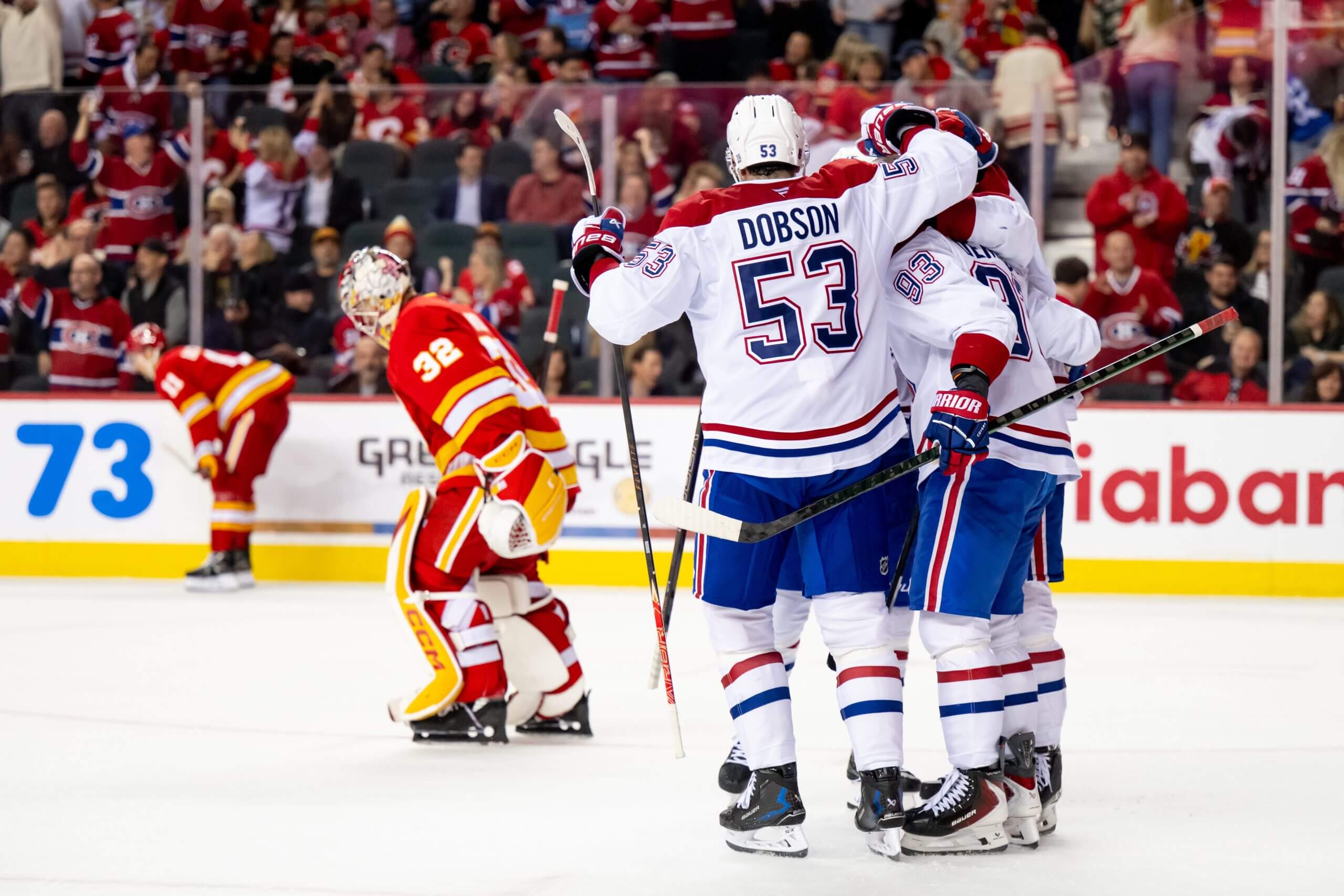
Dobson’s new teammates in Montreal have quickly grown to trust him offensively and defensively. (Brett Holmes/Getty Images)
New forward Zack Bolduc, acquired one week after Dobson, was asked earlier this season how he approaches a 50-50 puck in his own end if Dobson is the closest Canadiens player to that puck battle.
“I’m pretty confident he’s going to make the right play. So, for me, I need to find space,” Bolduc said. “Nothing’s guaranteed, but I know my teammates and what kinds of players they are, and I also know the probability of Noah coming out of that battle with the puck. So, it’s in those moments you want to be a bit ahead of the game.”
So, cheat?
“Exactly,” he said, “but in an intelligent way.”
That confidence in a teammate is invaluable.
MacArthur, Dobson’s coach at the Québec pee-wee tournament, has always been a big Canadiens fan.
But more than that, he is a PEI native.
What he loves most about Dobson is not that the defenceman plays for his favourite team, but that Dobson is also a PEI native and hasn’t forgotten it. Despite how small the island can feel, and despite how big Dobson has become as one of the most important players in a big market like Montreal, Dobson has never been too big for the tiny island that made him who he is.
When Dobson got married last summer in Rhode Island, his three groomsmen were MacArthur’s son Brodie, Jeremy McKenna and Carson MacKinnon, the top line and three leading scorers from the PEI team that won the Québec pee-wee tournament.
All these years later, that’s who Dobson picked.
“He could have been a big shot and had some of his Islanders teammates or whatever, but that’s Noah,” MacArthur said. “That’s why people root for him, and some of them are even cheering for Montreal when they never would have cheered for Montreal before. Because they see how modest he is, and he’s a great human being; he really is. People in PEI, or anywhere really, they’re drawn to that. They want people who remember where their roots are and where they’re from and how they treat people.
“It’s a big part of who he is, and his parents would never let it not be a big part of who he is. Because they appreciate everything the island has given them, as well.”
Every summer, Dobson runs a charity ball hockey tournament in his hometown of Summerside, where he grew up playing ball hockey on the streets. Last year, over 100 teams entered.
PEI is a part of him, and it always will be.
“Growing up on the island and playing minor hockey there, I was given every opportunity that a young, Canadian kid could ever ask for playing the game we love,” Dobson said. “Honestly, my whole time I was there playing hockey, I still think about those days and just how great of an experience it was. So, for me, I have that gratitude and appreciation to the community for what they did for me to get here now.
“I think it’s important for me to show that gratitude back and that respect back, because they gave me everything I could ever ask for growing up.”
— Chris Johnston contributed to this story.