
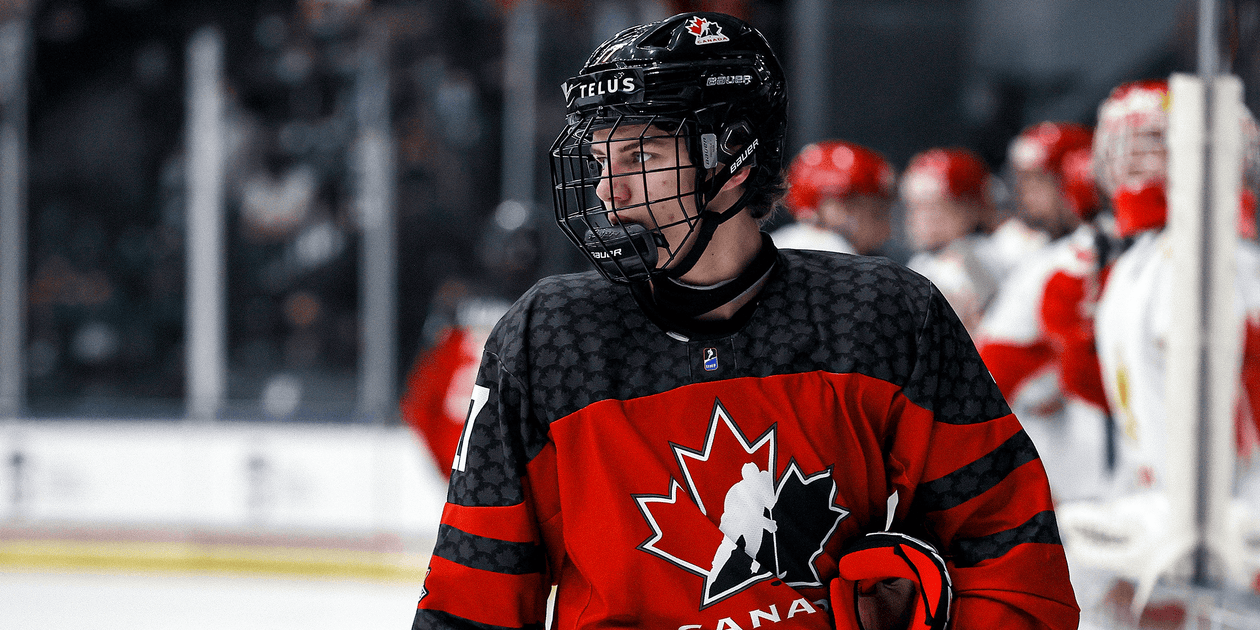
With the No. 1 pick in the 2023 NHL Draft, the Chicago Blackhawks selected Connor Bedard. Follow our live NHL Draft blog for analysis from all our writers and columnists.
To the north of downtown Vancouver, across the harbor, a series of mountains tower above the city. Jutting into the range, between Mount Fromme and Mount Seymour, sits a visible gap, a formation known as Lynn Valley.
Historically, Lynn Valley was a logging community that was settled at the turn of the century by blacksmiths, lumberjacks and millwrights. Back then, the neighborhood was called “Shaketown,” a nod to the cedar shingles produced in the area.
Like all Vancouver neighborhoods in recent decades, Lynn Valley has become a relatively expensive place to live. Still, it retains a certain working-class vibe — if not quite blue collar.
In the backyard of one of those quiet Lynn Valley streets, the thwack and ping of pucks banging against a mix of surfaces rings out … to the occasional annoyance of Connor Bedard’s neighbors.
“When I was really young, I’d be in the front yard and up the street,” Bedard recalls. “I had a net. I’d go out with my dad and shoot pucks all the time. Then, when I got older, my shot got a bit harder, I started to break a few windows.”
One neighbor, a professional carpenter, built a substantial wooden edifice in the Bedards’ backyard for Connor’s target practice. The open-air structure features a large wooden stage with planks at the far end, suspending a large, white shooting tarp, seriously worn in and peppered with the skids from tens of thousands of pucks.
The whole setup is modest and hardy. In addition to the custom construction work, there’s a net filled with a classic pocketed “shooter tutor” at the far end and a patch of synthetic ice at the near one so that Bedard can work on the shot that has NHL scouts drooling.
“I don’t know if I got complaints from neighbors so much as I’ve had to use some common sense,” Bedard says. “If I’m out there at 10 at night and firing pucks off of the wood or whatever, I’d hear about it.”
The neighborhood complaints started to subside when it became clear what the noise was all about. Connor Bedard, the hockey prodigy from Western Canada, was preparing for this moment. His draft year. After years of anticipation, Bedard is poised to be the No. 1 pick in next summer’s draft. But make no mistake. This was no solo journey.
Bedard’s father, Tom, works in forestry, putting in long hours in a dangerous profession. His mother, Melanie, keeps things running at home and hosts international students at the family house. Until he moved to Regina to play in the WHL, they rarely missed his games. And his older sister Madisen moved briefly with Connor, who was 15 at the time, to Sweden during the pandemic. Her classes had moved online, so she went with her brother to ensure that he wouldn’t be alone while the family sought out a place for Connor to play high-level hockey while the CHL was paused in the fall of 2020.
“It means everything,” Bedard says of the sacrifices his family has made and continues to make. “My dad is my hero in that way and someone I look up to so much. And I wouldn’t be anywhere without him or my mom and sister. They’re the reason I’m here.”
Connor says he doesn’t know how his dad managed to get to his games and still maintain his rigorous work schedule. “He’d get home at 4 after a 12-hour day and be driving me to 7 p.m. practice, getting home at 9:30 p.m., barely getting any sleep,” Connor says. “It’s insane what he does on a daily basis. He’s definitely the hardest-working person I know and he’s kind of instilled that in me.”
Not that Connor’s schedule is clear. This summer he’s in the gym with his trainer every morning for 2 1/2 hours. Four days a week, the work focuses on balance and lower-body strength. On the fifth day, Bedard joins a group of college and major junior players on a field for agility work.
Then every afternoon, it’s at least one on-ice session. Those sessions are led by local Vancouver hockey coach Jon Calvano, who has worked with Bedard since he was 5 years old and has watched the family dynamic shape his focus.
“Growing up in an environment where he sees the work ethic, the dangerous job his dad does, just working to give him every opportunity; he’s never taken it for granted,” Calvano says. “You see it in how he works, everything is 100 percent. That’s not a culture that I created as a coach or that a program created, that’s something that starts at his house and with his family.”
And once he’s back home, Connor returns to his backyard sanctuary and keeps working.
Connor Bedard was special from an early age. “I wouldn’t say you could see stardom at 5 years old, but you could see the work ethic and the self-motivation,” Calvano says.
By the time he was 10, though, Bedard started to separate himself from his age group. At the famed Brick Invitational tournament in 2015, Bedard scored eight goals in six games, including a key overtime winner for the Vancouver Junior Canucks. He was the leading goal scorer in the tournament.
“There’s this amazing picture from the Brick Tournament,” Calvano says. “We’re playing the Toronto Bulldogs, we end up in overtime at 3-on-3. First of all, he wasn’t going to come off the ice and secondly, he was determined that he was going to score.”
Bedard remembers that game, too. “Earlier in the shift, I thought I had a good chance,” he says. “Then I had the puck on a bad angle, the goalie came out pretty far so I didn’t shoot. I just skated around the net as fast as I could, kind of wrapped it.”
Calvano laughs at the memory. “It was an amazing individual effort. He stripped a guy of the puck, had a chance, did the Doug Gilmour thing and scored on a wraparound. And his celebration when he scored, it was just amazing.”
“I had a pretty terrible celebration to be honest with you,” Bedard says, laughing. “But it is a pretty cool photo.”

(Photo courtesy the Bedard family)
After the Brick Tournament, things began to ramp up for Bedard. He grew significantly, his body changing at roughly the age of 12.
“The first game I scouted him, he was a 12-year-old in bantam and I think he had six goals that game,” recalls Steve Marr, who’d go on to coach Bedard at the U18 level for the West Vancouver Academy Warriors. “So I probably strained my neck more than 10 times looking over at my scouting partner to say ‘Wow.’
“It doesn’t take many times watching him before you stop dropping your jaw. It gets to the point where you’re not surprised anymore.”
By 13, Bedard was skating with a group of local NHL players who worked with Calvano in the summer.
“I put him in the NHL group to play 4-on-4 and he was unreal,” Calvano remembers. “He’s playing with NHL guys and scoring goals on NHL goaltenders, and the guys were blown away.”
Now he was a full-blown prodigy. At 14, he was allowed to play U18-level hockey — colloquially known as “midget” level — with the Warriors.
“I played up my whole life,” Bedard says, “but it wasn’t with really older guys until midget.”
Playing U18 as a 14-year-old, Bedard led the league in scoring with 84 points in 36 games. And he did it while going through an arduous, lengthy and secretive process to apply for exceptional status in the WHL.
To be granted exceptional status in Canadian Major Junior is a rarity. Prior to Bedard, the WHL had never granted it.
The exceptional status designation in the CHL permits a player to play a full schedule of games — competing against some of the best amateur talent in the country, and players up to the age of 20 — as a 15-year-old. Only eight players in CHL history have been granted exceptional status, two of them (Bedard and Michael Misa) have yet to be drafted. Four of the other six were top-five NHL Draft selections, including three No. 1 overall picks: John Tavares, Aaron Ekblad and Connor McDavid.
“With his personality, it would’ve pissed him off if I’d ever given him special treatment,” says Marr, Bedard’s U18 coach at the time. “I made three exceptions because we had three evaluation weekends for his exceptional status process, and in those situations, I wanted to make sure he’d be set up for success. So I’d ask him questions ‘Who do you want on the power play with you, who do you want on your line?’ And it was the only time I ever gave him that.
“And he said: ‘Whatever our team needs, that’s what I want.’”
Once his exceptional status was granted, Bedard was immediately a standout as a 15-year-old in the WHL bubble — scoring 28 points in a shortened 15-game season.
“I knew immediately (that he was ready),” says Regina Pats head coach John Paddock, who was the team’s general manager at the time. “We had five or six days of practice in the Hub, and I was watching from the end — you weren’t supposed to be in close proximity to the coaches or anybody that was staying at the university — but Dave Struch, the coach at that time, and I talked briefly afterward through the glass. He said, ‘What did you think?’ And I said, ‘He’s the real thing.’ The 15-year-old looked like a 20-year-old out there. He was the best player on the ice.”
You’ve never seen anybody shoot like Connor Bedard.
What makes the shot special can be difficult to describe. It’s partly in the way that the 17-year-old holds his hands on the stick. It’s partly the wide variety of launch angles.
Bedard has an uncanny, flexible release point too, a self-conscious tribute to Auston Matthews’ signature drag shot. And there’s the timing, the technique, the strength on display. There’s the way that Bedard subtly opens his blade up on release to dissect an opposing goaltender with a cross-body finish.
Bedard’s pull shot is a chameleon. There’s a touch of genius to it, something ineffable that’s underpinned by a distinctive, metronomic rhythm. Bedard’s shot is an evolutionary hockey weapon, owing a debt to the recent history of the sport even as it stands alone. You know it’s special when you see it:
Over the course of the past decade, young players coming into the NHL have become unique shooters. Unlike the previous generation, which grew up with wooden sticks and shifted mid-career to whippier composites, these young players mastered shooting with composites as children. They have shots with a unique voice and a different understanding of the possibilities that advancements in stick technology have unlocked.
Matthews’ drag shot is the NHL’s best weapon at the moment. Watching him play — and shoot — changed everything for Bedard.
“Even now, I’ll just search up videos on shooting, or just watch his goals,” Bedard says of Matthews. “I think I’ve seen all of his goals. It’s something I enjoy doing and I use it a lot. He obviously created it, and it’s become the shot I use the most.”
You can imagine that a talent like Bedard, coming into his own as a player and maturing physically at just the moment that Matthews began to dominate in the NHL, would be drawn to the master of these new techniques. There was even a eureka moment that stands out to Bedard, one that altered his perception of what he could do.
“I don’t know if you know about this goal he scored against Buffalo in overtime. He’d scored goals like it before, but I saw it and it was the best shot I’d ever seen in my life,” Bedard says. “I’ve watched it over 100 times, I think.
“I don’t quite remember what year it was, but after I saw that, it was something that really popped to me. It was something I just needed to be able to do. Not that I’m going to be able to do it as well as him, but it was something I started working on after that.”
Calvano has seen Bedard work on his shot for over a decade.
“He’s a hockey nerd,” Calvano says. “He watches other players, he watches what they do, emulates certain things. And I think Connor saw the shot as his separator. He knew he had to have the release and the velocity, but I think when he saw Matthews’ pull shot, it sort of opened his eyes.”
This isn’t a new thing for Bedard either. Even as a young player, he’d watch games with a mini stick in hand, mimicking the moves he saw NHL players pull off.
“Honestly, I’m a huge Canucks fan to this day,” Bedard says of his hometown team. “I grew up watching every game. It was pretty funny, I’d be watching and while they were playing, I’d be playing mini sticks by myself, trying to recreate the moves.
“Whenever the Canucks got scored on, I’d throw a temper tantrum. They lost the Stanley Cup in 2011, so I was still really young and a big fan, and I remember I was crying for a few days.
“It was terrible.”
But Bedard doesn’t always focus his attention on offensive stars. His favorite Vancouver player was a fourth-line grinder, former Canucks winger Tyler Motte. In mid-January, Motte scored a goal-of-the-year candidate, beating Andrei Vasilevskiy with a between-the-legs finish. Bedard posted the highlight to his Instagram story and two weeks later, in early February, scored an eerily similar goal:
“Yeah, that might be a bit of a coincidence,” Bedard says. “It would be a cool storyline to say it wasn’t. It was pretty funny that it happened a couple of weeks after Motte did it. Maybe it was in my mind. I’ll give him some credit.”
The best hockey players occasionally slump, but those slumps don’t typically last very long. And when they end … watch out.
Case in point: Bedard had a tough start to his 2021-22 WHL campaign, scoring just 24 points for the Regina Pats in his first 24 games.
Going into the Canadian World Junior camp in December 2021, he thought he was a longshot to make the team.
But he did make the team, and then soon joined Wayne Gretzky as the only 16-year-old Canadian player to ever score a hat trick at the tournament. After the tournament’s abrupt cancellation due to the Omicron outbreak, Bedard went on to score 76 points over Regina’s final 38 games.
Busting out of a slump like that could be cause for celebration — or lead to an examination of what led to the slump or the run of good fortune. Enter: superstition. There are coaches who will turn their backs on shootout attempts. Star players who tie their skates at the exact same time before every game.
Bedard is particularly superstitious. “It’s bad,” he says.
Those close to him might agree.
“Sometimes I’d do something in preparing for the game, maybe by accident or on impulse, and then if he played well, I’d have to repeat it,” Marr says. “I’ve been around a lot of guys in the game and he’s right up there as a superstitious person.”
Ryan Kerr, Bedard’s longtime trainer, has seen it, too. “He had a consistently good 15-year-old year, and I watched the first game and we FaceTimed after the game,” Kerr says. “So then, because he played well, he wanted to do it again. Then again. He would be calling me pretty late at night, sometimes I’d be waking up answering his call.
“This year, he didn’t get off to the start that everyone expected. Then he made the World Junior team and when he came back to Regina, I had totally forgotten that he was already back in the lineup. So I didn’t watch the game and he had a four-goal game. So when I told Connor I didn’t watch the game, I wasn’t allowed to watch the next one. Then he had another good one. So he caught fire in the second half and I wasn’t able to watch it.”
One superstition everyone around him knows about: Don’t touch Bedard’s sticks before a game.
“I don’t know why I hate it, it’s just kind of weird,” Bedard says. “Before the last game of the year against Moose Jaw, everyone was lined up, all the parents and teachers, our management and owners, before we walked onto the ice. Our educational advisor just grabbed my stick, because he didn’t know, and I didn’t say anything to him, but in my head I thought ‘I’m not going to score today. No chance I’m getting 50.’
“His wife was also one of our educational advisors, and she knew and she just started ripping him. So my first shift, I hit the crossbar, and it took me till 5 minutes left in the game to score. So I’m sure he was stressing a little.”
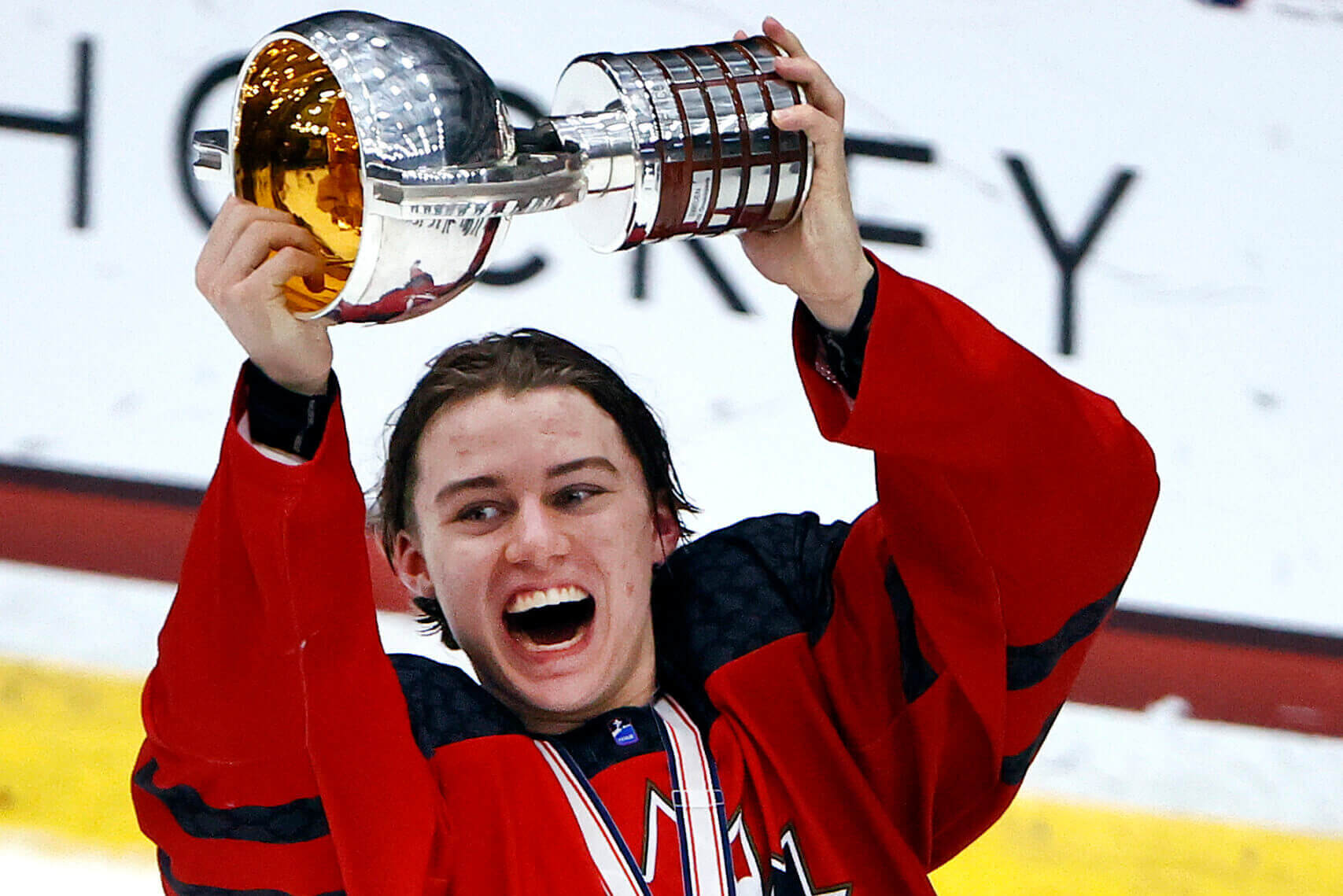
Connor Bedard celebrates with the championship trophy after Canada’s win in the 2021 U18 World Championships in Frisco, Texas. (Tom Pennington / Getty Images)
Sitting at the apex of a 2023 NHL Draft class that talent evaluators see as potentially historic, the glare of the hockey world will be trained on Bedard. The season gets underway early at the rescheduled World Junior Championships in Edmonton this week.
The expectations are high. Behind the scenes, NHL scouts are musing about whether Bedard might follow up on his historic 50-goal, 100-point age-16 season in the WHL by breaking 70 goals. In public, meanwhile, multiple teams are poised to tank, jockeying to maximize their draft lottery odds.
We’ve reached the point where Bedard is expected to be a household name for the next decade, but the pressure and scrutiny that comes with draft eligibility can be withering. Oftentimes, the conversations in the hockey world turn toward what a top prospect isn’t, as opposed to what he is, particularly for those players — like Shane Wright in this year’s draft — who enter the season expecting to be the first overall pick.
That’s part of the pressure Bedard will navigate. He’ll also have to endure impossible comparisons to Hall of Famers of the past and dominant players of today, spanning names from Steve Yzerman and Nikita Kucherov to Patrick Kane and McDavid.
Bedard, however, isn’t Yzerman or McDavid or Kucherov or Kane. He’s a superstitious and preternaturally focused young person. The son of a second-generation logger and a big Vancouver Canucks fan. He’s allergic to nuts. He’s an outrageously gifted hockey savant obsessed with practicing and adapting the moves he sees from the best offensive players in the world.
He’s his own man, albeit a precocious one.
And he’s not particularly comfortable with the too-lofty comparisons.
This spring, while watching intently on television as McDavid put up 12 points across five games in a dominant playoff series against the Calgary Flames, Bedard commented to friends that it was hard to imagine anyone believing he, Connor Bedard, could be that good.
“I kind of look at it, like, it’s an honor to be compared to or have your name put in the sentence with a Hall of Fame guy, it’s special,” Bedard says. “But I’m 17 and haven’t done anything yet.”
It’s a “yet” that looms large.
(Top photo: Tom Pennington / Getty Images)