

Lot of fun last night in Detroit.
The Red Wings beat the Dallas Stars 4-3 in overtime, two teams I know extremely well, and I wrote close to 3,000 words on the topic in a 20/20 that published last night.
After the game I had roughly a one-hour drive to my in-laws to meet up with the rest of the family to celebrate the holidays. As one usually does when driving late at night, I spent time overly thinking about hockey and random topics.
This story is a collection of those thoughts, things I learned in the past week, and other various notes.
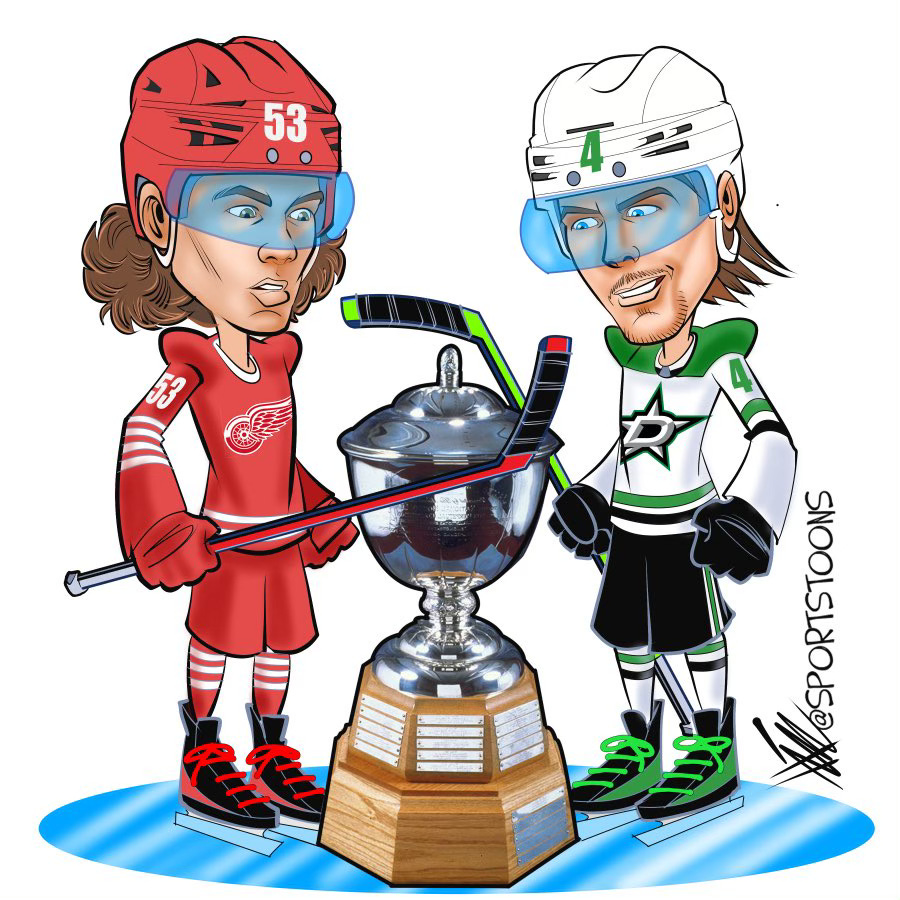
Much of the game between Detroit and Dallas was played with one or both of Miro Heiskanen and Moritz Seider on the ice.
As No. 1 defenders are expected, Heiskanen led his team with 27 minutes and 44 seconds of ice time. Seider did the same for Detroit clocking 22:36 in the victory while also serving up the game-winning assist to Dylan Larkin in overtime.
Now it’s hard to see any reality this season where Cale Makar doesn’t win the Norris Trophy this season. Makar has the past history, is leading all defenseman in point production, and is helping lead the Avalanche to a ridiculous record where they already have 61 points before Christmas morning.
But that doesn’t mean we can’t have a conversation here about Heiskanen and Seider, two defenders I love watching, and an opportunity they’ll have to better enter the Norris conversation that they’ve never been given before.
See, individual awards aren’t actually won on the ice. It matters, for sure, but they have to be earned in the court of public opinion and in scoring ledgers.
Heiskanen and Seider won’t generate the points to ever compete in that realm, especially in a world with Makar and Quinn Hughes, who is starting to pop off in Minnesota, so they’ll have to win the Norris in the court of public opinion.
It’s starting to happen for Seider, who was recently praised for his play on Spittin Chiclets, a podcast that, like it or not, swings the pendulum heavy for hockey media. Dom Luszczyszyn also recently laid out some positive data that reflects what Seider has done.
I really like Dom, we used to work together and he’s been a guest on my podcast, Expected by Whom? with Prashanth Iyer in the past.
(Side note: 2026 resolution, bring back Expected by Whom? more regularly.)
He also has an outsized influence on voter opinions, maybe even more than he should. Hockey writers, especially beat writers, don’t pay enough attention to the entire league. They spend so much time focusing on their one franchise, that most rarely even spend the time to go to media availability for other teams when they are in town.
So when it comes time to judge awards, many look at point totals or seek out outside sources to help inform their opinion. Dom’s work has become so well respected in the hockey community that in ways it’s become a crutch that some writers use to help fill out their award ballots.
So when Dom is championing your trophy hopes, that means you have trophy hopes.
Seider is a Norris candidate this season because of his play and because Dom has said so. Heiskanen is more of a Norris candidate because of his reputation amongst coaches, who still have a bit of sway on how voters eventually cast their ballots.
This brings me to the 2026 Winter Olympics, which could be the moment Heiskanen or Seider turn the Norris Trophy dreams into potential realities.
Seider is going to be a workhorse for Germany, he’s going to flirt with 30 minutes per night and he’s going to be one of the biggest reasons Germany advances to the medal round or not.
Finland is a much deeper hockey country than Germany, but Heiskanen will play a similar role, especially after an injury kept him out of the 4 Nations Face-Off last year. The entire hockey world will be watching, perceptions will be formed, and both Heiskanen and Seider will have a blank international canvas to sway voters.
Even if it doesn’t lead to full votes in 2026, it can also lay the groundwork for long-term perception. The 2014 Olympics, for example, set the stage where Jamie Benn was considered one of the best forwards on the planet because of his showing in Sochi.
Two years later, he was a finalist for the Hart Trophy, finishing third, based on both his play and his reputation.
There aren’t many defenders I personally would take over Seider and Heiskanen, especially if I was trying to build a Stanley Cup contender. I just hope both get a chance to make that the wider public perception through their international play in February.
It re-surfaced in the past two weeks that Stars forward Mikko Rantanen has a disc golf course named after him back in Finland.
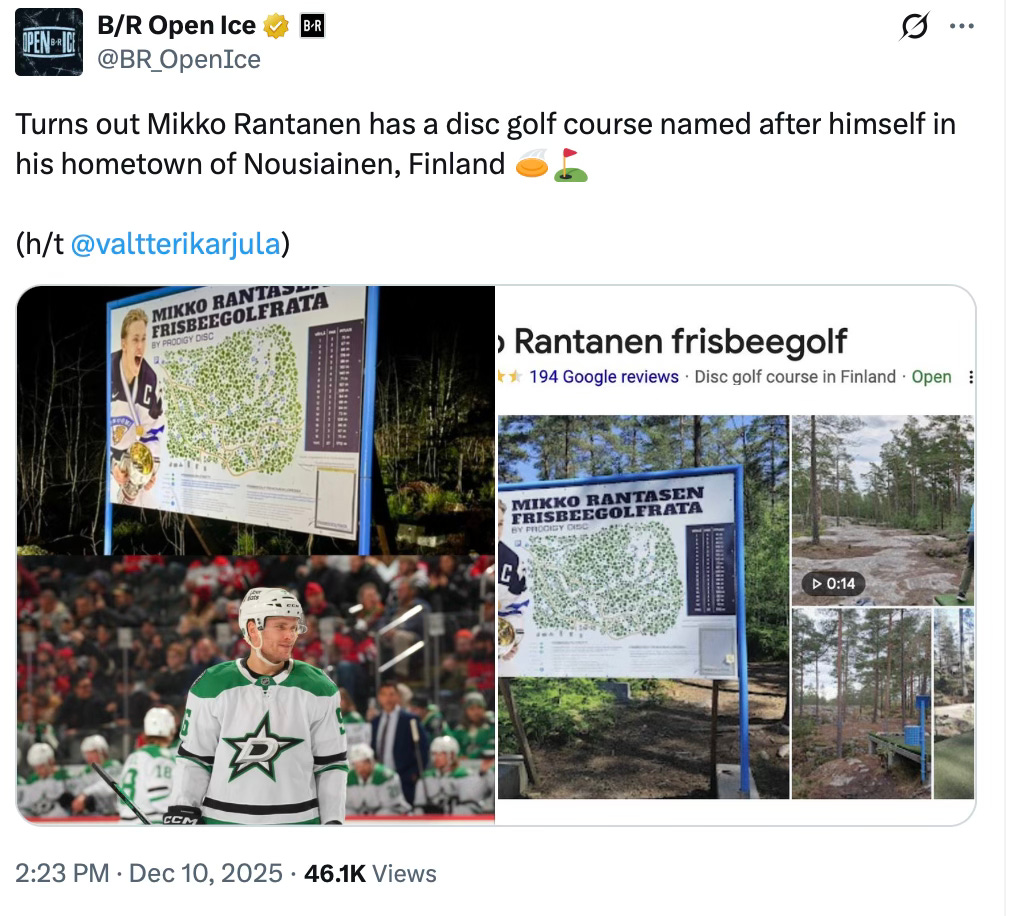
That’s fun, so I asked Rantanen about it yesterday morning when the Stars were in town.
“It’s a small town I’m from, and it was kind of cool for someone to ask to name it after me,” Rantanen said. “It’s not something I think about often, but it’s still a cool thing.”
Rantanen said he hasn’t actually played the course in more than five years, and he doesn’t really play much disc golf anymore, but it was more of a passion early in his career.
His teammate, Stars goalie Casey DeSmith, was one of the people who was alerted to Rantanen’s disc golf namesake earlier this month when he saw that same post on social media — yes NHLers have social media, they just use burners.
DeSmith used to be an avid disc golfer. In fact, he’s been classified as a professional by the Professional Disc Golf Association and has a sponsorship deal with a disc golf company that he signed in 2024.
DeSmith told me he saw that Rantanen had a disc golf course named after him and needed to learn more, and went and asked his teammate more about the course when he learned the news.
DeSmith himself said disc golf has been replaced a bit by real golf, which isn’t surprising for players in Dallas, and real golf has been one of his bonding mechanisms with his goalie partner Jake Oettinger.
It’s been pretty public that Red Wings coach Todd McLellan relies heavily on Trent Yawney, his top assistant coach.
When McLellan was hired, almost a year ago to the day, it was important to him that a job opening was also created for Yawney.
Yawney is McLellan’s personal connector, part of the human side of the coaching staff that helps connect a coach with his players. It’s something that McLellan is aware he needs and Red Wings players have told me can feel a bit necessary with the head coaches tough demeanor — if you are going to grind on your players, you need an ally that evens you out a bit.
Turns out that not only do they spend a ton of time together at the rink, but McLellan and Yawney also often carpool to work together, something the Red Wings head coach revealed during his post-game availability on Tuesday night.