
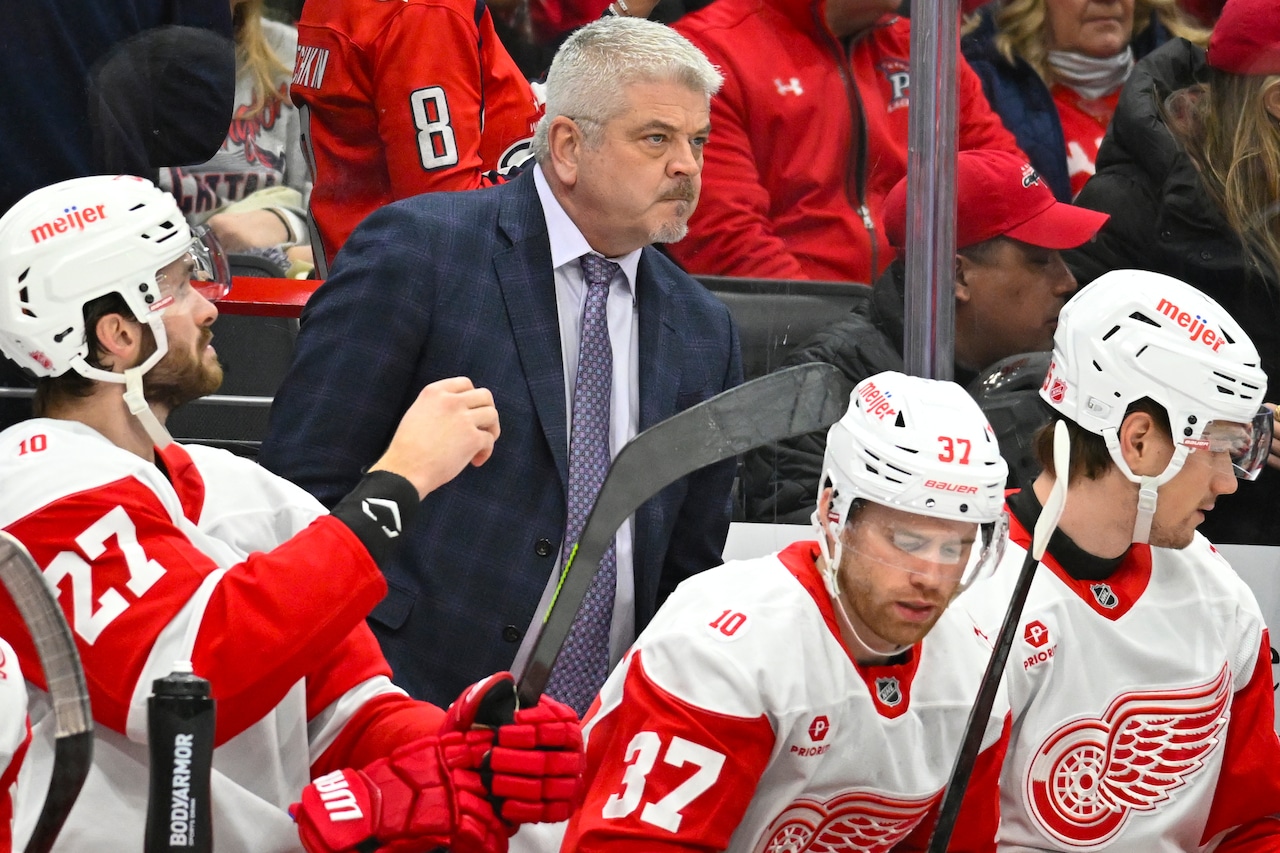
DETROIT – The Detroit Red Wings were reeling heading into the Christmas break a year ago, submerged in a sense of hopelessness following a 4-0 loss to St. Louis.
Three days later, general manager Steve Yzerman replaced coach Derek Lalonde with Todd McLellan.
The fiery McLellan brought credibility with an extensive resume of success as a head coach. He brought intensity with up-tempo, detail-oriented practices. He brought accountability by calling out players when they’re not performing up to standards. He brought belief to a franchise that has missed the playoffs nine years in a row.
“One year ago, that was probably the worst game I’ve been a part of; no energy from us,” Alex DeBrincat said. “To go one year later and see how confident we are as a group and where we’ve gone to is great. A lot more work to do but we’ve kind of found an identity.”
It was a rapid transition. McLellan met the players for the first time before the morning skate prior to the first game following the break, which they lost 5-2 to Toronto. The next day, during a long and intense first full practice with the team, McLellan famously barked “Play f—— hockey, you’ve done it your whole lives.”
They won their next seven games, the first of two seven-game winning streaks during McLellan’s first 20 games. It didn’t get them to the postseason, but it created faith in the direction of the franchise.
“That was baptism by fire,” McLellan said. “But we’ve had a year now to not necessarily learn the organization — had a pretty good feeling about the people in it and how it operated — but the most important thing is time to understand players, their games, their personalities, how they mix together, how they react to being poked or being hugged. Two extremes of coaching, sometimes both individually and as a group.
“We attacked the spirit of the team right off the bat, trying to build that back up and get some belief in each other again. And then systems and structure. I think we have improved in a lot of different areas, but I think there’s a lot of runway for not only maintenance, but improvement.”
McLellan credited “a receptive audience” of players eager to learn and improve.
“Just knowing the players, having relationships with them, what makes certain players feel good … when we hold them accountable, we don’t want to tear them down, but they have to be aware of certain situations and how we handle those moments,” he said. “Who plays well together, who doesn’t? Body language, they give us cues of either fatigue or frustration.
“We’re way further ahead now than we were in April, just spending time together. Training camp was important. It gave us time to work at structure and system. And then just building up confidence. Every time we get kicked hard, sometimes it takes a little longer to respond, but we dig ourselves out. That has to be a quality we maintain moving forward.”
McLellan has a command of the roster.
“He knows what our weaknesses are, what we need to work on, and we harp on those every day,” Ben Chiarot said. “He’s direct with the points he wants to make and what he sees and what he wants us to fix. I think that’s contributed to our success.
“He’s been around a long time and seen a lot of hockey, so we have a lot of faith in what he’s preaching.”
DeBrincat has enjoyed having McLellan as his coach and the way he operates.
“I think there’s a lot of respect for him around the room and the way he does things,” DeBrincat said “He’s a good motivator. He gets us ready. On the bench, he gives us instant feedback whether it’s something wrong or something good.”
The Red Wings have three games before the midway mark of the season. It’s a tight race with six points separating the top 12 teams in the East and much can change over the second half.
But 12 months into McLellan’s tenure, the outlook has changed drastically.