
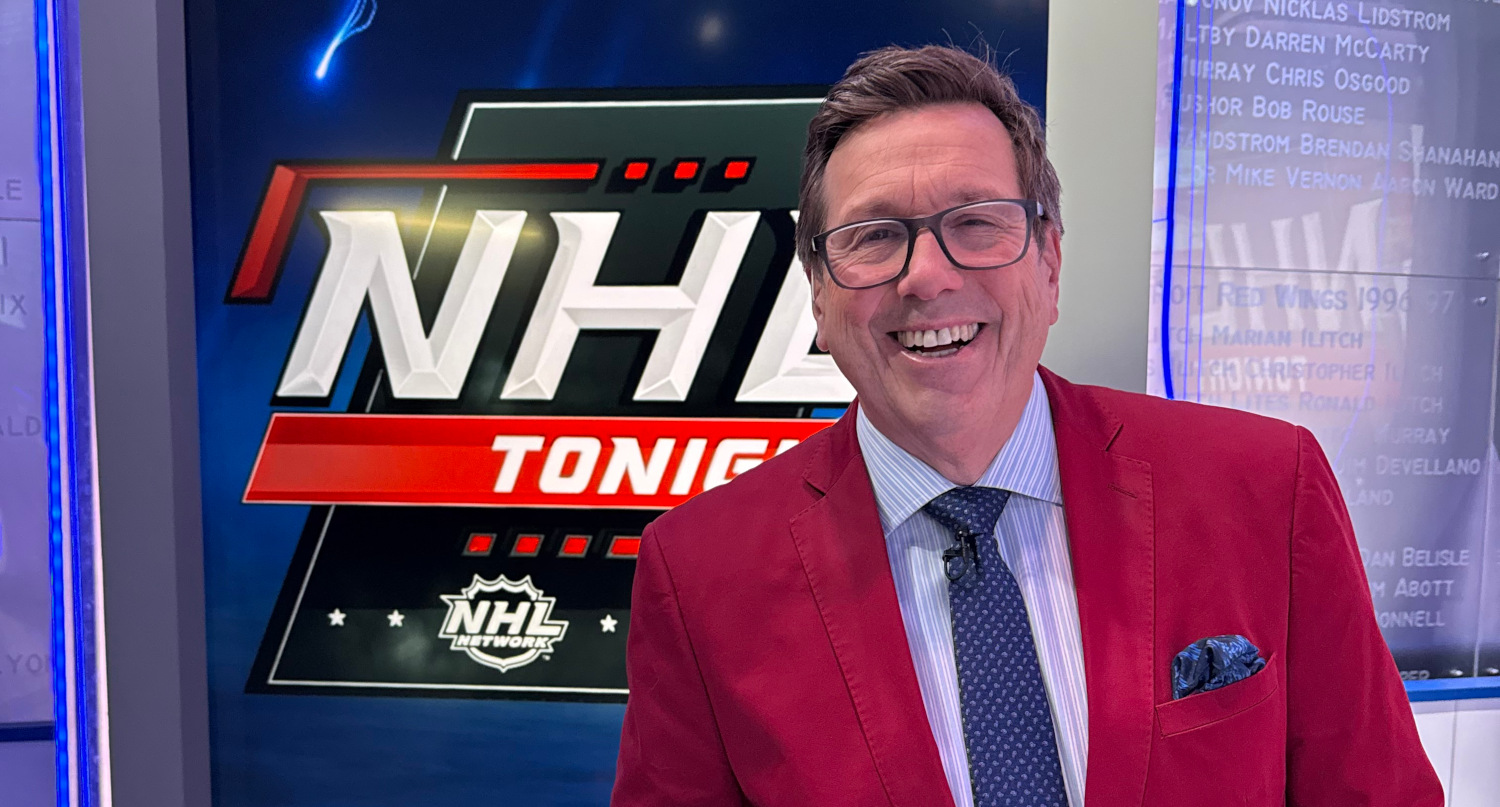
For someone who loves hockey as much as E.J. Hradek, it’s a wonderful time of the year.
The NHL Network broadcaster will work the 2026 IIHF World Junior Championship in St. Paul, Minnesota, which begins Dec. 26 with four live game telecasts on NHL Network.
Slovakia faces Sweden at 1 p.m. ET; Finland plays Denmark at 3:30 p.m.; Team USA takes on Germany at 6 p.m.; and Canada vs. Czechia at 8:30 p.m. The IIHF World Junior Championship concludes with the Gold Medal game on Jan. 5.
Hradek will provide the play-by-play for each Team USA game alongside former NHL winger Tony Granato.
We recently caught up with Hradek to discuss the tournament, which features some of hockey’s rising stars. We also asked him about the NHL and his unusual career path.
Note: This interview has been edited and condensed for length and clarity.
Awful Announcing: What should fans expect when they tune in to the World Junior Championship?
EJ Hradek: “I would say just passion, youthful exuberance. These are under-20 players, a good number of them are 19. You have some as 15 or 16. And they’re putting on the sweater of their respective country. This tournament has grown over the last couple of decades. It’s a tournament beloved in Canada and in some European and Scandinavian countries. I think in the U.S. over the last two decades in particular, it’s becoming more and more part of the holiday season for the hockey fans here.”
What is your connection to this tournament?
“One of my first real gigs professionally was with ESPN The Magazine when they launched. They were about, like, ‘What’s next?’ all the time. My scouting background had introduced me to the World Juniors and the value and the importance of the tournament. I was able to talk ESPN The Magazine into sending me to the tournament in Winnipeg, which ran from Christmastime 1998 into 1999. That was my first real trip to see it. In Winnipeg, it was a huge deal. Obviously, it’s a huge deal throughout Canada. I was in Finland in 2004 when the U.S. won its first gold medal. Over the years, I’ve had different roles throughout. And lately, I’ve been calling play-by-play, which I truly love. I love calling these games in this tournament.”
Among the draft-eligible players, who should viewers keep an eye on?
“The most high-profile player in the tournament among the draft-eligibles is Gavin McKenna from Canada. He is playing at Penn State University right now, and he’s likely to be the No.1 pick in the draft come June. The rules have changed in junior and college hockey. In years gone by, a player from the Canadian juniors, the Western Hockey League, where Gavin McKenna played, would not be eligible to play NCAA hockey. That has changed now. He’s playing at Penn State. He’s playing against older players. It’s more of a challenge. He’s trying to develop himself there.”
What about the players who have been selected in the draft? Who are you curious to see?
“For Team USA, they have Cole Hutson. His brother (Lane) is playing for the Montreal Canadiens and was the Rookie of the Year. He’s a terrific player, and Cole is cut from the same cloth. They both went to Boston University, and Cole is there now. He’s been drafted by the Washington Capitals. He’s a smaller defenseman, but very elusive, very competitive. He was a part of the team that won the gold medal last year. Team USA is trying to do something it has never done: win three consecutive gold medals at this tournament. I’ll be eager to see him. Eager to see his college teammate, Cole Eiserman. He was drafted by the Islanders.”
Switching to the NHL, what do you think of the Winter Classic matchup between the New York Rangers and Florida Panthers at loanDepot park in Miami on Jan. 2?
“The Panthers are back-to-back Stanley Cup champs. They’ve been to the final three years in a row. It was really hard to do in this era. They had the good fortune of the cap going up. And that enabled them to keep a lot of players in the offseason. This is a matchup of two teams that played in the conference final two years ago. The Rangers should be happy they’re playing on the road because they’ve been way better on the road than they’ve been at home this year. Florida is starting to round into form. They’ve had a number of injuries. They’re hoping to get Matthew Tkachuk back in the lineup for that game. They’re without their captain, Aleksander Barkov. So, that’s a negative for them. But they’re playing better.”
The @BuffaloSabres made a major move by announcing Jarmo Kekalainen as the team’s new general manager — @MichaelDelZotto and @EJHradek_NHL break it all down! 🦬
📺: Watch #NHLTNFirstShift weekdays at 4p ET on NHL Network pic.twitter.com/ypMl8A6oY7
— NHL Media (@NHLMedia) December 15, 2025
What has surprised you the most about this NHL season?
“Everything. I think it’s just so incredibly tight. With it being an Olympic year, the schedule is condensed. Guys are in and out of the lineup, and there’s not a lot of difference between the teams to begin with. There’s Colorado, which is at the very top right now. They’ve only had two regulation losses through. That’s kind of amazing to do. The three best teams in the league are all in the same division: Dallas, Minnesota, and Colorado. But then, outside of that, the league is really bunched tight.”
How else might the Olympics affect the season?
“It’s going to be a sprint to the finish. Some pretty good teams are going to miss the playoffs this year. There’s an opportunity there for a team like the Red Wings, who haven’t been in the playoffs in 9 years, and for the Buffalo Sabres, who just made a managerial change. There are going to be some good teams that are left out. There’s going to be some teams that have been out that might get in. So, we’ll see.”
You started hosting NHL Tonight: First Shift in October 2024. What has that experience been like?
“I want it to be conversational. That’s the thing I’m striving for on a day-to-day basis: to keep the show conversation, to keep it topical, to keep it as current as you can. I love that we do it, for the most part, five days a week. In that space of podcasts and hockey, there are some really big ones, but they are usually two or three times a week. They are longer. They demand more time from the listener. We’re about 48 minutes of content Monday through Friday. It’s easier for the listener. For me, I’m bouncing between different co-hosts pretty much every day. So that’s like anything else. There’s good and bad, right? The good is that we get different opinions all the time. The bad is that you don’t form that natural chemistry that you would have, as in years gone by, when I’ve done a show with Jackie Redmond or Steve Mears for long stretches.”
What was your career path to broadcasting like as you transitioned from a part-time scout with the Dallas Stars to ESPN to the NHL Network?
“It’s a crazy path. When I was at ESPN, I would help close a magazine story, write a story for a dot-com, do a radio hit, and maybe do a TV hit, all on the same day. That’s commonplace now. But in the early 2000s, it was a lot less so. So, I was among the first people to do it.
“I always wanted to do games as well, and I did some college games for ESPN back in the early 2000s. They let me do some of the college hockey games they had. They lost the NHL package, so I never really had an opportunity there. I left to come to the NHL Network in 2011 on a full-time basis.”
Did you always love hockey?
“I’ve always loved sports. I zeroed in on hockey. I became kind of a rink rat as a player, played club college hockey (at Pace University), and then got into club college hockey coaching. I moved to Dallas for a magazine job down there in the early ’90s. The Minnesota North Stars moved to Dallas, and I was in a position to make connections with management people in the Dallas Stars. They gave me an opportunity to do some scouting work, and so I did that for a couple of years in the mid to late 90s. Then I go to ESPN to help launch that magazine. I think it makes me a little bit of a unicorn. It’s something that I’m pretty proud of.”