
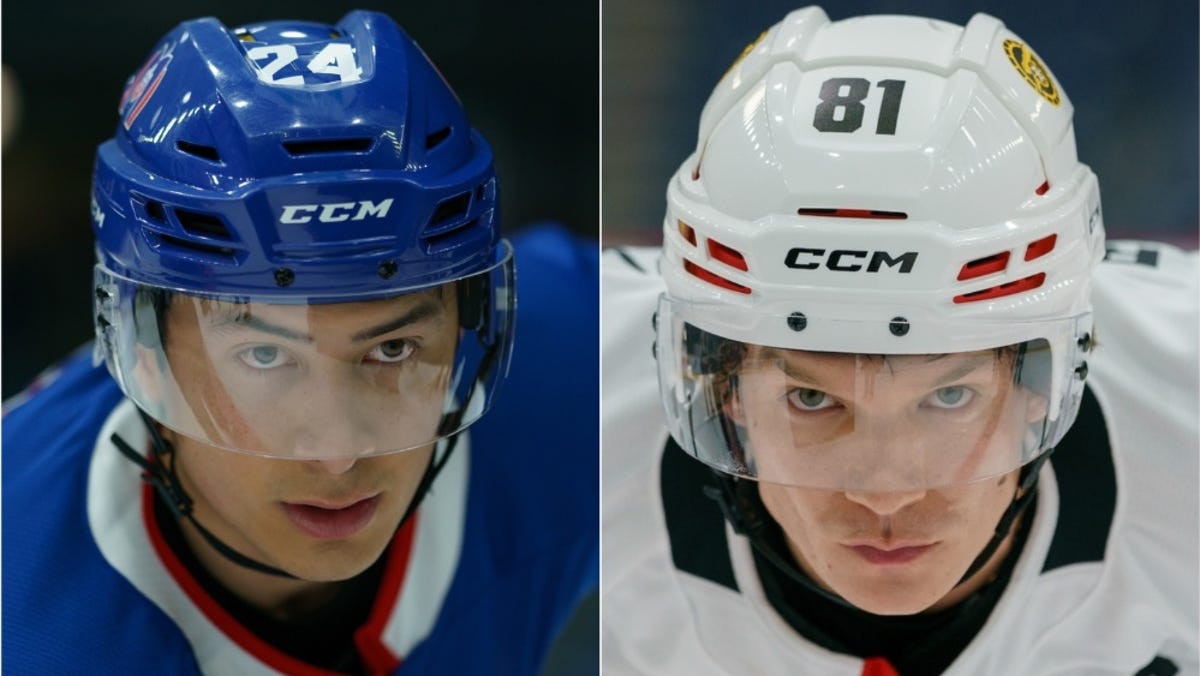
Heated Rivalry has inspired watch parties, fan edits, and a level of obsession usually reserved for playoff runs. It has also found its way into NHL buildings.
For director Jacob Tierney, that response raises a bigger question: Can a TV show from Canada — adapted from Rachel Reid’s Game Changer book series with the help of HBO — help hockey reach beyond its usual audience? Now that the finale at the cottage has aired, it seems clear the answer is yes.
Tierney suspected he had bronchitis when he spoke to USA TODAY’s For The Win and was on antibiotics, the result of a nonstop press tour promoting the show’s occasionally spicy queer hockey romance centered on the magnetic Shane Hollander and Ilya Rozanov, played by Hudson Williams and Connor Storrie.
The show has grown so big that the NHL released a statement addressing its impact and influence (via The Hollywood Reporter):
“There are so many ways to get hooked on hockey and, in the NHL’s 108-year history, this might be the most unique driver for creating new fans. See you all at the rink.”
That surge in popularity has also meant that Williams and Storrie have gone from virtually unknown to overnight stars.
“I’m just happy it’s working. I’m delighted,” Tierney told For The Win. “People seem to like it, and that’s what matters.”
Fans have gathered in sports bars to watch the show’s biggest moments as if they were Stanley Cup games — and they’ve noticed everything. That includes Easter eggs ranging from Hollander’s heartbeat matching Rozanov’s jersey number to needle drops timed perfectly to pivotal plot points.
“Honestly, people have noticed everything — things I didn’t even consciously put in,” Tierney said. “I’ve never felt so observed in my life.”
Some of those songs from the soundtrack, like “I’ll Believe in Anything” and “All the Things She Said” have massively spiked with listeners.
For The Win caught up with Tierney to discuss the viral series, its breakout stars Williams and Storrie, co-star François Arnaud, the soundtrack fueling the show’s momentum, and the NHL and Montreal Canadiens — also known as the Habs.
Fans can watch the first season of Heated Rivalry, which was recently renewed for a second season, on HBO Max.
This interview has been condensed and edited for clarity.
When did you realize you had something special with this show, especially with leads who weren’t established stars?
Tierney: I’ve been doing this a long time. I knew we had something really good, but that doesn’t always matter. There’s so much noise now — so much TV, so much content. I knew we had a good show, and once HBO picked it up, I knew we had a fighting chance to get noticed. But everything that’s happened since has been completely insane. I never could have predicted any of this.
We were never going to cast stars in these roles. That was always the idea. I think romance as a genre is often better served by lesser-known actors, because the audience can really project onto the characters rather than a pre-existing persona. With something like this, it was important that they could just be Ilya and Shane — not bring other baggage into it. The level of alchemy has been wild. We definitely didn’t anticipate anything like this.
What kind of impact do you hope this has on the hockey community?
Tierney: It’s a great question. I think you have to wait and see what these things actually do. But it’s incredibly cool that someone in the Bruins organization and someone with the Habs are clearly really into it and keep playing our songs. That’s [expletive] amazing.
I’m born and raised in Montreal — the Habs are a religion where I’m from — so every time they show our trailer playing on the Jumbotron, it’s so [expletive] cool.
I hope what the NHL said yesterday is sincere, that they really are valuing new eyes and the new air that comes with that. Hockey is a sport I love deeply, but it doesn’t always reach beyond its core fan base. I think it could use a little crack, a little oxygen getting in there.
The NHL seems to function like the Catholic Church in terms of its insularity. People say that with Habs all the time: Only the Habs do pageantry better than the Catholic Church.
There’s a stoicism to hockey, a desire for this monolithic image, and I think the sport can survive a lot more than that. I don’t imagine a culture shift but even if it’s just moving an inch to the left, I don’t think that’s a bad thing. Ultimately, the bigger the audience, the better for the sport.
Rachel Reid and I are huge hockey fans. This show is a love letter to hockey in its own way. It was never made to slight the sport — that’s just not true.
How have you elevated the source material with a soundtrack filled with so many amazing Canadian indie bands?
Tierney: I have a friend who said to me recently: “Do people know that the soundtrack is just a playlist you made in 2008?” Fair enough. These are just songs that I love that speak to me.
I’ve been a Wolf Parade fan since their first EP. With Feist, I grew up with Broken Social Scene and that whole explosion of Canadian music, which was incredibly meaningful to me. I love music, and I’m always looking for new stuff too — whether it’s Wet Leg or whatever connects with me now.
If a song moves me, and it works with the images, hopefully it moves other people too. The reaction to the music has been really rewarding. Wolf Parade actually sent me a lovely note yesterday — they were really happy. And “I’ll Believe in Anything” is an anthem and it deserves all the attention it’s getting. It’s an amazing song.
What can Heated Rivalry teach athletes and fans alike about vulnerability and intimacy?
Tierney: You’re already seeing shifts with younger players being aware of their own mental health and trying to take care of yourself. The NHL has made some good efforts, like the Player Assistance Program. There is a desire there.
A lot of traditionally masculine cultures struggle with allowing people to say things out loud. Not every bit of vulnerability has to be presented behind closed doors. You can be vulnerable and still have the mental and physical toughness required to be a professional athlete.
If anything, vulnerability is attractive. It’s not harmful, and it’s good for your mental health.
For future seasons, do you envision even more hockey on screen, especially with a potentially larger budget?
Tierney: I don’t think it changes that much. I’ve always described this as a workplace romance — hockey is their workplace. I love hockey, but I wanted to make a show where you don’t need to understand icing to follow the story. It’s about rivalry and competition, about winning and losing.
Someone tweeted that they were glad the hockey “fades to black” on Heated Rivalry, which made me laugh because that’s usually how sex is treated.
There actually is a fair amount of hockey in the show, and our hockey coordinator did a [expletive] great job. It looks good.
But this was never going to be a show where you get an episode that’s just a full game. That’s not happening. Hockey is still the beating heart of the show, though — and you’ll definitely get more of it in the second season.