
The 2026 World Juniors start on Boxing Day in St. Paul and Minneapolis, Minn.
Here’s your quick introduction to the tournament, including rundowns of all 10 teams, predictions, draft-eligibles to watch, frequently asked questions and more.
Team-by-team need to knowGroup A
United States: USA Hockey is hosting the tournament for the first time since 2018, and looking to three-peat for the first time ever. This Team USA is notably weaker than the last two that won gold, especially in net and down the middle, but they’re still a contender. Center James Hagens (Bruins) and defenseman Cole Hutson (Capitals) were two of the top players in last year’s event and are both back, and they’re surrounded by an impressive group of talented wingers.
Sweden: The Swedes have infamously won gold at the World Juniors just twice, but they always enter the tournament among the favorites, and that’s no different this year. Top 2026 prospect Ivar Stenberg, Blackhawks first-rounder Anton Frondell and Islanders first-rounder Victor Eklund should be top players at this event, and the Tre Kronor have double-digit forwards who could play on any team. Watch out for Ducks second-rounder Lucas Pettersson, too. They don’t have a star defenseman, but they’ve got a good seven there as well.
Slovakia: The Slovaks are usually carried by a couple of drafted stars, but after staples Dalibor Dvorsky and Maxim Strbak aged out, this year’s team is a younger and less talented one. Draft-eligibles Tomas Chrenko, Adam Nemec, Tobias Tomik and Adam Goljer will make them a pitstop for scouts, though.
Switzerland: The Swiss should be reasonably competitive on the back end and in net this year. They’re bringing two drafted goalies and three drafted defenseman, and their undrafted 19-year-old D (Daniil Ustinkov, Gian Meier) are solid players at this level as well. Up front, the undrafted Jamiro Reber is a good player at this level, but Lars Steiner (2026) and Jonah Neuenschwander (2027) are the names to know. Steiner is a potential top-50 pick this year.
Germany: The Germans are headlined by three forwards: Oilers prospect David Lewandowski, Capitals prospect Maxim Schafer and 16-year-old forward Max Penkin, a 2027 draft-eligible who has scored two professional goals in Germany’s top-flight DEL this season. The diminutive and speedy Dustin Willhoft is fun to watch at the junior level, too, even if he’s not an NHL prospect. The Germans could be at risk of finishing at the bottom of Group A.
Group B
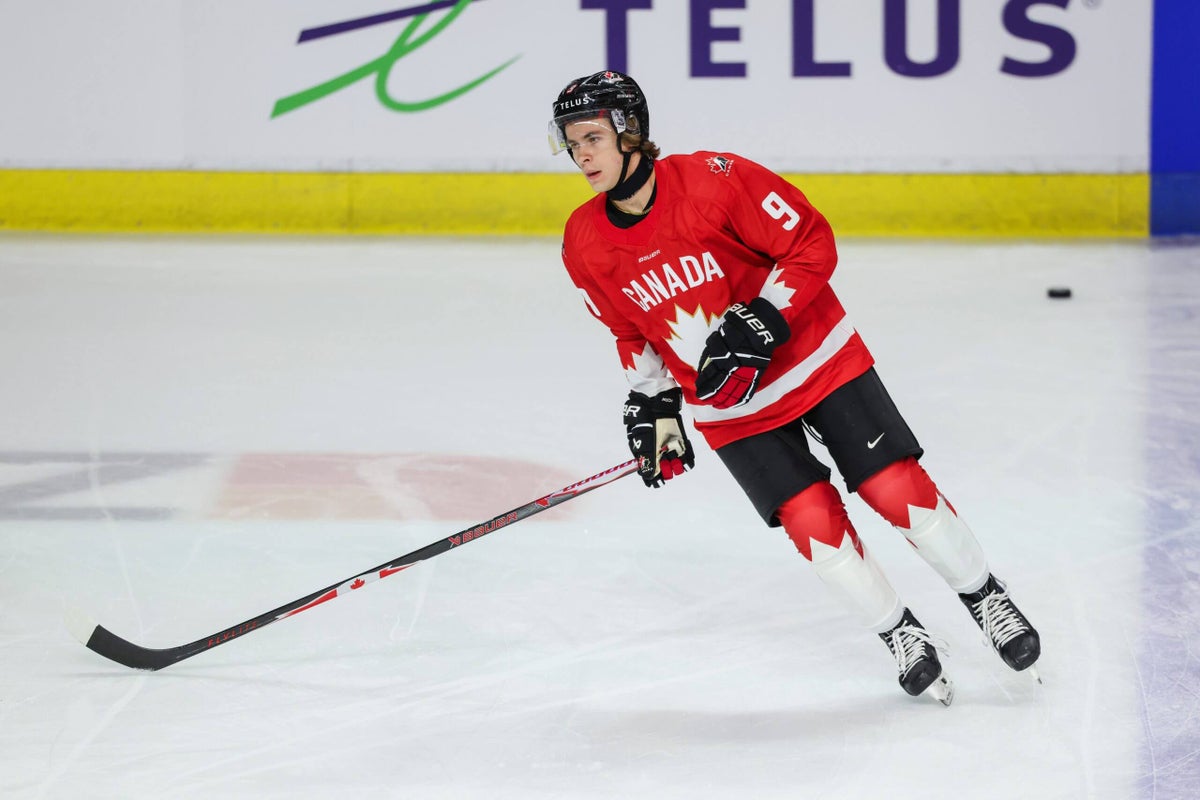
Canada: After back-to-back quarterfinal disappointments, Canada again enters this year’s tournament as the gold-medal favorite. They’ve got a roster full of first-rounders, the best goalie tandem (the Kings’ Carter George and Predators’ Jack Ivankovic) in the event for a change, multiple players on loan from the NHL, and a handful of the most potent forwards in the event (led by 2026 star Gavin McKenna and top 2025 picks Michael Misa and Porter Martone). There should be no excuses for this year’s group.
Czechia: The Czechs have played in a medal game at four straight tournaments, and have medaled in the last three (two bronze, one silver), and while they don’t have the game-breaking forward (such as Jiri Kulich or Eduard Sale) or star goalie (like Michael Hrabal) they’ve had at those events this year, they’re bringing arguably one of the best blues lines to the tournament (led by first-rounders Radim Mrtka and Adam Jiricek, and age group standouts Tomas Galvas and Jakub Fibigr, as well as a supporting cast that includes 18-year-old Mammoth prospect Max Psenicka and 2026 draft-eligible Vladimir Dravecky. Diminutive Wild forward prospect Adam Benak has been a top performer internationally as well, and their group up front also includes Blackhawks first-rounder and UMass standout Vaclav Nestrasil, as well as top 2026 prospect Adam Novotny and a good veteran group of 19-year-old returnees. Don’t be surprised if they’re back playing in a medal game.
Finland: The Finns are missing some star power, but 19-year-olds Aron Kiviharju (Wild), Emil Hemming (Stars), Aatos Koivu (Canadiens), Heikki Ruohonen (Flyers), Daniel Nieminen (Predators) and Julius Miettinen (Kraken) are very good players at this level, they’re returning Kings goalie prospect Petteri Rimpinen (who was the goalie of the tournament last year), and they’ve got draft intrigue with projected 2026 first-rounders Oliver Suvanto (a big, strong center) and Juho Piiparinen (a well-rounded right-shot D). The Finns have a way of exceeding expectations, so don’t count them out.
Latvia: Last year’s Cinderella story after an upset over the Canadians and a near one over the Swedes in the quarters, the Latvians will be looking to make more history again this year in their pursuit of three straight quarterfinal appearances for the first time ever at the event. They should get there, too. They were the youngest team in last year’s tournament and are returning standouts Olivers Murnieks (2026) and Bruno Osmanis, as well as a still-young group that will attract scouts: Alberts Smits (a potential top-10 pick in 2026), Rudolfs Berzkalns (2026) and towering 2027 prospect Roberts Naudins. They’re always a fun, plucky watch.
Denmark: After earning promotion from Division 1A, the Danes will be up against it to stay in the top flight. Panthers fourth-rounder Mads Kongsbak Klyvø is their only drafted prospect, and they don’t have any high-end draft-eligibles.
2026 NHL Draft prospects to watch
The old saying goes that this is a 19-year-old’s tournament. And it’s true. The odd super high-end draft-eligible will make Team Canada or Team USA, and there are usually a few draft eligibles on most of the European teams, but the bulk of the top 10 in any given draft class is typically at home during the World Juniors. This year, that’s not the case.
If Canada and Sweden play (as they did twice in pre-tournament), there’s a chance the top three picks in the draft are all in that game, and certainly three of the top five. Gavin McKenna’s place at No. 1 will either continue to slip out of his grasp or be tightened again. And challengers Keaton Verhoeff and Ivar Stenberg have a chance to continue to test that.
This is one of the best tournaments in years for amateur scouts, frankly — the best since Russia’s exclusion, for me. Canada, which also named potential top 5-6 pick Carson Carels to the roster, is bringing three draft eligibles, which is actually a bit of history. With the big three, Carels, Smits for Latvia, Novotny for Czechia, Suvanto for Finland and Chase Reid for the USA, the bulk of the top of the draft will be on display at this year’s tournament. Swedes Viggo Bjorck and William Hakansson, plus Finn Piiparinen, are three more first-rounders, too. Plus more second-round types such as Steiner, Chrenko and Dravecky. No shortage if you’re a draft junkie!
Frequently asked questions
Which top prospects and NHL players are missing?
Canada is always without an NHL player or two, and this year that number has ballooned to a handful: Macklin Celebrini (Sharks), Matthew Schaefer (Islanders), Beckett Sennecke (Ducks), Ben Kindel (Penguins), Berkly Catton (Kraken) and Sam Dickinson (Sharks).
The Finns are the only other team in the tournament missing an age-eligible player after Sabres first-rounder Konsta Helenius wasn’t loaned for what would have been his third World Juniors. Helenius is a near point-per-game player with Rochester in the AHL at the moment.
What would Team Russia have looked like?
The Russians would have been a formidable opponent in this year’s event. Goalies Mikhail Yegorov (Devils), Pyotr Andreyanov (Blue Jackets) and Semyon Frolov (Hurricanes) could have given them the best trio in the event, and they would have been supported by a team led by Flames prospect Matvei Gridin (who has already scored in the NHL), Devils top-10 pick Anton Silayev, KHL standouts Yegor Surin (Predators) and Alexander Zharovsky (Canadiens) and second-rounders Daniil Prokhorov (Islanders) and Ivan Ryabkin (Hurricanes).
Where is next year’s tournament?
The hosts for the next three World Juniors have already been announced. They are:
2027: Edmonton and Red Deer (Canada)
2028: Tampere and Turku (Finland)
2029: Quebec City and Trois-Rivières (Canada)
Tournament schedule
Dec. 26
Sweden vs. Slovakia, Grand Casino Arena, 1 p.m. ET
Denmark vs. Finland, 3M Arena, 3:30 p.m. ET
Germany vs. United States, Grand Casino Arena, 6 p.m. ET
Canada vs. Czechia, 3M Arena, 8:30 p.m. ET
Dec. 27
Slovakia vs. Germany, Grand Casino Arena, 2 p.m. ET
Latvia vs. Canada, 3M Arena, 4:30 p.m. ET
USA vs. Switzerland, Grand Casino Arena, 6 p.m. ET
Denmark vs. Czechia, 3M Arena, 8:30 p.m. ET
Dec. 28
Sweden vs. Switzerland, Grand Casino Arena, 2 p.m. ET
Finland vs. Latvia, 3M Arena, 4:30 p.m. ET
Dec. 29
Germany vs. Sweden, Grand Casino Arena, 1 p.m. ET
Finland vs. Czechia, 3M Arena, 3:30 p.m. ET
Slovakia vs. USA, Grand Casino Arena, 6 p.m. ET
Canada vs. Denmark, 3M Arena, 8:30 p.m. ET
Dec. 30
Switzerland vs. Germany, Grand Casino Arena, 2 p.m. ET
Latvia vs. Denmark, 3M Arena, 4:30 p.m. ET
Dec. 31
Switzerland vs. Slovakia, Grand Casino Arena, 1 p.m. ET
Czechia vs. Latvia, 3M Arena, 3:30 p.m. ET
USA vs. Sweden, Grand Casino Arena, 6 p.m. ET
Canada vs. Finland, 3M Arena, 8:30 p.m. ET
Jan. 2
Relegation game, 3M Arena, 12:30 p.m. ET
Quarterfinal 1, Grand Casino Arena, 2 p.m. ET
Quarterfinal 2, 3M Arena, 4:30 p.m. ET
Quarterfinal 3, Grand Casino Arena, 6 p.m. ET
Quarterfinal 4, 3M Arena, 8:30 p.m. ET
Jan. 4
Semifinal 1, Grand Casino Arena, 4:30 p.m. ET
Semifinal 2, Grand Casino Arena, 8:30 p.m. ET
Jan. 5
Bronze medal game, Grand Casino Arena, 4:30 p.m. ET
Gold medal game, Grand Casino Arena, 8:30 p.m. ET
Predictions
For fun, here’s how I see things playing out. I think the Sweden-USA New Year’s Eve game is the biggest of the tournament, because it likely decides the top seed in Group A, and I think it’s about a coin toss. I leaned Sweden, because I think they have fewer holes, though on top-end talent, USA might have the slight edge.
Group A
1. Sweden
2. USA
3. Slovakia
4. Switzerland
5. Germany
Group B
1. Canada
2. Czechia
3. Finland
4. Latvia
5. Denmark
Quarterfinals
1A Sweden def. 4A. Latvia
2A USA def. 3B Finland
1B Canada def. 4A Switzerland
2B Czechia def. 3A Slovakia
Semifinals
Canada (1) def. Czechia (4)
Sweden (2) def. USA (3)
Bronze medal game
USA def. Czechia
Gold medal game
Canada def. Sweden
Tournament MVP: Gavin McKenna (Canada)
Top F: Gavin McKenna (Canada)
Top D: Cole Hutson (USA)
Top G: Carter George (Canada)