
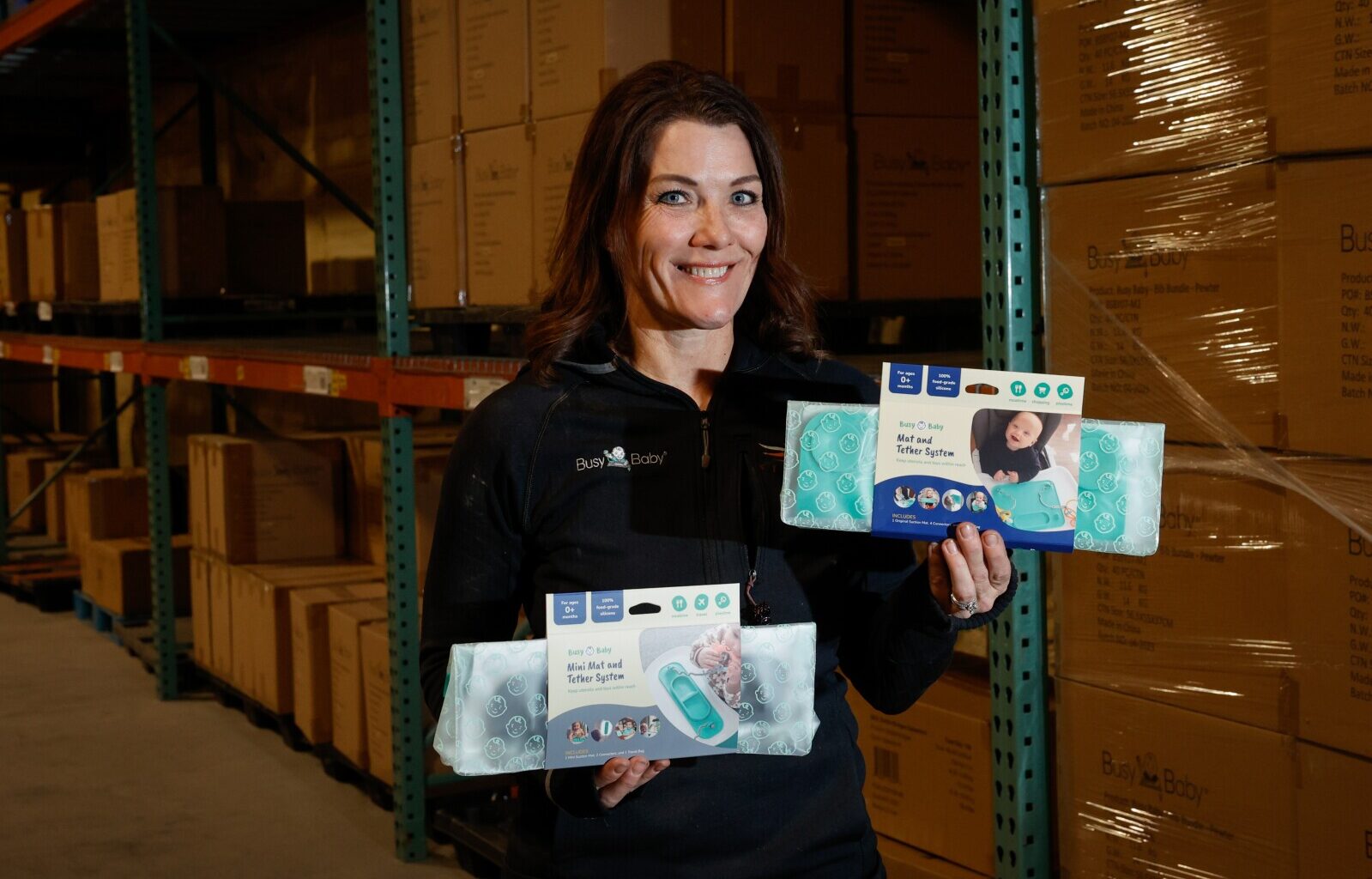
ZUMBROTA, Minn. — Looking back at 2025 is like remembering a wild ride on a tariff-powered roller coaster for Beth Benike, the founder and CEO of Busy Baby.
While her company is still operating today at the end of the year, she describes it as “hanging on by a thread.” That is very different from the high point at the start of the year.
Benike and her 8-year-old company were soaring in early spring. In March, Busy Baby products appeared on shelves at Target. As a U.S. Army veteran, she received a national award for entrepreneurial work. The U.S. Small Business Administration had also named Busy Baby as the Minnesota Business of the Year.
Busy Baby makes baby-related products, including a patented signature product, the Busy Baby Mat. The soft silicone placemat features suction cups to stay in place with stretchy tethers to attach baby toys.
Benike, who created the prototype in her kitchen in Oronoco, Minnesota, was enthusiastically looking forward to the future from her warehouse/distribution center in Zumbrota.
Then came April and President Donald Trump’s new international economic strategy, which focused, in part, on China, where her products are manufactured. A full order was awaiting shipment there.
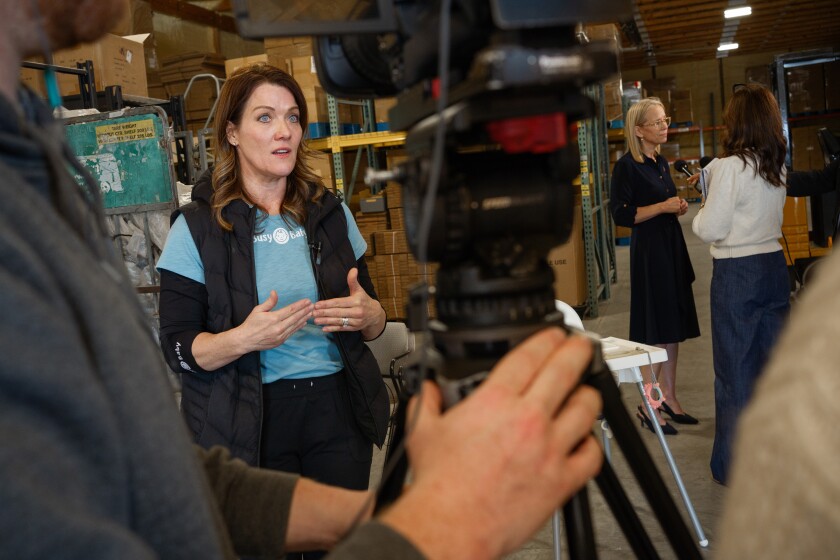
Beth Benike, co-owner of Busy Baby, and Democratic U.S. Rep. Kelly Morrison, from Minnesota’s Third Congressional District, do interviews following an event to discuss the impact recent tariffs have had on Benike’s business Monday, April 21, 2025, at the Busy Baby warehouse in Zumbrota.
Joe Ahlquist / Post Bulletin
“April 7 was the day that tariffs went up to 145% and my world came crashing down,” she remembers.
Benike posted an emotional video online about the “devastating” impact of the tariffs on her business and how she was worried that she might lose her home if she couldn’t earn the expected revenue to cover a loan.
That video unexpectedly made Benike into the face of U.S. small businesses that were struggling in the wake of the tariffs. There was simply next to no manufacturing infrastructure in the U.S. for Busy Baby and thousands of similar operations. When there were manufacturers, it was not cost effective to create the small batches that businesses like Busy Baby could afford.
“My ‘cry baby’ video went viral, and I ended up being on The New York Times Daily podcast. Gavin Newsom had me on his podcast. Stacey Abrams had me on her podcast. I was featured by the AP, Newsweek, Bloomberg, BBC, CNN and China news stations. … Looking back at my calendar, I made a media appearance almost every day in April,” she said.
An academic paper about how tariffs impacted Busy Baby is now a part of the curriculum at Harvard Business School.
“I suddenly had to learn a lot about politics and government. The last eight years, I’ve really spent with my nose down, taking care of either my business or my kids. I didn’t watch TV. I didn’t watch the news,” Benike said. “I had to explain what was happening with tariffs to the best of my knowledge. It turns out that resonated with America, because most people don’t understand tariffs.”
Meanwhile, her supply of products ran low as the delivery of her latest shipment from China was delayed, and she struggled to scrape up the $35,000 tariff fee from when the tariffs dropped to 70%. The shipment arrived two months later than originally planned.
Her brother, who was her business partner, left the company in September because Busy Baby could no longer support him. Beth Benike cashed in her retirement savings and did not pay herself as a Busy Baby employee for most of the year.
To keep the company alive, she partnered with two sisters in South Korea to sell her products shipped directly from China. Then she connected with a husband and wife team in the Czech Republic to sell there as well as in Slovakia and Hungary. Other deals with small entrepreneurs opened doors in the United Kingdom and Australia.
However, that still didn’t bring Busy Baby back up to its pre-tariff levels.
“The Black Friday cyber weekend, usually some of the best days of the year, had about 50% less sales than usual,” she said.
Benike attributed some of that to the current economy and the rest to the two months when Busy Baby was not out of stock and not actively marketing. She believes that the company is still trying to get the “marketing flywheel” momentum back.
After working with her local bank, she is no longer worried about losing her home as she was in April. However, businesses that were renting commercial space from her have left. That means the struggle today is to keep her warehouse/distribution center in Zumbrota.
Times are still tough, but Benike’s business mentor believes that she still has the core of what is needed to be successful.
“I asked him if this was a bad relationship? I should just let it go with all the debt and all the struggles. Am I hanging on too tight here?” she said. “And said, ‘No, you just need a tank of gas. You’re driving a Ferrari. You’ve got a great product with great reviews. You’re expanding internationally. You can’t give up on this yet.’ And I just can’t. … It would be devastating to just turn off the lights.”