
Truth be told, Jay Harrison wasn’t exactly sure where his post-playing days were going to take him.
The former Winnipeg Jets defenceman, however, didn’t wait until retirement to find out.
Harrison, who spent parts of 15 seasons playing professional hockey before hanging up the blades, was curious by nature and had plenty of interests outside of sports.
His decision to pursue other things while still an active player didn’t split his focus, it enhanced it.
“I found a passion for education, even in junior. I liked being a student and took well to it,” Dr. Harrison explained during a recent telephone conversation from North Carolina.
“After establishing myself in a year or two in the American Hockey League, I decided to start to chip away and then lean in and get excited about things I was learning beyond the game.
“Obviously not taking my mind off the game, where my focus was to become the best player that I could be, but the secret that I found was that the academic side of things was contributing to that.”

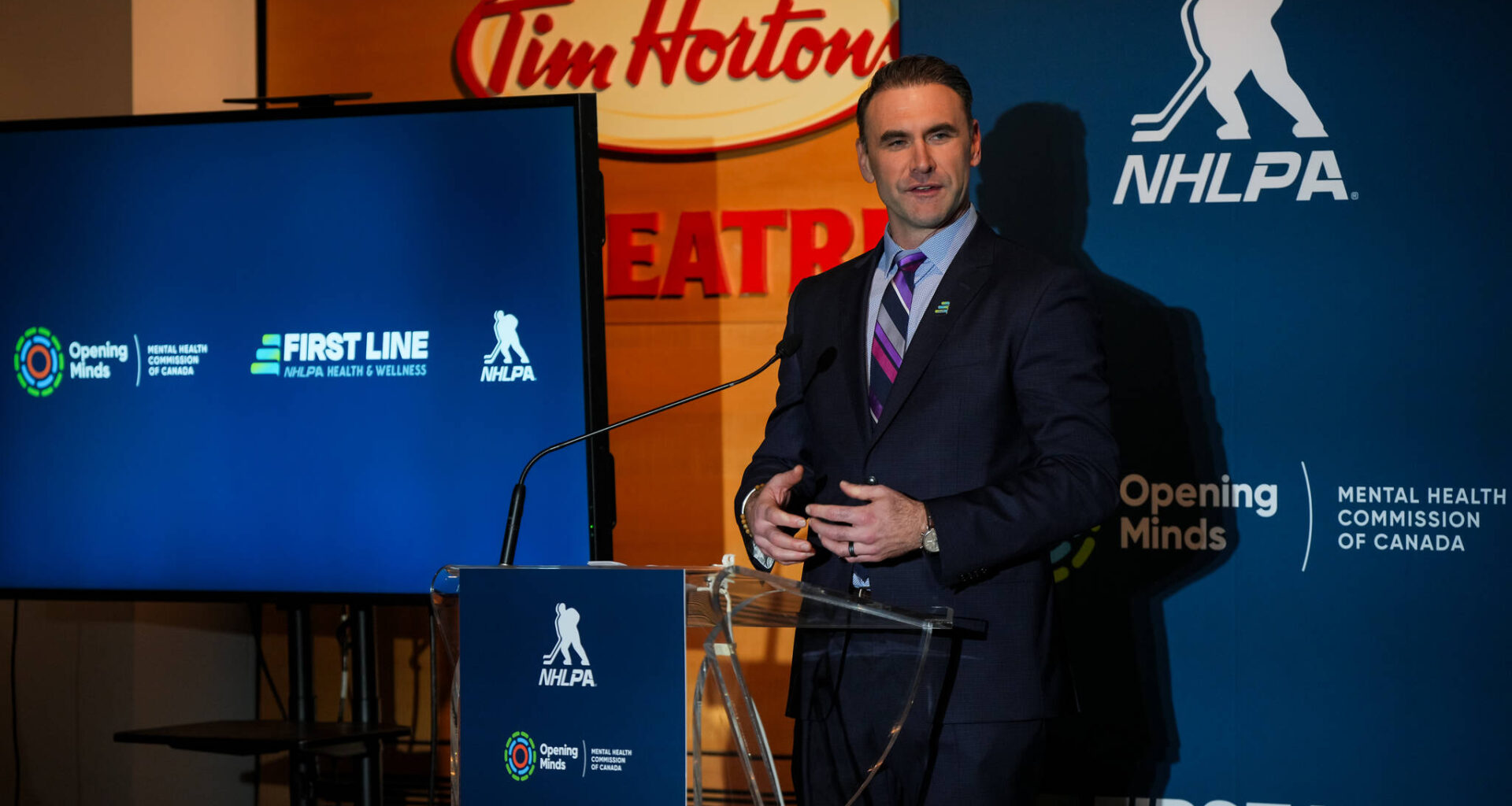
Chris Tanouye / NHLPA
Jay Harrison speaks at the First Line NHLPA Health and Wellness Press Conference in 2024.
It wasn’t always easy for Harrison to balance his studies while fighting tooth and nail to stay in the NHL, where he spent just over half of his professional hockey career, including 35 games with the Jets during the 2014-15 season.
Harrison was always a thoughtful interview subject, someone who brought insight to whatever question he was asked, so it makes sense he was interested in the field of psychology.
“The idea of finding new areas to contribute, to learn, to establish competence and autonomy in different areas of my life, it allowed me to handle the game much better,” said Harrison. “To navigate my athletic identity and the realities and difficulties of being a professional athlete and a father and a husband all at the same time.
“We have this gain paradox, the idea of protecting what you are going to lose ends up strengthening what you thought you were losing.”
“We have this gain paradox, the idea of protecting what you are going to lose ends up strengthening what you thought you were losing.”
During his time with the Jets and the Manitoba Moose the following season, Harrison was working on his master’s degree in clinical health counselling, which he completed in 2019.
“It’s a long walk if you want to be in psychology, that’s just the nature of the field,” said Harrison. “Luckily, in hockey, I learned to enjoy the pain. I was well-suited for that walk. I loved the pursuit, the knowledge acquisition in psychology. It fits with my brain and my life experience. I like models, I like theory, I like asking why and I like talking to people.
“So when you put all of those things together, it’s a pretty good field for someone like me. I was chipping away at all of that stuff with Winnipeg as well.”

Ann Heisenfelt / The Associated Press files
Jay Harrison patrolled the blue line for 35 games as a member of the Winnipeg Jets during the 2014-15 NHL season.
Some of Harrison’s experiences in further understanding the human condition included working in the PTSD clinic at Ontario Shores, working in a forensics clinic and working in the borderline personality clinic.
Later, he pursued a research degree and doctorate in performance psychology, which he completed in 2023.
The concept of his PhD was simple: how can you prove that taking your eye off the ball on occasion can actually help you see it better?
“I was able to show that this phenomenon is actually real,” said Harrison. “It’s not just me, it happens in a lot of professional athletes in North America — and it’s an amazing, untapped resource for a lot of players, to enhance their well-being and ultimately, their performance.
“The path was always being walked, so that’s led to a place here, where I’ve been able to establish my own business and practice and consulting, where I take the unique experiences from both of these worlds and bring them together in a way of how athletes and people in general can live their best lives through what they do at a high-performance level and not have to sacrifice their best selves to do what they do or to a high performer.”
“It’s an amazing, untapped resource for a lot of players, to enhance their well-being and ultimately, their performance.”
Along with his work in consulting and counselling, Harrison is also working with the National Hockey League Players’ Association as a consulting psychologist and one of the projects he’s overseeing is a health and wellness program called First Line, which was developed by the Mental Health Commission of Canada, Opening Minds and the NHLPA’s Health and Wellness Team.
It’s a voluntary program for members of the NHLPA and it’s bringing awareness and important dialogue into NHL locker rooms around the subject of mental health.
Efforts to destigmatize the topic of mental health have been underway for quite some time, but tangible progress is being made as the focus shifts to self care instead of the barriers related to the potential opportunity cost that can be created in a high-pressure environment.
“As we shift the perception and context of what it means to experience mental-health challenges, it’s not a static thing, where either you have a mental-health condition or you don’t,” said Harrison. “We are all moving in the state of our mental health, therefore, accessing resources and utilizing resources along that journey is the pursuit of optimal functioning.
“So, when you can shift that, you don’t have to admit that you’re broken, you don’t have to admit there’s a deficit to receive mental-health support. But rather, it’s seen as an opportunity and a way that you can maximize and optimize your potential performance and well-being, with all of those things working holistically to be the best version on and off the ice.
“You don’t have to admit that you’re broken, you don’t have to admit there’s a deficit to receive mental-health support. But rather, it’s seen as an opportunity.”
“We are seeing that freedom to think differently, to overcome. We all come with different ways that we think about an experience. This is just a great opportunity to provide some education and to provide some skills as well, for players to have more confidence talking around mental health.”
Harrison explains the First Line program isn’t only for individuals with an interest in higher education.
“This isn’t about becoming a psychologist and you don’t have to have a mental-health problem to be a part of it, you simply have to be curious and interested and would like to learn more skills that may help you support yourself or important people in your life, at the rink or at home,” said Harrison.
“No one has to do it, but players are choosing to do it, because it’s important. We’ve all been touched by mental-health challenges, whether it’s in ourselves or in our immediate families or a little bit distant.”

Trevor Hagan / THE CANADIAN PRESS files
Captain Adam Lowry (right) is one of nine Winnipeg Jets to complete the First Line program developed by former teammate Jay Harrison (left).
Nine members of the Jets, including captain Adam Lowry, have completed the First Line program and have seen some of the benefits first-hand.
“Just to help recognize some of the signs. Not necessarily being able to treat these people, but being able to recognize if they need help, if they need someone to talk to, where you can point them to,” said Lowry, who was a teammate of Harrison’s with the Jets.
“If something tough is going on or they’re dealing with something, that they have a safe space at the rink where they have different people they can talk to.”
“These different avenues that they can go, so that no one has to feel like they’re struggling alone. Learning how to develop those relationships with your teammates, where it’s not just surface-level stuff and they feel comfortable opening up. So that if something tough is going on or they’re dealing with something, that they have a safe space at the rink where they have different people they can talk to, they have these things so they don’t have to turn to other things, to self medicate or numb the pain.
“It doesn’t become one of those slippery slopes, where it’s really hard to get people out of these deep holes, where they think they can keep pushing alone for so long. But the sooner you’re able to reach out, the sooner you’re able to talk about it. There are so many different ways that you can not only help them, but help yourself.”
Lowry isn’t the least bit surprised to see Harrison thriving in his post-hockey career.
“I remember that we used to joke that he was the most interesting teammate that we’ve ever played with,” said Lowry. “He would be doing classes on the plane. I think he had four daughters under four at the time and he was still finding time to carve out the studying.
“He always seemed like such a wise, smart, passionate guy. Not just about hockey, but about life and everything. To see how it’s progressed for him, it’s been really cool to see that next stage of his career flourish.”
winnipegfreepress.com/kenwiebe

Ken Wiebe is a sports reporter for the Free Press, with an emphasis on the Winnipeg Jets. He has covered hockey and provided analysis in this market since 2000 for the Winnipeg Sun, The Athletic, Sportsnet.ca and TSN. Ken was a summer intern at the Free Press in 1999 and returned to the Free Press in a full-time capacity in September of 2023. Read more about Ken.
Every piece of reporting Ken produces is reviewed by an editing team before it is posted online or published in print — part of the Free Press‘s tradition, since 1872, of producing reliable independent journalism. Read more about Free Press’s history and mandate, and learn how our newsroom operates.
Our newsroom depends on a growing audience of readers to power our journalism. If you are not a paid reader, please consider becoming a subscriber.
Our newsroom depends on its audience of readers to power our journalism. Thank you for your support.