
CRANBERRY — It was a very simple question posed to multiple Pittsburgh Penguins players and coach Dan Muse, but one with a few different answers.
What do the Penguins need to do to get back to the successful form of their first 25 games that had them near the top of the Eastern Conference? Or asked another way, what do they need to change to purge the malodorous gusts of the last 10 games?
A couple of players softpeddled the answer, but we were not fishing for cliches.
“I think we’ve got to put our foot on the gas right away,” Ryan Shea said. “Usually at the beginning of the year, you run into slow stretches, and you’re always in your head, like, ‘there’s plenty of year left to go.’ But now, once it hits Christmas, it’s really when everything is kind of in full speed. Teams are gaining in the standings, and you just can’t be one of those teams that starts to fall behind.”
True, but what needs to change?
Clearly, something took a left turn with the Penguins game over the last few weeks. The nearly month-long absences of Evgeni Malkin and Blake Lizotte did not create scores of breakaways and odd-man rushes against. Those injuries didn’t buckle the details of the Penguins’ game so badly in the final minutes that pulling the goalie and scoring against them was as automatic as beating them in overtime.
So, what was it?
With a little prodding, we got some answers that were also backed up by Muse when we posed the same question to him.
Now we start getting into it.
“I think the biggest thing, at least for me, and what I see, is I think we started playing way too slow. The neutral zone, even just breakouts. I think we were just slowing things down for, like, even the D–I just think that we were kind of using our partner a little bit too much instead of going using the quickest option,” Shea explained. “I think that just leads to–you see how teams have in the past clogged up the neutral zone on us–and I think that all stems because we’re disconnected, because we’re playing too slow, breaking pucks out.”
It would seem opponents knew the Penguins were struggling a bit with being connected and playing faster, so they made a point to take away the middle of the ice. In other words, opponents adjusted to the Penguins’ new style.
Now it’s time for them to clean up the sloppiness and get on teams before those teams take away the middle of the ice. Playing faster prevents teams from settling in.
“That’s why you see when we are playing fast and above teams, we’re really locking down the neutral zone,” concluded Shea. “I think when you’ve seen our best games this season, I think we did that. A lot of them, like Toronto, their big guys couldn’t even get through it.”
Shea’s explanations were so helpful, I thought you might like to hear the full conversation:
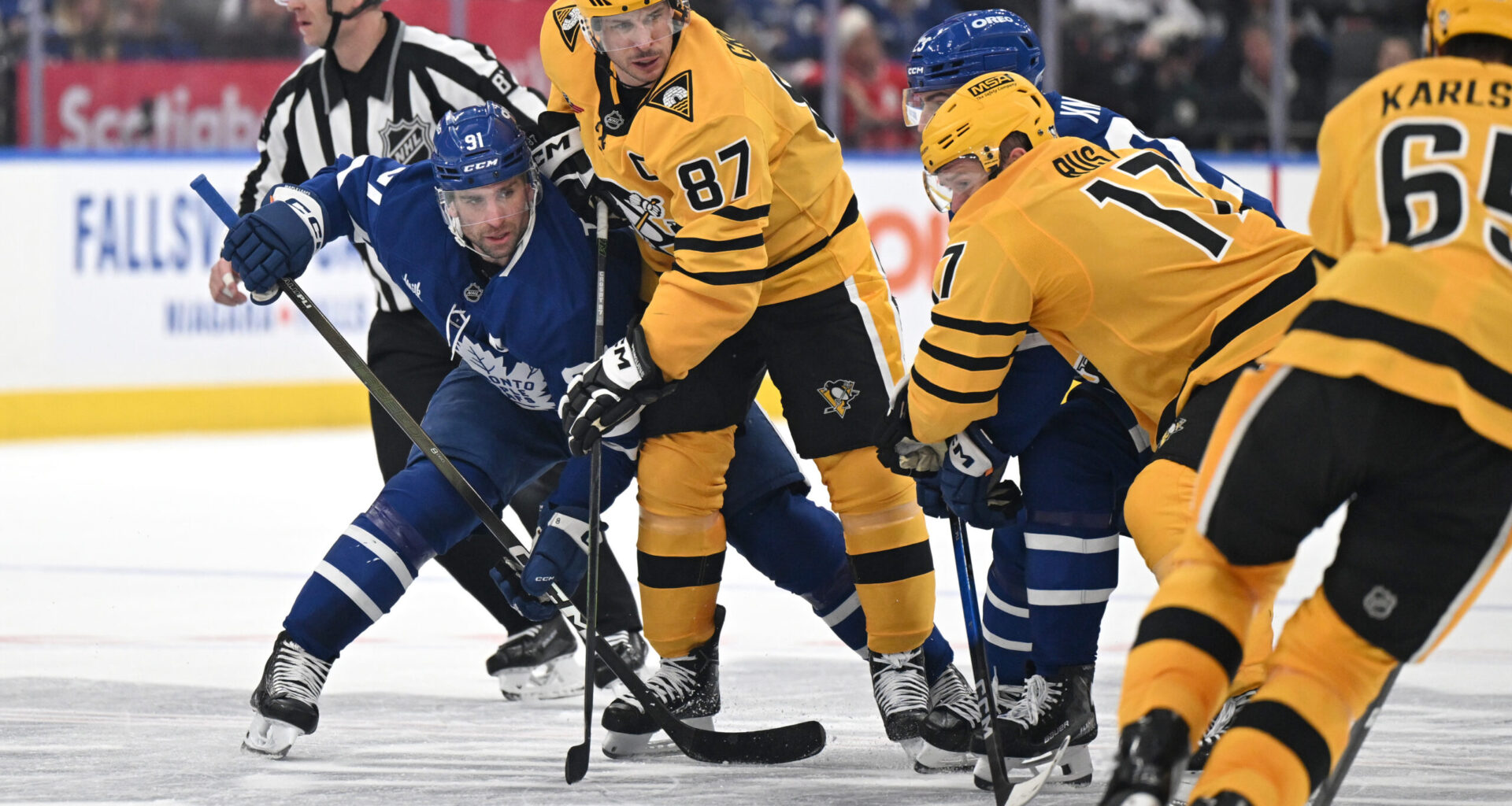
Of course, Toronto’s top players may have struggled, and Auston Matthews was an afterthought, but William Nylander had a pair of goals. He could have had more because of the Penguins’ extraordinary carelessness with the puck.
“The (scoring chances) we’re giving up right now are too loud, you know? Multiple breakaways against. We can control that. The odd man rushes. That’s something that we can control, and we can do a better job of (preventing),” said Muse. “And then when it is time to defend within our structure, I think making sure that we’re doing it with some detail–so that can be cleaned up, (too). And so I think that’s the starting point.
I think, if you go back over this little stretch, I think we played a faster game in the past, too–just in our transition and the way we break out and we move up ice, and we got away from that, especially in the last couple. So I think that’s an area that we can improve as well.”
The reasons for the slower game are probably as much a matter of conjecture as analysis. The short reality is that things began to break down, and one illness begot more.
“You know, (we were) rolling four lines. It didn’t matter who was up against who [sic], we all had the same thing in mind and the same job,” Noel Acciari said. “Just be a heavy, hard team. Make teams not want to play us. And I hope we get back to that, just north, south. The goals were coming at that, and (we played) defense first.”
The next few games will be perfect tests against zippier teams, but not necessarily hard teams: Chicago and a pair against Detroit.
Now that teams know what to expect, it is game on, and the Penguins are the ones who need to adjust now.
Tags: Penguins Analysis Penguins Locker Room Pittsburgh Penguins
Categorized: Penguins Locker Room