
CHICAGO — The Pittsburgh Penguins are a little better off Monday than they were a week ago.
Not only did the Penguins shed the worry and angst of a deep skid by beating up on the shorthanded Chicago Blackhawks 7-3, but coach Dan Muse has clearly found something that makes the team, especially the defense corps, better.
The third pairing of Ryan Shea and Jack St. Ivany has been a bright spot for several games running, but Sunday, they each had career nights as Shea registered three assists and St. Ivany two.
Before the outburst, Pittsburgh Hockey Now asked Muse after Sunday’s morning skate about the duo. No, it’s not the points that really matter. It’s about the ability to finally have a physical shutdown pairing.
“I think something that has really stood out in games–and when you go back and watch it–I think they’ve both done a really good job just on the defensive side; their positional play, the box outs, down low,” Muse said Sunday morning. “I think as a pair, they’ve gotten a number of stops in the defensive zone, and gotten them early, and so that leads to just being hard to play against.”
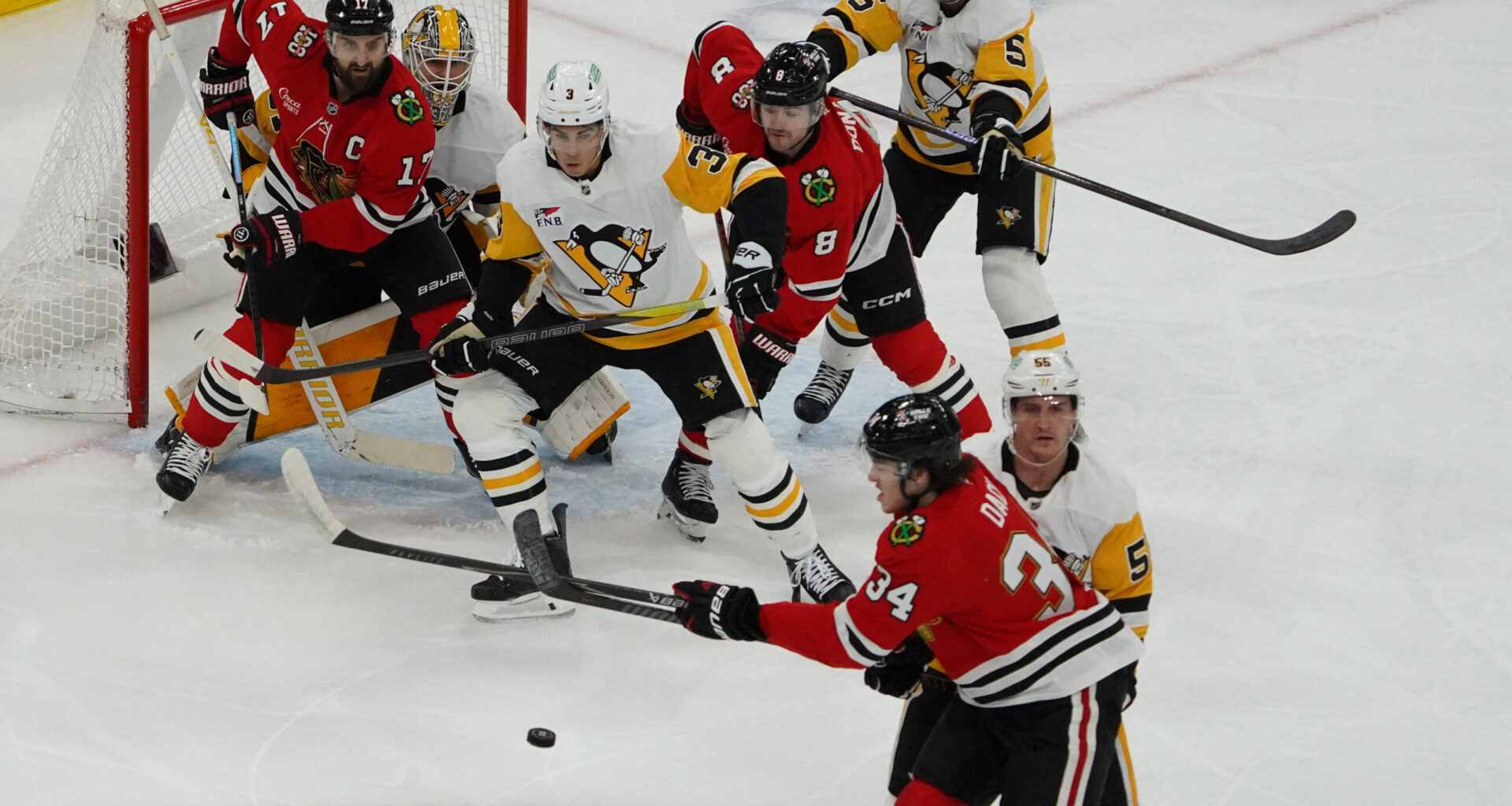
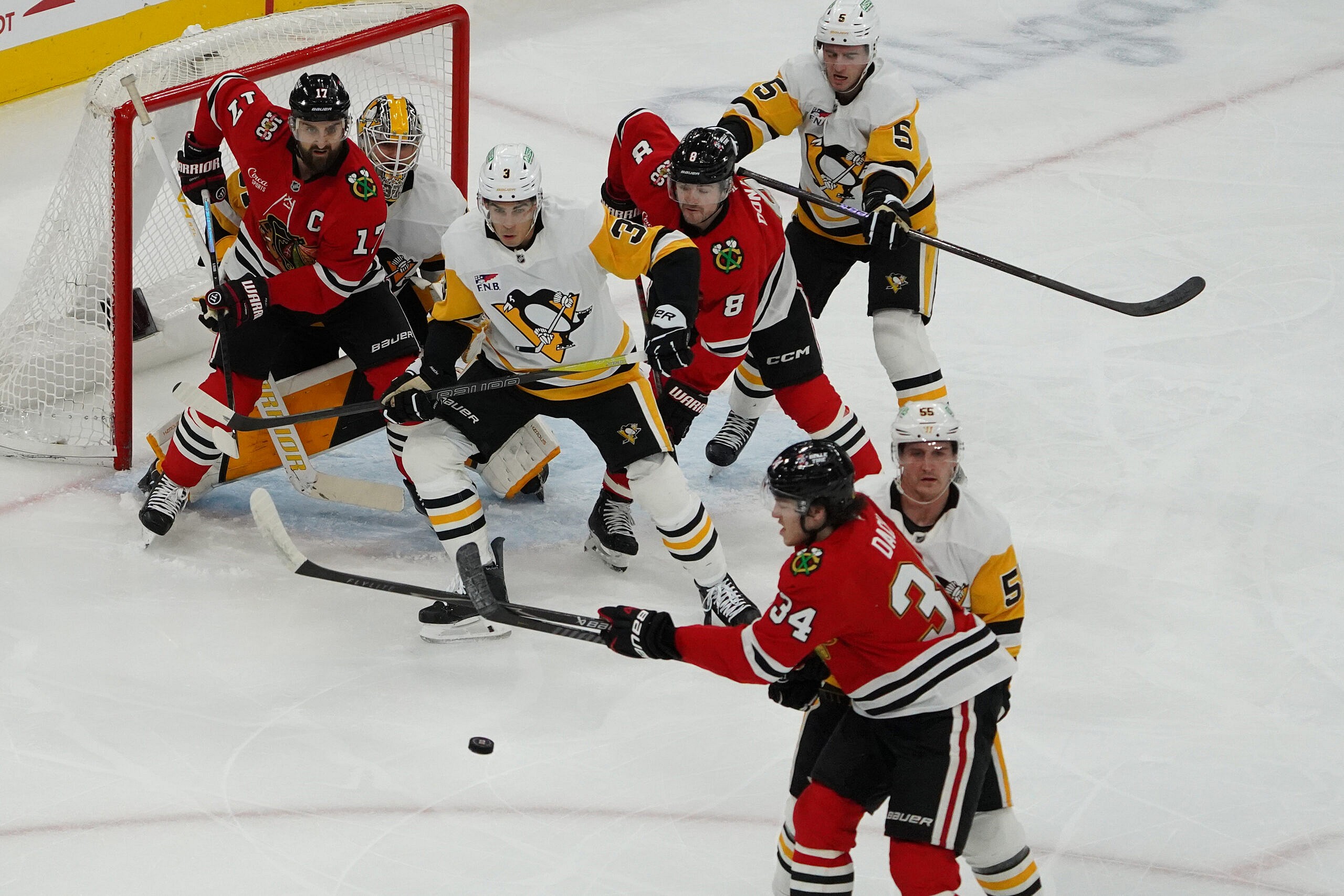
The story’s lead photo shows everything. Both D-men taking care of the net-front and not allowing a loose puck to become trouble:
 David Banks-Imagn Images
The pairing works for several reasons, though St. Ivany’s inclusion on the NHL roster ahead of veteran Matt Dumba was a little bit surprising. Penguins general manager Kyle Dubas simply decided to give the 26-year-old, 6-foot-4, 197-pound blue line some NHL ice to determine once and for all if he was NHL material.
St. Ivany had a strong start to his NHL career down the stretch of the 2023-24 season, in which the Penguins made a furious charge toward the playoffs. That run fell short, but St. Ivany impressed and started the 2024-25 season in the NHL before things simply didn’t work.
His game went sideways.
St. Ivany likes to play tight gaps at the blue line, be physical near the net, and he is at his best when blunting the play along the walls. However, despite his age, he’s still green by pro hockey standards (this is just his fourth pro season), and last season he tried to be more rounded and add an offensive push to his game.
Instead of adding to his game, it fell apart, and he was back with the Wilkes-Barre/Scranton Penguins of the AHL before the end of November.
This year, he suffered a right-foot injury while blocking a shot in preseason and missed most of the next three months, but he had shown enough in preseason to get a chance.
“I don’t know, it’s just … it’s easy with him,” Shea said. “I know we kind of read off each other nicely. And it’s good when you have the first couple of shifts, and you’re a plus-two. You’re feeling good, you’re feeling that you can play your game, and you don’t have to fight the puck.”
PHN has graded the pairing as the Penguins’ best in each of the last few games.
St. Ivany played five games on a rehab assignment in WBS, and has now played five NHL games, the first couple with Ryan Graves on the left, the last few with Shea.
Not only has Shea-St. Ivancy shown to be a shutdown pairing, but the pair’s individual reliability allows Muse to effectively mix-and-match the D pairings in the third period.
Muse has shown a willingness to change the pairings late in games with a lead, and having Shea–who has played most of the season with Kris Letang as the defensive conscience, and St. Ivany– himself a stay-home blueliner–gives Muse real options to effectively shorten his bench.
“I think they’ve done a good job with (being hard to play against). And then I think in terms of the offensive side, you’ve seen some involvement too,” said Muse. “I think picking the spots, whether it’s getting involved off the rush or involved in the O-zone, Jack had a good chance there in the third period against Toronto (Dec. 23), just kind of making a good read and kind of joining it from the weak side. So I think there’s been a pretty good balance there from those two.”
It’s been an unexpected but successful lineup swap. Analytics showed the third-pairing of Ryan Graves and Connor Clifton was the best D pair for shot attempts (60%), scoring chance ratios (60%), and expected-goals for (61%). All stats courtesy of NaturalStatTrick.com.
That’s still true. Shea-St. Ivany does not have the analytics to back up what the eyes are showing and the coaches are seeing. The pair has a mushy middling 50% Corsi, 54% expected goals rate, and 53% scoring chance ratio.
Yet, it’s the blossoming potential of the pair that makes it an easy keeper. With the reliable St. Ivany, Shea has played with the puck, adopting the more offensive stance without being expectant or risky. He has also joined St. Ivany in being physical at the net front.
Likewise, St. Ivany can also cautiously step into the play, as he did on the first goal Sunday, when he took the available play about 15 feet inside the blue line and put the puck on net.
Justin Brazeau tipped St. Ivany’s shot, and Anthony Mantha promptly scored on the rebound. St. Ivany’s little play–taking the extra time and space without being greedy for more–was a simple play that created an important goal.
St. Ivany made a smart little play to set up the final Penguins goal–a hard pass that bounced off the end wall and into the slot, where Noel Acciari treated it like a rebound, quickly chipping it into the net.
Shea also had his moments with the puck Sunday, creating space at the top of the zone with nifty stickhandles around Chicago defenders. He set up Bryan Rust’s first-period goal by undressing one would-be defender off the left wall, stepping into the open space, and making a simple play to Rust, who was charging into the offensive zone from the penalty box, uncovered.
With a little self-effacing humor, Shea laid out the goal.
“At first, I wanted to try to hit (Connor Dewar) backdoor, but I didn’t have a step on (the defender). He actually did a good job back-checking. And then after I spun, they had a couple of guys that came at me, but they kind of half came at me,” Shea explained. “After I got to the middle, I saw Rusty. He was calling from, I think, when he stepped out of the box. So I knew, I knew he had it, and the puck’s better off in his hand than mine.”
The pair has not yet been tested with a late lead, or at least one that could be overcome, but the strength of their individual games has clearly encouraged Muse. Sunday, Erik Karlsson missed most of the third period, so the D-men had to add extra minutes, but they were still ahead of third-pairing pace, and each played over 19 minutes.
Given Muse’s Sunday morning comments, that sort of role elevation may have happened anyway. Trying to use the offensive defensemen in late situations for puck possession and movement has not worked for the team. Perhaps Shea’s all-around game and St. Ivany’s ability to clear a path near the cage are the right call.
Either way, after just a few games and 39 minutes on ice together, there’s obviously a comfort level from the Penguins’ coaches and discomfort from opponents that the Penguins needed.
Tags: Jack St. Ivany Penguins Analysis Pittsburgh Penguins Ryan Shea
Categorized: Penguins Analysis