

After a painfully slow start to the season, the Edmonton Oilers are heating up, with wins in eight of their last 12 games. And while the goaltending situation remains the 800-pound gorilla in the room, there are encouraging signs surrounding the team. Chief among them? The return of the league’s deadliest power-play.
One of the curious parts of Edmonton’s trying start to this season was a power-play that looked something closer to league average than the unit we have grown accustomed to: a lethal attacking unit that seemingly converts on every man-advantage opportunity. For the Oilers, it’s equal parts top-end skill and chemistry, or familiarity, playing with one another – Connor McDavid, Leon Draisaitl, and Evan Bouchard serve as a three-headed monster that no penalty-kill has been able to reliably figure out.
Right now, the Oilers power-play is scoring at an otherworldly rate – their 14.2 goals per-60 minutes is comfortably the highest number in the league (Dallas is ranked second at 11.6 per-60, for baseline purposes) and, if sustained through the full season, would be the most productive power-play we have seen in the post-2007 statistical modern era. Since Bouchard has come into his own as a power-play quarterback, this group has dominated the league, but right now it’s outperforming its own freakish standards:
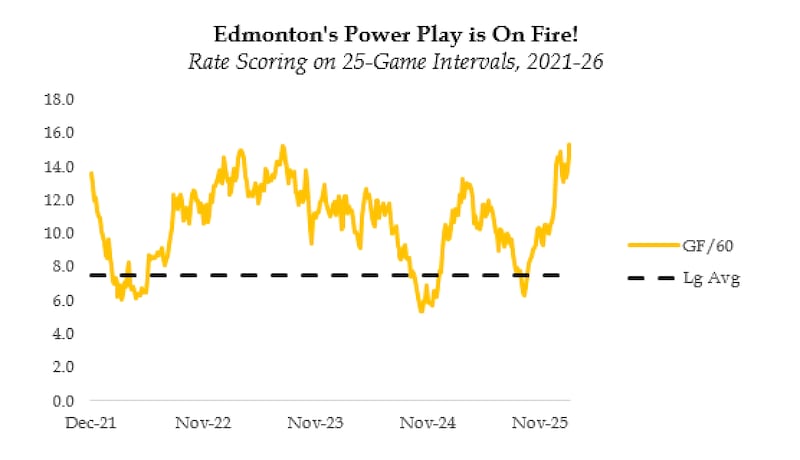 Oilers’ power-play (TSN)
It goes without saying the Oilers have a massive advantage over their peers when they operate a power-play that produces goals at nearly twice the rate of the league average; doubly so in the post-COVID era of the NHL, where power-plays have become meaningful differentiators separating playoff contenders and pretenders. This is a scoring league right now and teams that can generate offence like this are positioned well to qualify for the postseason and beyond.
I’ve argued for some time now that video coaches around the league should be studying the Oilers’ power-play for tips and tricks. It’s easy to point to the Goliath duo of McDavid and Draisaitl and assume their success is entirely personnel-based, but it’s not: Edmonton’s power-play is fantastic in transition and gaining the offensive zone, and it’s even better at sustaining the offensive zone once they gain it. This allows for multi-shot shifts and a higher frequency of chances generated from between the circles where goaltending save percentages typically plummet. McDavid and Draisaitl (and Bouchard) are certainly key to making this work, but skaters like Ryan Nugent-Hopkins and Zach Hyman also play meaningful contributory roles. Their power-play’s shot profile (via HockeyViz) is a nightmarish visualization if you’re a fan of a Western Conference foe:
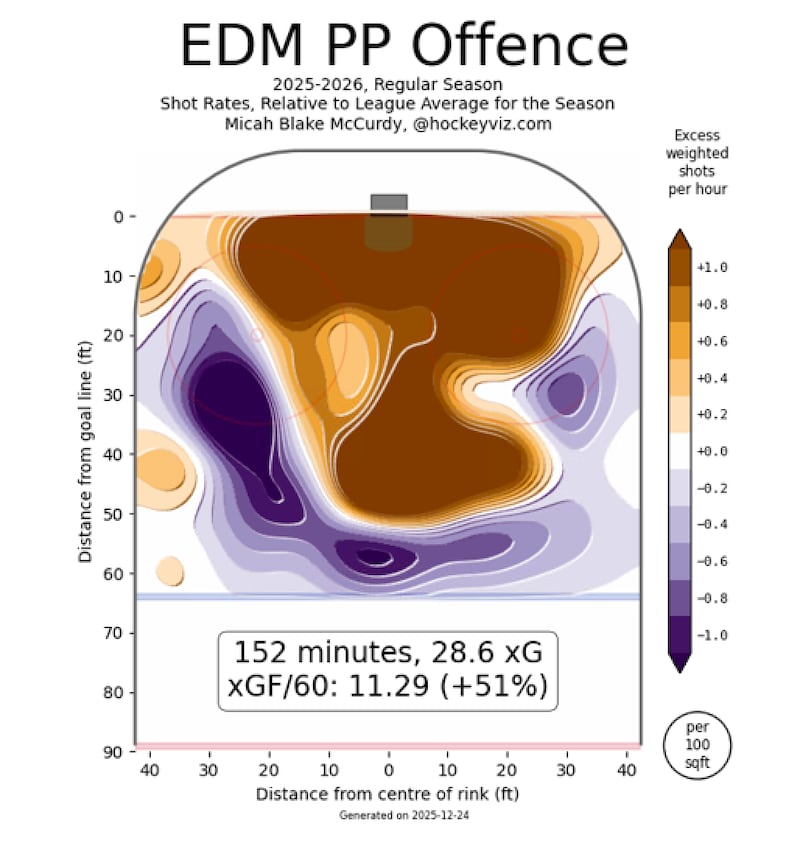 Oilers’ power-play shot generation (TSN)
Draisaitl’s 11 goals lead the power-play in scoring and, correspondingly, he’s drawn many of the accolades, but the Oilers have 26 goals from other skaters outside of him.
Think about it from this perspective: Edmonton’s power-play without Draisaitl would still be top-ten in league scoring, ahead of the Florida Panthers and Vancouver Canucks (25 goals apiece). And it’s nearly double that of the Toronto Maple Leafs, who have potted just 14 power-play goals over the duration of the season.
The Oilers organization and fan base know their path to the Stanley Cup is heavily tied to shoring up the goaltending position and, as a team, cutting down on that goals against number. But make no mistake, this team is still more than capable of outscoring teams – even great teams – on a nightly basis. If Jarry turns out to be a sizable upgrade on the departed Stuart Skinner, there’s no reason this team cannot make a bid at a Western Conference threepeat.
Even if their path may be a tick more challenging this season!
Data via Natural Stat Trick, NHL.com, Evolving Hockey