
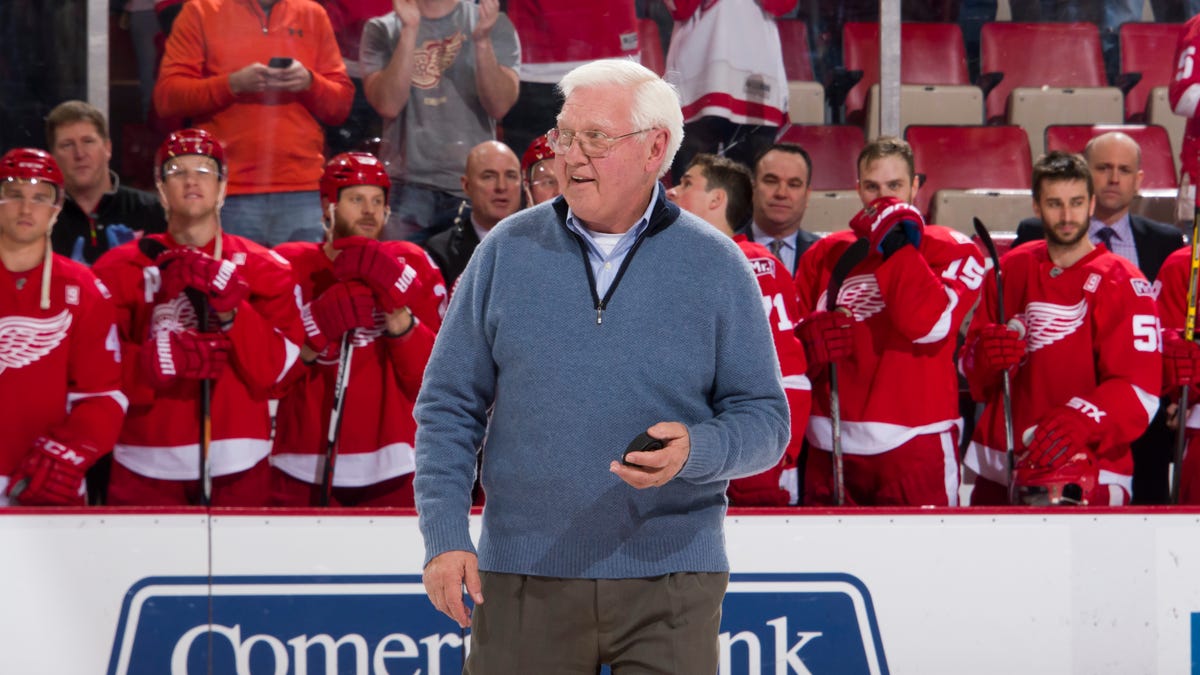
According to many, Alex Delvecchio played in Gordie Howe’s shadow.
But according to No. 9, he wouldn’t have had the career he had without No. 10.
“I can thank Alex for a lot of good years,” Howe, Detroit’s Mr. Hockey, once said. “We read each other very well.
“I played with some great hockey players, but none came to his order.”
Delvecchio, who played for the Detroit Red Wings from 1951-73 and helped the franchise to three Stanley Cup championships during his Hall-of-Fame career, died July 1 at the age of 93. He finished his legendary career with 456 goals, 825 assists and 1,281 points, second in franchise history in all three categories when he retired in 1973 ― second, in fact, in all three categories to Howe.
Delvecchio played in 1,550 games for the Red Wings, the most ever for one player who spent his entire career with one team, until Detroit’s Nicklas Lidstrom broke his record decades later, playing in 1,564 for the Red Wings.
Delvecchio succeeded Sid Abel in the Red Wings’ new version of the “Production Line,” alongside Howe and Ted Lindsay. Howe once referred to Delvecchio as a “great artist.”
When Delvecchio was a rookie, Howe and Lindsay would sit on the bench and marvel at the youngster’s skills. He went on to be considered one of the greatest 100 players in the history of the NHL.
He was inducted into the Hockey Hall of Fame in 1977, and the Wings retired his number in 1991.
“I never did play the game to have them hang my jersey in the Joe Louis Arena or anyplace, or be a Hall-of-Famer,” Delvecchio once said in an interview. “I just wanted to play the game, play it as best as I could, contribute to your hockey team, and I feel that any of those other honors are like bonuses.”
After his retirement, Delvecchio spent two stints as the Red Wings’ coach, and one as their general manager.
Delvecchio was among many notable sports figures, locally and nationally, who died in 2025.
Here’s a look back at those for whom we said farewell.
◆ ◆ ◆ ◆ ◆
There were better players on the 1984 World Series-champion Tigers. There were Hall-of-Famers. But there weren’t many, if any, who were more athletic than center fielder Chet Lemon, who died May 8 at the age of 70.
Lemon played nine seasons for the Tigers, from 1982-90, collecting clutch hits and spectacular plays on defense ― one of those catches in Anaheim was so great, it even was turned into a commercial for the team’s flagship TV station, splicing together actual video of the catch, and then of Lemon, flipping up his shades, making a pitch for WDIV.
“I always believed my job as a pitcher was made easier when Chet was behind me in center,” Dan Petry said. “He was also a fierce competitor on the baseball field and a great teammate,” Lance Parrish added. “I loved him like a brother.”
The Tigers also said goodbye to former players Octavio Dotel (April 8, age 51), Daryl Patterson (Aug. 28, age 81), Tom Timmermann (Nov. 14, age 85) and Joe Coleman (July 8, age 78), who started 39 games and won 19 of them for the 1972 playoff-bound Tigers.
Dick Groch, the pride of the Blue Water Area and legendary scout who discovered future Hall-of-Fame shortstop Derek Jeter for the New York Yankees, died Oct. 1, at the age of 84. Baseball also lost Hall-of-Famers, including “Mr. Baseball” Bob Uecker (Jan. 16, age 90), Dave Parker (June 28, age 74) and Ryne Sandberg (July 28, age 65), and former commissioner Fay Vincent (Feb. 1, age 86), 1985 World Series-champion New York Mets manager Davey Johnson (Sept. 5, age 82), and Chicago White Sox cult hero Bobby Jenks (July 4, age 44), who memorably closed out the 2005 World Series.
◆ ◆ ◆ ◆ ◆
Marshawn Kneeland played five seasons at Western Michigan, but just one of those under head coach Lance Taylor. It didn’t take Kneeland long to endear himself to Taylor.
“Marshawn was so much more than an incredible football player. He was a remarkable young man who meant so much to our program and to me personally,” Taylor said. “His leadership, energy, and smile were infectious, and he left a lasting impact on everyone in our program.”
Kneeland, a Grand Rapids native and defensive lineman who was in his second season in the NFL, died Nov. 6 at the age of 24, of an apparent suicide in suburban Dallas, just days after he scored his first professional touchdown. Following his death, WMU and the Cowboys held game-day tributes in his honor.
Locally, the football world lost Mike DeBord (April 15, age 69), Central Michigan’s head coach from 2000-03 and a longtime Michigan assistant); one-time Lions interim head coach and Lions player Dick Jauron (Feb. 8, age 74); college coach and executive Buddy Grier (Sept. 22, age 82), a Waterford native who is widely credited with drafting UM quarterback Tom Brady to the New England Patriots; Wally Gabler (Feb. 9, age 80), a Michigan quarterback and Royal Oak native; Roger Shoals (June 30, age 86), a Lions offensive tackle in the 1960s; and Bill McCartney (Jan. 10, age 84), a Riverview native who as head coach led Colorado to the 1990 national championship, after spending several seasons on Bo Schembechler’s staff at Michigan.
Former commissioner Paul Tagliabue died Nov. 9 at the age of 84, and the NFL also mourned Indianapolis Colts owner Jim Irsay (May 21, age 65), Chicago Bears owner Virginia McCaskey (Feb. 6, 102), and Hall-of-Famer Steve McMichael (April 23, age 67), who battled Lou Gehrig’s disease.
◆ ◆ ◆ ◆ ◆
In addition to Delvecchio, the hockey world lost Hall-of-Famers Bernie Parent (Sept. 21, age 80) and Ken Dryden (Sept. 5, age 78) in 2025, as well as Eddie Giacomin (Sept. 14, age 86), who finished his career with the Red Wings. The Red Wings also mourned player alums Mark Kirton (Aug. 17, age 67) and Marcel Bonin (Jan. 19, age 93).
Bob Goodenow, a Dearborn native and lawyer who was executive director of the NHL Players Association from 1992 until his resignation in 2005 following the labor stoppage, died Sept. 13 at the age of 72. He was a graduate of University of Detroit’s Law School.
The hockey world also lost Guido Tenesi (June 17, age 71), a Detroit native who appeared in the cult hockey movie “Slap Shot”; Lisa Brown-Miller (May 2, age 58), a West Bloomfield native and Holland resident who won Olympic gold as a player and later coached at Providence and Aquinas (May 2, age 58); and Bob Lemieux (May 9, age 80), the first coach and general manager of the Kalamazoo Wings.
◆ ◆ ◆ ◆ ◆
Rich Adubato’s only coaching experience was at a small college in New Jersey when he joined the Detroit Pistons’ staff under Dick Vitale in 1978. A year later, he took over as interim head coach, after Vitale was fired. Adubato, who went onto coach the Dallas Mavericks and led the WNBA’s New York Liberty to the finals in three of his four seasons, died Nov. 6 at the age of 87.
The Pistons also mourned the death of center Elden Campbell (Dec. 2, 57), a former first-round draft pick who spent most of his career with the Los Angeles Lakers, but finished his 16-year NBA career with Detroit, winning an NBA championship in 2004 (against the Lakers).
The basketball world also said goodbye to Lenny Wilkens (No. 9, age 88), who was inducted into the Basketball Hall of Fame three times, as a player (nine-time All-Star), coach (NBA champion) and a member of the Olympic “Dream Team” staff, and still is widely considered one of the greatest coaches in the history of the NBA; and Gregg Glenn III (July 28, age 22), a Michigan basketball player before transferring to Tulane.
◆ ◆ ◆ ◆ ◆
In the spring of 2024, Michigan Golf Hall-of-Fame member and legendary teaching instructor Dave Kendall, the founder of the Kendall Golf Academy and co-owner of Washtenaw Golf Club in Ypsilanti, was diagnosed with terminal brain cancer. He feared he’d never play golf again. Not only did he play again, he thrived, making the 11th and 12th holes-in-one of his life, and even shooting his age (69). He died Sept. 16, at the age of 70.
“He wasn’t just a golf coach,” said John Retzer, who runs the Golf Blogger website. “He was a life coach.”
The golf world also lost longtime pro Mike Hill (Aug. 4, age 86), the Jackson native and Michigan Golf Hall-of-Famer who won three times on the PGA Tour, and 18 times on PGA Tour Champions. His brother, Dave Hill, also was a decorated golf professional Dave Hill. Masters and U.S. Open winner Fuzzy Zoeller (Nov. 27, age 74) died, as did Jim Carras (June 21, age 92), who led the UM men’s golf team to the NCAA Championships three times as its coach.
◆ ◆ ◆ ◆ ◆
The Tigers need extra space on their Mount Rushmore of great broadcasters, and Ray Lane (Sept. 27, age 95), a Detroit native, would fit just swell up there ― just like he fit in everywhere, on and off the air. He broadcast several sports.
“The thing about Ray is, he could do everything,” Jim Brandstatter, former UM broadcaster, told The News after Lane’s death. “He could do baseball play-by-play that fit with Red Barber or Ernie Harwell. He could do football, and did it well, with such an easy flair. He did the Red Wings, and Pistons. And yet, I think, what set Ray apart was his humanity. He had this everyday-guy personality. He got along with cab drivers and presidents of companies, and players and coaches and owners. Ray could sit with any of them, because he was the same guy to all of them.”
The sports-media world also mourned national baseball writer Scott Miller (June 20, age 62), a Monroe native and Hillsdale College alum, and national writer and best-selling author John Feinstein (March 13, age 69), who wrote “Season on the Brink” about his year embedded with Bobby Knight and Indiana basketball.
◆ ◆ ◆ ◆ ◆
George Foreman was a heavyweight champion boxer at the age of 20 and at age 45, and after he finally retired, he was a champion in business, too ― his table-top grill a staple in kitchens and dorms from coast to coast, selling more than 100 million units. Foreman died March 21, at the age of 76.
“He was a genius,” said boxing broadcaster Jim Lampley, who called fights with Foreman on HBO, after Foreman’s days of fighting the likes of Muhammad Ali and Joe Frazier (“Down goes Frazier!”) were over. “People would say, ‘Well, genius, what do you mean?’ I’d say, ‘Well, check the bank account.”
Boxing also lost four-time world champion Ricky Hatton (Sept. 14, age 46) in 2025, as well as Rahaman Ali (Aug. 1, age 82), Muhammad’s younger brother, who took his own turn as a fighter.
◆ ◆ ◆ ◆ ◆
For many coaches who star in the high-school ranks, preps is a stepping stone. Not for Al Fracassa, who coached Birmingham Brother Rice football from 1969 through 2013, leading the program to nine state championships. Fracassa’s first state title was in 1977, and his last three were in his final three years, 2011-13.
He died Sept. 7, at the age of 92.
“He was more than a coach of X’s and O’s; he was great the way he handled kids,” said John Herrington, another high-school football coaching legend, at Farmington Hills Harrison. They knew each other for 45 years. “I never saw a kid from Brother Rice that didn’t admire him and enjoy playing for him.”
◆ ◆ ◆ ◆ ◆
Hulk Hogan wasn’t always the biggest deal, and neither what then was known as World Wrestling Federation. Then came March 29, 1987, at the Pontiac Silverdome, where Hogan famously slammed Andre the Giant. The rest was “Hulkamania” history. Hogan, real name Terry Bollea, died July 24 at age 71.
“He was a living action figure,” said Joe “Violent J” Bruce, the Insane Clown Posse member and Metro Detroit native, who grew up a big fan of wrestling, and idolizing Hogan.
WrestleMania III was a big financial risk for Vince McMahon, but it paid off in a big way ― as chronicled by The Detroit News in a 2017 oral history ― to the tune of $12 million in ticket sales (the crowd was announced at 93,173, but probably was under 80,000) and pay-per-view buys, big thanks to Hogan and Andre.
◆ ◆ ◆ ◆ ◆
Andy Isaac was an open book to his legion of social-media followers ― whether it was his hot (sometimes, scorching so) takes, his disdain for the Chicago Bears (FTB!) and his love for the day he coined Faturday, as he deemed Saturday the perfect day for a cheat day. The passionate and hilarious fan of all things Detroit sports also honestly chronicled his long battle with cancer, before his death March 6, at the age of 45. All four Detroit pro sports teams and Michigan State, his alma mater, expressed sympathies.
“Andy was the blueprint for how to establish a legacy, and despite having such a long battle with cancer, cancer didn’t define him,” said Emily Waldon, a baseball writer from Grand Rapids who leaned heavily on Isaac during her own cancer battle. “Andy was defined by his intentionality, his passion and his love for the City of Detroit.”
◆ ◆ ◆ ◆ ◆
The state sports community also mourned the death of Roy Kramer (Dec. 4, 96), who coached Central Michigan football from 1967-77, winning the 1974 Division II national championship ― still the only team national title in school history. It was a catalyst for CMU making the move to Division I and entering the Mid-American Conference. He later was athletic director at Vanderbilt, and commissioner of the SEC, but his heart always remained at CMU.
Brian Eisner (Sept. 10, age 83) coached the Michigan men’s tennis program to 18 Big Ten championships and 18 NCAA Championships appearances, and Rochester Hills’ Gerald Barr (March 19, age 86 became a local folk hero, of sorts, when he bowled the first 300 of his life in his 80s ― and then bowled his second perfect game less than a month later.
tpaul@detroitnews.com
@tonypaul1984
 Want to comment on this story? Become a subscriber today. Click here.