As the Seattle Kraken close out the calendar year, it’s safe to say they’ve turned things around on the penalty kill. Statistically, they’ve gone from completely off the map in a dreadful league of their own—as bad as five percentage points behind the then-31st-ranked Ottawa Senators at 64.8 percent—to taking over that 31st spot themselves at 71.7 percent.
There is still room for improvement. After a 4-3 loss to the Detroit Red Wings on Dec. 6 capped a three-game stretch in which Seattle allowed seven power-play goals on eight chances, the Kraken switched formations and have since been one of the NHL’s better penalty-killing teams, killing 85.7 percent of opportunities.
“Something’s got to be done about it, and there’s only one way to go,” coach Lane Lambert said after that Detroit game. Indeed, something has been done about it.
In this Kraken Notebook, we’ll look at how a formation change has helped turn the PK around, learn about Berkly Catton switching to No. 27, and much more.
New PK versus old
After that Detroit game, I broke down in Three Takeaways what was wrong with the PK, most notably that seam passes were far too easy to come by for opposing teams. While digging through the Sound Of Hockey… dot com… archives for that story, I came across another article I’d written about the 2022-23 playoff team and how it improved its penalty kill in the middle of the season.
Stop me if you’ve heard this before. That season, the Kraken ranked 31st in the NHL on the penalty kill while using the wedge-plus-one system. After a 7-2 loss to the Edmonton Oilers on New Year’s Eve, during which they allowed two power-play goals, Seattle began working on a simplified diamond system. Over the next three-plus months, the Kraken killed 83.9 percent of penalties.
The details aren’t exactly the same, but Seattle’s PK is going through an almost identical evolution right now.
“I think we switched it up probably about a couple weeks ago, three weeks ago, maybe, and it’s a bit of a learning experience at the start,” Ryan Winterton said. “I think learning anything new is a little different, but I think the guys have bought into it, and our kill since then has been pretty good.”
Added Matty Beniers, who was used more frequently in the old formation: “I think there’s a lot of shared responsibilities in [the old system]… One guy’s kind of trying to focus on the bumper [in the slot], but also trying to take away the backside. Honestly, what we did was kind of take a little bit of the onus off the forwards and put a little bit more on the D, and the D have just done a great job with that.”
Beniers indicated that things are more clear-cut for the forwards, who can now focus on defending one player at a time while allowing the defensemen to handle being outnumbered more often. Defensemen are better suited to deal with 2-on-1 situations than forwards, making that a positive change.
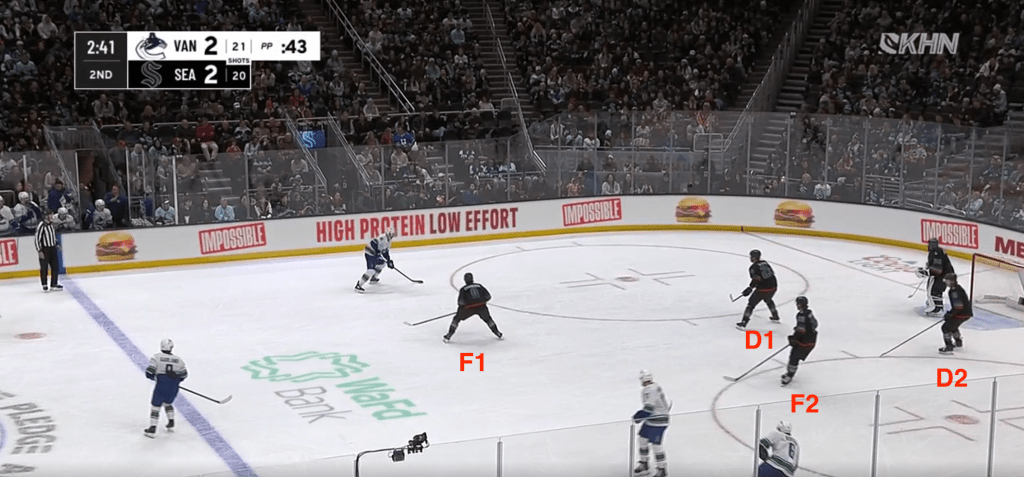
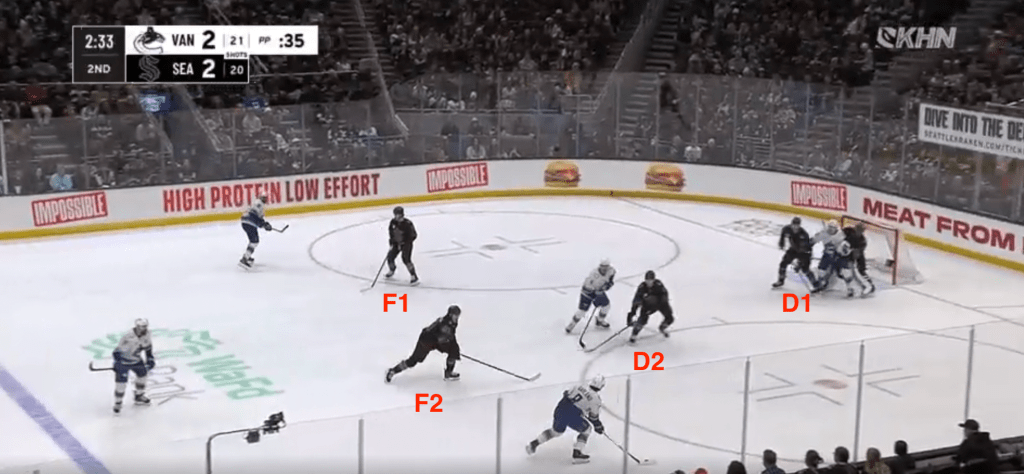
Now, instead of constant rotation and reading off one another to determine who is pressuring at the top of the zone, the formation moves as one. It expands and contracts, with rotation only occurring when the entire diamond is pulled far enough in one direction to effectively turn the whole formation, as shown below from a successful kill against the Canucks.
Here, as the puck moves around the zone, all four players move together, with Chandler Stephenson (F1) moving from the top of the diamond to the right side, Ryan Winterton (F2) moving from the left to the top, Jamie Oleksiak (D1) moving from the right to the bottom, and Cale Fleury (D2) moving from the bottom to the left. The players never trade with one another like they did before, they just shift around.
The biggest improvement from this new look has been taking away the wide-open seam passes that were plaguing the Kraken, as noted in Three Takeaways after the Detroit game.
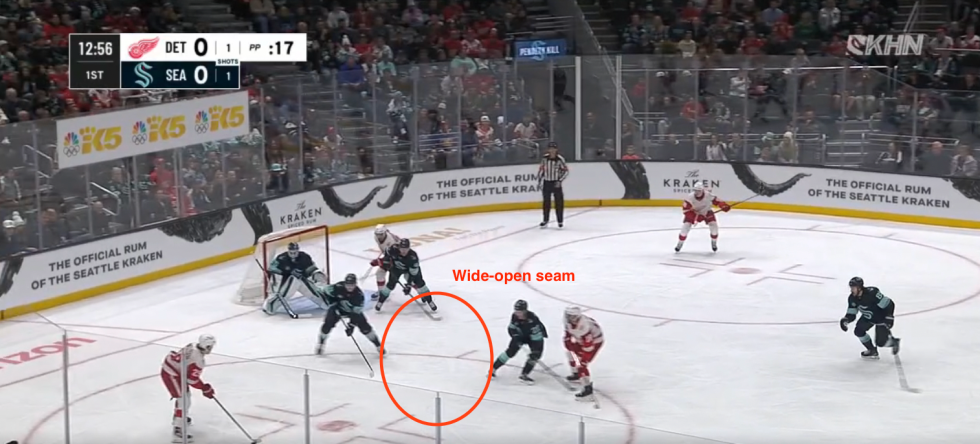
“100 percent, I think that’s what we try to take away. You always try to take the seam pass away,” Eeli Tolvanen said. “They’re the hardest thing to— you know, if you get the seam, stuff opens up. So I think, yeah, for sure, we’ve done a better job with that now, not giving them those lanes and keeping the puck on the outside.”
The main reason this works so much better is that there are now two players across the middle of the ice, instead of a triangular formation that placed two players near the crease and one in the slot. When a puck is contested along the wall, the diamond quickly spreads as Seattle’s skaters pounce and try to advance it out of the zone. If they lose possession, they retreat right back into position, with minimal confusion about assignments.
Oleksiak also credited small personnel tweaks, with himself, Adam Larsson, Ryan Lindgren, Fleury, Ben Meyers, Freddy Gaudreau, Stephenson, Tolvanen, and Winterton carrying most of the PK duties, and said the killers have grown more comfortable with one another.
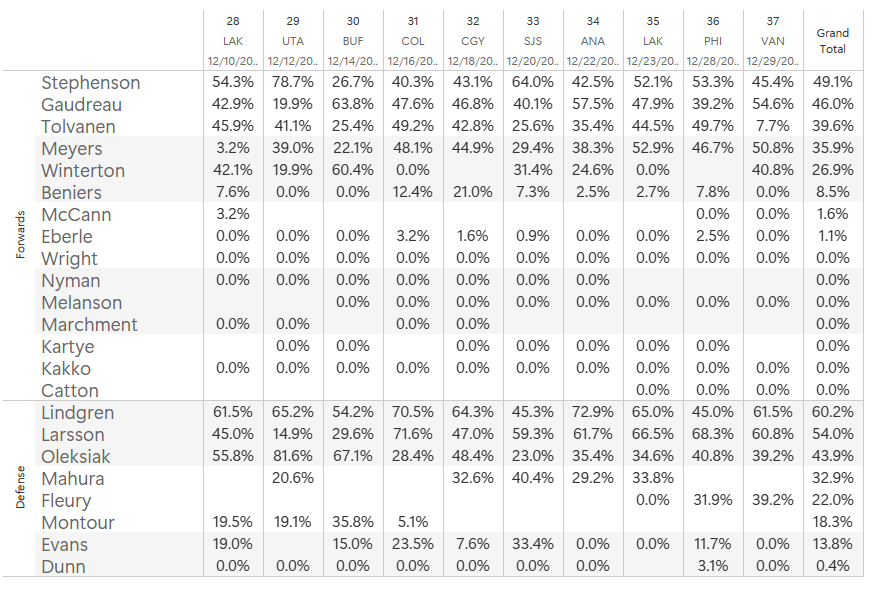 PK usage since Dec. 10.
“I think it’s a product of being more comfortable to pressure more,” Oleksiak said. “That kind of comes with chemistry, learning each other’s tendencies. And I think working with the coaches, we’ve been very diligent in practice and whatnot, and I think it’s been good.”
Added coach Lane Lambert: “I think [assistant coach] Aaron Schneekloth has done a real good job of having the guys understand exactly what we’re looking for. We made some changes, that’s all there is to it, and I think we’re more aggressive with those changes.”
Berkly Catton back in 27
The team officially announced a rare in-season jersey number change for Berkly Catton, who ditched No. 77 in favor of his more familiar No. 27, previously worn by Mason Marchment before he was traded.
Berkly Catton sporting No. 2️⃣7️⃣ this morning. 🤔 #SeaKraken pic.twitter.com/9vwKA0oUOE
— Sound Of Hockey (@sound_hockey) December 31, 2025
Catton said he learned Tuesday that changing back to the number he’s worn since childhood—and briefly with Seattle before the Kraken acquired Marchment in the offseason—would be possible.
“I had 27 before, just for a short time before [Marchment] came, and actually, [Jason Botterill] called me yesterday and told me there was a chance that they could do it this year,” Catton said. “Obviously, I was kind of thinking next year, maybe, but then [head equipment manager Jeff Camelio] and his staff obviously worked hard and got it done. So I’m really grateful for that.”
Catton added that he’s worn the number for as long as he can remember and believes it was chosen for him by his mother, whose birthday is April 27.
It was noted during Catton’s availability that even his team-issued workout sneakers had already been updated to No. 27. The equipment staff works fast.
Lambert happier with Oleksiak’s game
During Seattle’s back-to-back Losing Streaks Camille and Cynthia, Oleksiak found himself in Lambert’s doghouse. For the first time since joining the Kraken in their inaugural season, Oleksiak was a healthy scratch for two games.
At the time, I asked Lambert several times about the surprising lineup decision and finally got a more telling answer on attempt No. 3.
“I think he’s been okay,” Lambert said before Oleksiak was scratched for the second time on Dec. 8. “There’s a couple areas, and I’m not gonna get into that with you guys here, but he and I have talked about that, where we would like him to be better. But he’s not the only guy, either.”
Since Seattle’s 4-1 loss that night to the Minnesota Wild, Oleksiak has played every game and—anecdotally—appears more willing to use his massive frame to body opponents off pucks.
“I have [seen improvement],” Lambert said Monday. “Every once in a while, and it doesn’t matter who you are, you have to be reminded a little bit, and I think he’s been solid since. Certainly, I think he’s been more physical, more assertive, which we need from him. He’s a big body, so I think he’s played well here. And you know, for the most part, he’s played well all season.”
Oleksiak was thoughtful when asked how tough it was to be a healthy scratch at this stage of his Kraken tenure.
“I mean, obviously, things like that are difficult, but it’s a long year. There’s ebbs and flows, and you’ve just got to kind of respond to a situation like that the right way,” Oleksiak said. “And that’s what I try and do. I try not to get negative and try to find the opportunity in it. And again, it’s a long season. It’s a roller coaster. Things happen, and I think you’ve just got to learn along the way. So, yeah, I think I’ve really been mindful of bringing what I can to help the team win.”
Winterton makes big impact in return to lineup, Melanson’s special moment
Speaking of healthy scratches, Winterton sat out Seattle’s 4-1 win over the Philadelphia Flyers on Sunday before returning Monday, scoring a big goal against the Canucks, and helping the team earn a point in the 3-2 shootout loss.
Winterton, who had a few cups of coffee at the NHL level over the past two seasons, has solidified himself as a full-time player this season, though the occasional healthy scratch has started to appear for him. This was only the second time all season he’s been out of the lineup (the previous was Seattle’s 4-2 loss at the Calgary Flames on Dec. 18), though, and he didn’t seem too bothered by it.
“Obviously, it’s pretty cool being up here at the big club,” Winterton said. “I’ll hopefully stay as long as I can, and I think it’s been great for my development, just kind of playing with faster, stronger guys, and trying to learn the systems and do what I can to stay here.”
His goal Monday was a beauty, coming on a cross-crease pass off the rush from fellow 2021 draftee and former Coachella Valley Firebirds teammate Jacob Melanson.
WINTER IS HERE! ❄️ 🚨
More sketchy defending from leaky VAN, and the fourth line burns them. Jacob Melanson gets his FIRST NHL POINT, setting up Ryan Winterton, and JOEY DACCORD GETS THE SECOND ASSIST!
That’s Winterton from Melanson and Daccord, just as we expected.
2-1… pic.twitter.com/Qo1E3zfSe5
— Sound Of Hockey (@sound_hockey) December 30, 2025
It was a special moment for the hard-nosed Melanson as well, who earned his first NHL point with the primary assist and has continued proving his worth as a prototypical bottom-six winger.
“After I saw the puck in the net, I kind of looked over to see who made the pass and saw it was Melly,” Winterton said. “And I think there’s a picture going around that— we’re kind of both just smiling. I kind of blacked out a little bit, but I’m super happy for him. It’s probably the first of many, so it was a big one for him, and a big one for the team at the time.”
“It’s special,” Melanson said. “I mean, you always want to get your first NHL point, and for it to happen like that with Winnie being able to score was pretty cool, and I mean, it’s something I’ll remember forever.”
Melanson said his phone lit up afterward with messages from friends and family back home in Nova Scotia.
“I mean, I’m from Amherst, a small town, so everyone was paying close attention to me,” Melanson said. “I got a ton of texts from back home, and a lot of people reaching out, just saying, ‘Congratulations.’ It’s awesome to have that support and see all that.”
Odds and ends
Just a few more quick tidbits…
For those wondering why Joey Daccord wore his standard white gear instead of his black setup with Seattle’s Abyss jerseys on Monday, he said he felt he looked smaller in the black gear and that the holes appeared more visible. Coincidental or not, he’d been giving up more goals in that setup, so he reverted to white.
Adam Larsson was absent from practice Wednesday, but Lambert said he’s just “under the weather” and will be fine.
Aside from Larsson being replaced by Josh Mahura, the team ran the same line rushes we saw against Vancouver.
Jani Nyman was reassigned to Coachella Valley on Tuesday. Here’s what Lambert said about that: “Jani did a lot of good things here, and I think for him, part of his development was certainly being here—and he’ll be back again—getting to understand the way things are done, how we’re doing things here. And it’s important for him to keep playing as well, and it’ll be nice for him to go down there, playing the power play, have some success that way, and get himself ready to come back whenever that might be.” Lambert added that he wants Nyman to focus on what he is supposed to do when he doesn’t have the puck.