
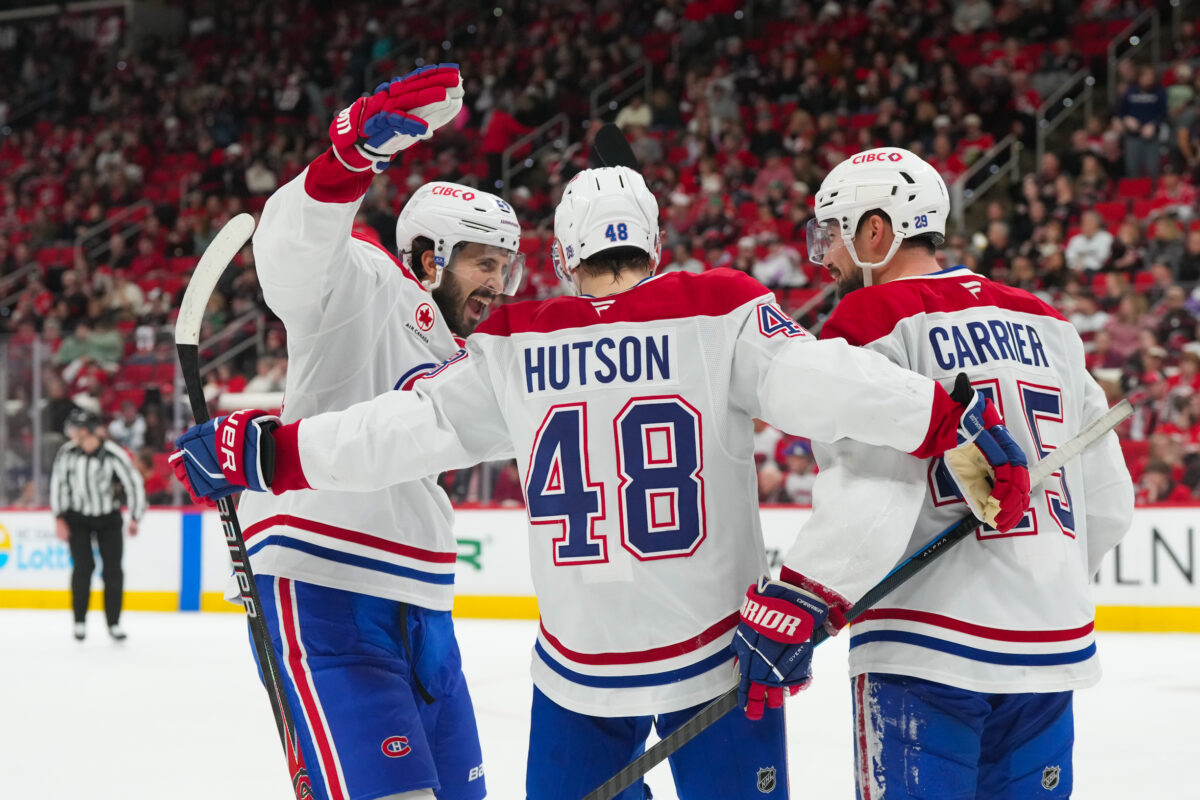
During last offseason, the Montreal Canadiens were coming off of a surprising playoff berth, one that saw them eliminated in five games in the first round by a more experienced and physical Washington Capitals. Many areas of need were identified by the team, the fans, and the media. To build a Stanley Cup-contending club, Montreal needed to add several missing key components, primarily related to size, experience, and depth in specific positions.
Related: Montreal Canadiens Need to Find the Right Fit for Kaiden Guhle
General manager (GM) Kent Hughes has been busy addressing these needs, and there are more yet to be addressed. Patience and finding the right player is the focus, but there are solutions available; the key now is seeing if the price is right.
Canadiens’ Multiple Needs
First, acquiring a top-six power forward with size has been — and still is — a requirement. Hughes and media analysts identified the need to acquire a big, skilled forward who can compete physically and provide an offensive punch, which is still an open file on his desk.
“There’s a lot of areas that we need to improve to be a team that’s still playing now. We need more scoring, we need to be bigger, we want to be more competitive.”
Second, a reliable second-line centre is necessary. Following injuries to Kirby Dach there was significant concern, but that injury opened the door for a young rookie to step up. So far, Oliver Kapanen seems to have filled that role nicely, with his ability to score but also due to his two-way play and reliability on the penalty kill (PK) units. Kapanen helped fill a gap after key departures last summer drained the PK units. Others stepped up as well, and Hughes’ mid-season acquisition of Phillip Danault turned an area of concern into a strength.
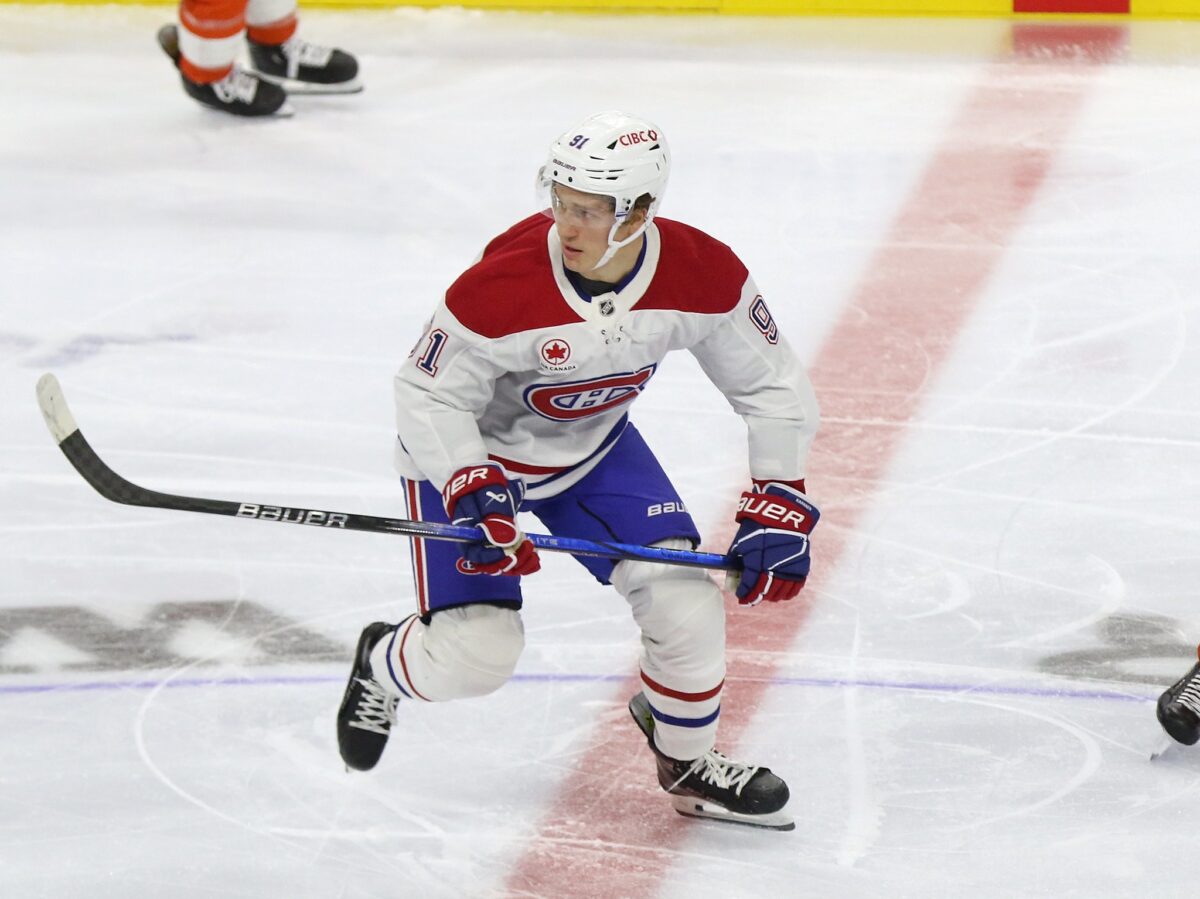 Oliver Kapanen, Montreal Canadiens (Amy Irvin / The Hockey Writers)
However, one of the biggest areas of concern management raised was the need to increase overall playoff physicality and compete. The team needs to develop a more physical edge and “compete” throughout the lineup. While Tom Wilson and the Capitals praised Montreal’s compete level after the series, it was clear they were outmuscled. While it can be argued that the Canadiens don’t need to replicate the Capitals’ identity, it does need to be pointed out that they are one of the smallest teams in the NHL and have one of the smallest forward groups in the NHL, specifically.
The blue line isn’t the problem on the Canadiens roster as there is far more size, grit and toughness spread throughout. Kaiden Guhle, Arber Xhekaj and Jayden Struble complement the more mobile defenders such as Mike Matheson and Noah Dobson who have size but defend with mobility and positioning. Lane Hutson defends with his smarts and positioning.
The debate is not if the core has enough skill to beat teams in the playoffs; they absolutely do. The debate is whether Montreal are physical enough to match up against skilled teams that can play the tough, gritty, and physically punishing playoff style such as Washington, defending Stanley Cup champion Florida Panthers, and the Tampa Bay Lightning. If the Canadiens can consistently smother teams with the forecheck and a physical cycle game, they have the skill necessary to score on a regular basis.
Debates about whether these teams are still or can be considered Cup contenders are moot because for Montreal to be able to not only contend, but actually win a Cup, they need to first eliminate any or all of these clubs.
Canadiens Have Solutions Available
The Canadiens are in the top 10 in the NHL in the standings midway through 2025-26 and are only two points out from leading the Atlantic Division outright. But that’s regular-season success. There is no arguing that the game changes in the playoffs, and size matters. The 2025 playoffs proved that as Wilson ran roughshod over Montreal, and that will be the approach any opponent takes with the NHL’s youngest team in the 2026 playoffs. Juraj Slafkovsky can bring that same edge as Wilson and can do so in the top six.
However, there is a lack of that grit and physicality in the other five players that make up the scoring lines. They are, without a doubt, a skilled team. Their top six oozes skill thanks to youngsters Nick Suzuki, Cole Caufield, and Ivan Demidov. While they have needs, they aren’t in need of making a deal now, as the Canadiens are ahead of schedule in their rebuild. After just having made the playoffs last season, the original goal was to just “be in the mix” for a berth. The goal for this season was stated unequivocally as qualifying for the playoffs, and now they are competing for home-ice advantage in the first round when they were only aiming for a wild-card berth.
According to Marco D’Amico of RG.org, Montreal is kicking tires to fill its needs. Specifically, he notes that the Canadiens will listen to physical, scoring middle-six forwards, but only if the cost makes sense beyond this season. Hughes and company are focused more on deals that provide a long-term impact. They want to avoid trades that look good or only help with short-term optics, especially compared to teams that consider themselves contenders now who will be facing real pressure at the 2026 Trade Deadline to make their additions; those teams will drive up the prices on assets to turn it into a true sellers’ market.
That would price Hughes out of nearly any available big name he would have interest in. There is no rush at this stage to make a deal, especially as they await the return of several middle-six forwards that could ideally bring some speed, offence and size. Dach, Patrik Laine and Alex Newhook are all on the long-term injured reserve (LTIR) but are slated to make their returns all by mid-March.
That means now is not the right time to make the kind of acquisition that could be classified as a knee-jerk reaction to add for the sake of adding, especially if it’s only in the form of a rental player; one example is Vancouver Canucks forward Keifer Sherwood who is likely looking to cash in for maximum salary on the open market thanks to his success this season.
“It’s going to come down to who’s available, at what cost, and if we’re acquiring a more experienced player that can help us in the here and now more so than in the future, what kind of commitment are we making to that player? Are we acquiring a guy with four or five years left? Are we acquiring a guy with a year left? What do we look like a month from now, health-wise and everything else, with an Olympic break for some, not all, obviously?”
The importance of patience is not lost on Montreal’s GM, as he does recognize his team is still not in its contending window just yet. That’s something that is widely communicated around the league, according to D’Amico’s source, who states, “that’s not a team that’s in a position that needs to make a trade right now to keep pace. They’re in a good place and simply need to add when the opportunity presents itself”. The Canadiens do have the assets, in the form of draft picks, prospects, and even young NHL-ready players, to make that deal move if they can find the right trade partner.
Montreal is linked to just about anyone on a selling team, and the club’s needs are well defined and widely known. Some players may not be mentioned often, like Columbus Blue Jackets forward Charlie Coyle. He is a big (6-foot-3, 228-pounds) bruising forechecking forward who could be a fit as a power forward on the top line, taking on the role as the hard-hitting forecheck and puck retrieval player they had Slafkovsky playing as. He can also play centre if required, but his impact as a top-line winger could far more than his impact at centre, especially with Kapanen currently playing excellently in a top-six role already. However, Columbus hasn’t reported being ready to be a seller, even on a rental forward like Coyle.
Another name mentioned by D’Amico is the Calgary Flames’ Blake Coleman. The 5-foot-11 and 198-pound winger is not exactly the big bruiser people envision when they think “power forward”; he is known for playing that style. Coleman could fill some needs, such as physicality, versatility (he can take faceoffs and play up and down the lineup), but also adds a championship pedigree with two Stanley Cup rings with the Lightning.
He plays a simple game built on pressure and forechecking, which is what head coach Martin St. Louis is looking to add to that top line, but he is also a defensively responsible player. This season, Coleman has 13 goals and 21 points through 44 games (on pace for a 25-goal, 40-point season), along with a plus-10 rating, one of only three Flames on the positive side of that statistic. He has two seasons left on the contract that pays him $4.9 million, which makes him more attractive as he isn’t a rental.
Patience and finding the right player must remain the Canadiens’ focus. Waiting for the best fit is a luxury not many teams have at this stage of a rebuild, but Montreal has that. The key now is finding one at the right price.
