
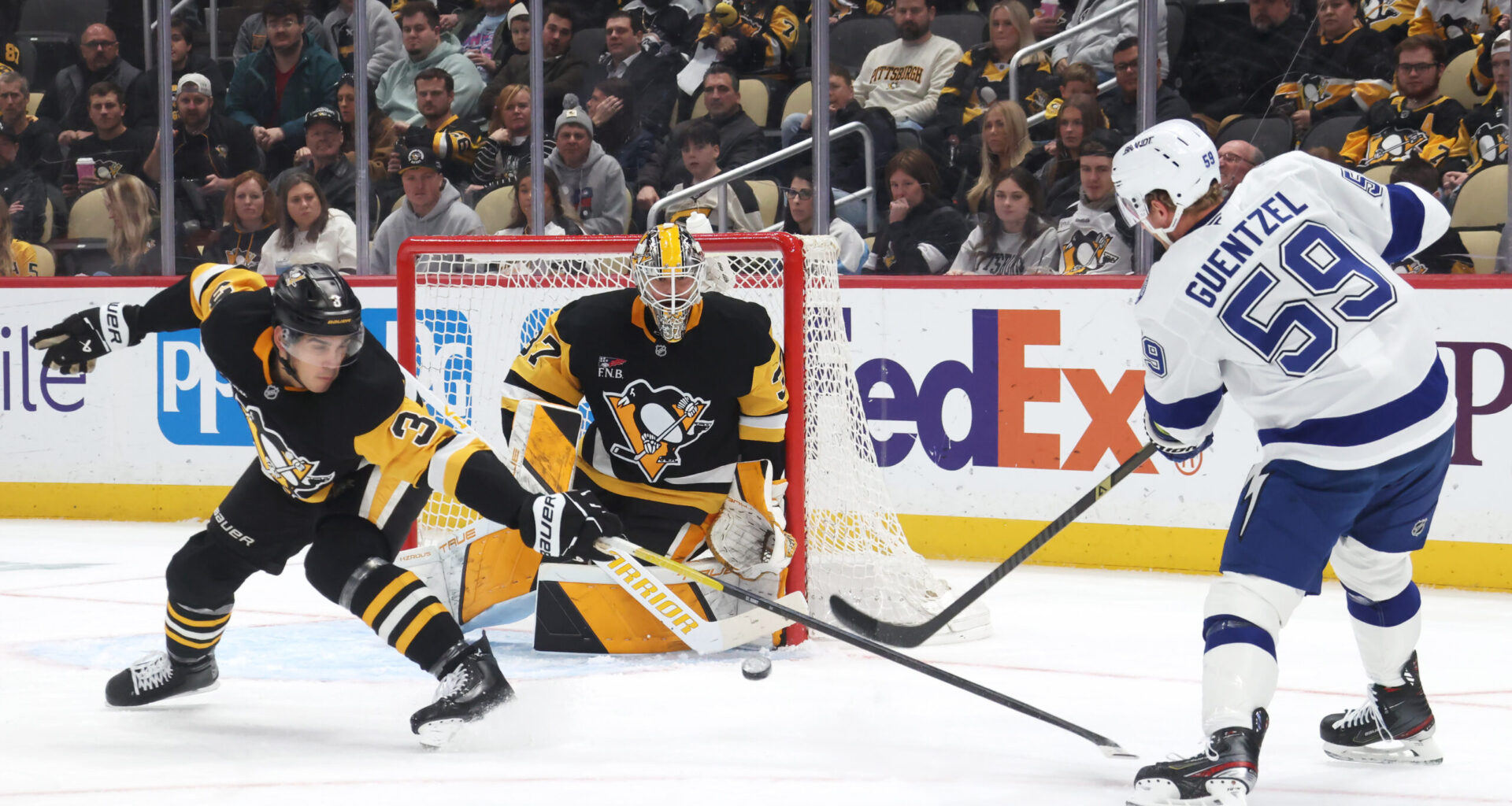
The Pittsburgh Penguins’ scoreless streak began to run like the national debt clock. Seconds became minutes became periods. As the seconds ticked away in the third period against the Tampa Bay Lightning, and just before the Penguins hit seven-plus periods without a goal, Evgeni Malkin lit the lamp.
Glory be and Hallelujah. After 148:27, the Penguins remembered how to score a goal. If Penguins broadcasting legend Mike Lange were on the radio call, they could have been aptly described as not scoring since the eighth-grade picnic.
Malkin’s goal at 17:44 of the third period finally broke the Penguins’ dry spell but also tied a well-played hockey game, 1-1, and forced overtime. And forced a shootout.
Despite Arturs Silovs winning his last shootout, the Penguins’ goalie was again disappointed after an otherwise brilliant performance, and Tampa Bay won 2-1 in the skills competition at PPG Paints Arena.
The Penguins are 1-7 in shootouts this season. And it seemed Tampa Bay was playing for a shootout, too. They were caught trying to slow-play the extra time, and the Penguins nearly took advantage.
But when the game went to the shootout, the Penguins were again befuddled. Only Egor Chinakhov scored, as Sidney Crosby frustratingly didn’t even get a shot on his attempt. Silovs allowed two of three to score.
Tampa Bay has won 11 in a row. The Penguins are winless in three and have scored two goals.
“We played well. I don’t think we gave them too many good looks–with a team that’s got that many skilled players who score a lot of goals. We’ve been on a bit of a run here to kind of limit (opponents) five-on-five, especially not a ton of good chances,” said winger Bryan Rust begrudgingly. “I thought we played really well. We had a lot of chances of our own, but I think we just need to score a few more of those.”
The Penguins almost won the game a few times in overtime, and they earned a hard-fought point.
Yet, there were some salty feelings in the locker room. Like Sunday in a 1-0 loss to Boston, the Penguins played well enough to win, but watched with some disgust as chance after chance was turned away or that extra play evaporated without a goal.
Rust had three glorious chances in overtime as he got behind Tampa Bay defensemen and cut across the crease with his vintage forehand move. He played a stellar game, but there were no smiles and no second goal.
They couldn’t feel too bad, even if they kind of did.
“Even in the two games prior, we’ve done a lot of good things, and I wouldn’t have been surprised if we came up with wins in all three of those games. So, I think tonight was another story that we played really well all through the lineup,” said defenseman Brett Kulak. “And I thought Vasilevsky was a bit of a brick wall for them, on most of our Grade A scoring chances, but we had a good game.”
There were a few moments of utter confusion and controversy in the game. Tampa Bay’s goal could have been whistled down as Silovs caught the initial shot. After a moment or two, the puck was no longer in his glove. He didn’t know it, and the puck was within his stance, but defenseman JJ Moser raced to the net to poke it into the net as the Penguins turned away, assuming the play was over.
“In my mind? I thought it was like pretty long time (without a whistle), but, you know, the referee sees it otherwise. So I can’t really say,” Silovs said.
It was a judgment call and could have gone either way. After all, there are still salty Nashville fans who remember the 2017 Stanley Cup Final, Game 6.
Refs and Reaction
Referees also had a tough night. They got the calls right, but it took some work and plenty of confusion with the clock operators to get there. They overturned their first minor penalty on the Penguins in the first period when they huddled to correctly rule Tampa Bay’s Brandon Hagel had fallen by himself, with no help from the Penguins (who were several feet away).
Refs also bungled Connor Clifton’s concurrent fighting major and boarding major. The scoreboard never had the boarding major, and Anthony Mantha didn’t step into the box to serve it until only 43 seconds were remaining in the boarding penalty.
Just imagine if there hadn’t been a whistle to allow everyone to figure out the mistake at the last second.
For his part, Clifton owned his boarding mistake.
“I’m committed to the hit. I watched it live on the iPad after, and yeah, I got him from behind, definitely a board,” said Clifton. “But I feel like he committed. And then he kind of chipped it in, instead of coming around and trying to enter the zone with the puck, which I thought he would. Yeah, unfortunate, but we ended up killing it off.”
Refs also seemed to overturn themselves on a call against Jack St. Ivany later in the third. St. Ivany skated over to the awaiting open door of the penalty box, but they made no call.
They were fooled by Jake Guentzel, who drew an interference penalty against Clifton in the middle of the second period. Guentzel went flying behind the Penguins’ net like a Hollywood stuntman in a bar-fight scene.
However, Chris Rooney and Furhman South got the calls right–probably even the Silovs whistle–and they called a good game, albeit with a few detours.
Penguins Analysis
The Tampa Bay tactical game was extraordinary in the first period and part of the second.
Tampa Bay seized on the Penguins’ dearth of skating defensemen without Erik Karlsson in the lineup and largely controlled the neutral zone. The Penguins were, at best, OK getting out of their own zone, but did so without speed or aggression.
The Penguins’ neutral zone game was not as good or structured, but they did take away enough of the middle of the ice that Nikita Kucherov’s blistering shots were from 30 or more feet, and Silovs could see them.
In fact, the Penguins’ defense did a nice job of keeping Silovs clean for 65 minutes.
In turn, Silovs did a nice job of bailing out his team when they needed it.
The Penguins’ rush game was matched by Tampa Bay’s neutral zone set–the Penguins very rarely had a numbers advantage. Even connecting stretch passes seemed to be into the swarm of Tampa Bay defenders.
For the second consecutive game, the Penguins’ offensive game came to life in the second half of the game.
What the Penguins did well was move the puck and, quite simply, move. They didn’t race around the perimeter like last-second Christmas shoppers circling the parking lot, hoping for space. Instead, the Penguins began to skate with the puck into the dirty areas, forcing reactions by Tampa Bay’s defense. They won more puck battles, which created space and lanes, and then moved the puck to the open man.
The Penguins began to get chances, or at least the top line with Bryan Rust, Sidney Crosby, and Rickard Rakell did.
The middle six? Sporadic.
Highlighting the Penguins’ current battle with getting the puck across the line, as they opened up the game in the second period, they also got far too cute, including Sidney Crosby, passing up good shots and instead looking for a pretty connection and a sure goal.
They got neither, and their scoreless streak reached 130:43 after the second period.
Penguins Report Card
Team: B
It’s difficult to grade a team in a game that drags on without either team scoring. For the first 30 or so minutes, the team was hanging on like a boxer who is outmatched, avoiding the knockout punch but unable to throw power punches in return.
Once the Penguins had the space, they played well–but are still searching for chemistry in the O-zone. An extra pass replaced a good shot. Traffic at the net was more drive-by than impactful, and Andrei Vasilevskiy made plenty of good saves.
Arturs Silovs: A+
He stopped 30 of 31.
The Penguins’ goalie was tested. Tampa Bay clearly had a scouting report and they went high blocker-OFTEN. Silovs popped about a dozen of those shots to the corner or high into the air, away from the net.
He was on his game with very good rebound control. The only goal was one of those bad luck bounces.
The further away he gets from the team’s December slide, the better he looks and the better his numbers look.
Bryan Rust: A
He’s a difference maker. He had six shots and as Tampa Bay made the middle of the ice a no-go, he broke inside. Rust may have changed the Penguins’ game with his low-zone hustle.
Noel Acciari-Blake Lizotte: A+
Lizotte celebrated his new contract with one of his best games of the season. On the major penalty kill, Acciari and Lizotte spent considerable time with the puck and in the offensive zone. It was one of the most impressive kills of the season.
The line with Connor Dewar also had the best chances of the first period. Lizotte is always high-energy, but he was even a little bit more Tuesday.
Kris Letang: A
There were plenty of people who wear suits to the games who were concerned about Karlsson’s absence and the effect on Letang. Would Letang try too hard? Would he try to play his high-flying, high-risk game to make up for the hole on the blue line?
Nope. Letang played a perfectly solid game. The Penguins’ power play got better with each chance, and he judiciously picked his spots to charge ahead.
Evgeni Malkin: Yep
You began to see his game coming into focus. The direct attack. The precise and creative puck movement. He was very good on the power play and very good in the third period. The puck followed him, and he was going to decide the game.
Egor Chinakhov: Quietly Good
Chinakhov continues to impress with a complete game. He needs to be more aggressive in the offensive zone. His wrist shot is wicked. He hit the post with a good tip, but he also made several defensive stops.
Split Decisions
No Penguins player had a poor game. But some could be judged with positives and negatives.
Tommy Novak: He had a few high-danger scoring chances, but he didn’t do much with them. He wasn’t stiff on the walls, which yielded possession.
Connor Clifton: He was fine. But that boarding penalty was a bad move.
Ben Kindel: The rookie was forcing the puck Tuesday. Three times, he charged into several defenders, trying to beat them at the blue line, but lost the puck.
Justin Brazeau: It wasn’t his best game. The Penguins need more big bodies playing like big bodies–creating chaos near the net, winning wall battles, and owning pucks. Brazeau wasn’t at his best in the no-space game.
Tags: arturs silovs Penguins Analysis Pittsburgh Penguins Tampa Bay Lightning
Categorized: Penguins Analysis