
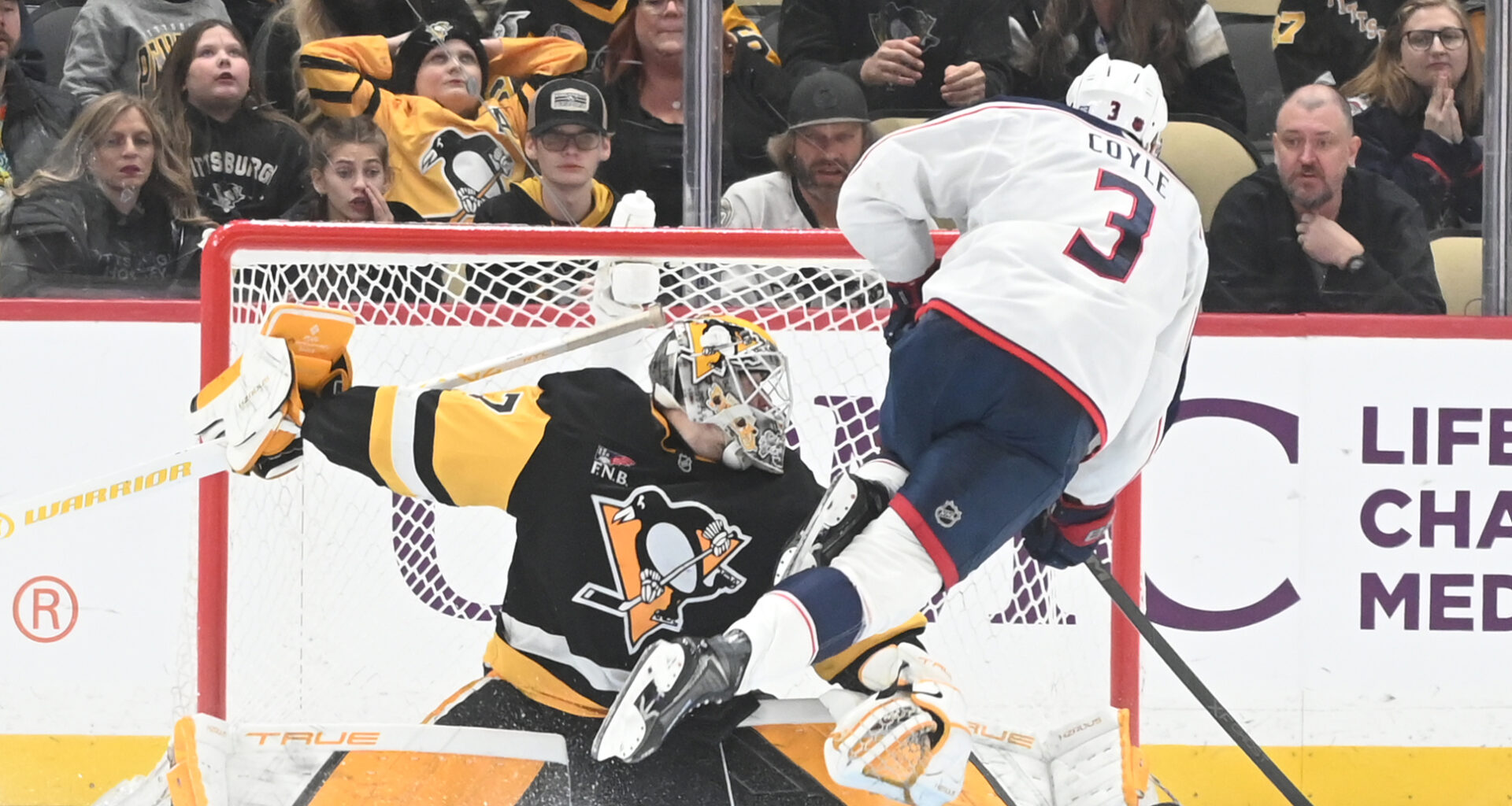
Arturs Silovs is shouldering a massive amount of blame for the Pittsburgh Penguins’ continued shootout woes. Silovs fell to 1-6 in shootouts this season, and the team is 1-7.
The Penguins rallied against themselves and their opponent, the Columbus Blue Jackets, on Saturday, forcing overtime and eventually, the dreaded, not-safe-for-work viewing shootout.
The Penguins earned a point, but lost 4-3 in the skills competition to Columbus at PPG Paints Arena.
While the focus is on the Penguins’ goalie, he stopped two of the first three attempts, but the Penguins’ shooters (Rickard Rakell, Sidney Crosby, Egor Chinakhov, and Bryan Rust) scored only once in four rounds.
Chinakhov has scored in two straight attempts and was the only scorer in black and gold.
“The first one they scored, you know, I felt I was all over it, and it somehow found a way,” Silovs said. “I think it’s just, yeah, we’re just going to keep working on it. And I think we’re getting better, but I think there’s still another level.”
Silovs has indeed struggled this season, but eventually, the Penguins also have to score. Before demanding something extreme and that absolutely will not happen–like putting Stuart Skinner in the net for the shootout–cast a good bit of blame on the skaters, too.
A 25% success rate isn’t going to win many shootouts, regardless of the goalie.
“Yeah, it’s gonna have to be all (video, practice, and one-on-one work). It’s costing us points, so we’re going to continue to work at it. I think each night, there’s a different story to it,” said coach Dan Muse. “I mean, I thought (Silovs) made a couple of big saves, gave us a chance in it. And you know, we also need to score goals. So it’s both sides. And so we got to put work on both sides.”
However, the extra-time loss was also in part due to the Penguins’ near-maddening inability to score in overtime. They blitzed Columbus from the opening faceoff but never lit the lamp.
Evgeni Malkin had a pair of wristers at point-blank range but couldn’t find the net behind Columbus goalie Elvis Merzlikins. Ben Kindel had a breakaway, too.
While attention is being paid to the shootout performers, a couple of facts should be noted.
First, the Penguins do not have players who are especially good at the shootout. They just don’t.
The Penguins practice shootouts, and many players have shown their moves. Trust me, there isn’t a diamond in the rough hiding within the lineup; not Ben Kindel, Rutger McGroarty, or even Brett Kulak.
Honest, one of the best Penguins at the shootout is Kevin Hayes. He learned the slow, slower, sloooowwwerrrrr move that opens up goalies. Hayes is 1-for-1 this season, but there isn’t a place for him in the current lineup.
Second, an idea: one item Silovs might want to try is a poke check. Charlie Coyle scored the shootout winner because he was allowed to make three moves. I’m sure a few guys can pass along Marc-Andre Fleury’s number. Fleury was the undisputed master of the shootout poke check and the winningest shootout goalie in history.
Silovs is stopping just over one-third of shootout attempts. Just a thought.
Penguins Analysis
The Penguins alternated between dialed in and a step behind themselves. They were genuinely awful in the first five to seven minutes of the first period, but then rallied to dominate Columbus for the final 12 minutes, not allowing a shot. And they were pretty terrible for a good chunk of the second period, too.
It was a back-and-forth tactical battle that was also decided in part by the Penguins’ level of play. Their mood swings were dramatic, and there was no middle ground.
In their better moments, the Penguins were playing an aggressive chip-and-chase game to create a forecheck and more rush opportunities. Especially the Penguins’ top line with Crosby, Bryan Rust, and Rickard Rakell. They were pressuring Columbus on every shift by getting on pucks down low and working behind the defensemen.
It was textbook.
“Just try to outwork them, get pucks behind them, and force them to play a lot of defense,” said Rust. “And I don’t think they have guys who necessarily love to play defense. We just tried to outwork them.”
However, Columbus also had a response to the Penguins’ rush game. They protected the house with several, if not four, bodies. They ceded shots from good areas, but those shots often met bodies, and there was certainly no room for down-low passing.
The Penguins were terrific. And the Penguins were brutal.
“I mean, it’s a tight game, we had chances. They had some chances. I mean, it was pretty even, relative to the score,” Crosby said. “I think we would have liked to have our power play sharper, and maybe that’s a difference, but even over time we possessed the puck a lot, so unfortunately, we couldn’t get the next one.”
The Penguins were great for most of the third period, and they were sharp in overtime. Columbus scrantly touched the puck, but the Penguins … never scored.
Penguins Report Card
Team: C+
There are two reasons for the barely passing grade. First, the terrible start. For the first seven minutes of the first period and a sizable portion of the second, Columbus was on its game and aggressive, while the Penguins’ passes plunked the back of teammates’ skates or missed by several feet, screaming out of the offensive zone. And they fed Columbus’s attack.
The second reason for the low grade is the lack of finish. The Penguins had glorious chances. So many. Yet, they needed an extra attacker goal to earn a point and didn’t win in overtime, when they should have. The Penguins had no less than a half dozen chances in OT.
Arturs Silovs: B
There wasn’t a soft goal in the bunch. The Penguins seemed to lose their bearings a few times, leaving Columbus with unobstructed rips at Silovs. He made enough good saves to keep the Penguins in it.
Penguins Power Play: F
The team was 0-for-3 and had four shots. However, it was PP2 that seemed to find success. PP1 was, for the most part, a disaster. Shots and passes caromed out of the zone. They failed to set up and pressure Columbus.
Connor Clifton: A+
I absolutely loved his game. It was a bit wild, but he also threw caution to the wind and jumped into the play like he was an offensive defenseman. He inexplicably pulled up on what would have been a short breakaway, but he scored a big goal in the first period by stepping into the circle to snap a good shot, and he was buzzing with the puck in the offensive zone.
Evgeni Malkin: A
If you watched the game, I swear you saw something you have not seen in a couple of years: That vintage, fearsome Malkin gallop. That very unique, up on his toes, powerful skating stride when he has the puck that tells his team and the defenders that he is going to do something. Now.
Malkin was visibly faster Saturday. He was flying.
And, Tommy Novak is figuring out how to play center beside him–after all, Malkin was all over the ice, taking the center’s role, playing the wing … where the puck was, so was Malkin. Novak let Malkin lead and complemented him well.
“I think the lines they’re generating chances. I think even coming out of the belly– coming out of the zone–tonight, they were able, especially early on, to generate a good amount of speed coming up ice.”
Mantha-Kindel-Brazeau: More
The towers and the rookie didn’t have a great night. They had possession and some shots, but they had just one high-danger chance, according to NaturalStatTrick.com, and that lines up with the eye test. They just weren’t very dangerous.
Tags: Columbus Blue Jackets Penguins Analysis Penguins game Penguins report card Pittsburgh Penguins
Categorized: Penguins Analysis