
For the first time in a long time, the Montreal Canadiens can look at their blue line and feel something that has been missing for years: stability. Not just short-term competence, but a long-term vision that is already taking shape at the NHL level. While the Habs are still a young team finding consistency, their defensive group might quietly be positioning itself to become one of the strongest defensive cores in the league over the next several seasons.
This isn’t a projection built on hope alone. The pieces are already in place, the contracts are secured, and the pipeline behind them is strong. For a rebuilding team, that combination is gold.
The Group and the True Core
The current blue line features Lane Hutson, Noah Dobson, Alexandre Carrier, Mike Matheson, Kaiden Guhle, Arber Xhekaj and Jayden Struble. It’s a group with variety, puck movers, shutdown defenders, physical presences, and, more importantly, clear role definition.
At the heart of it all sits the true core: Hutson, Dobson, Matheson and Guhle. Hutson is the engine. His offensive instincts, edge work, and ability to manipulate space already make him a unique defenseman in the NHL. He’s the type of player you build systems around, not just pairings. His ceiling as a top-pair, game-driving defenseman is extremely high.
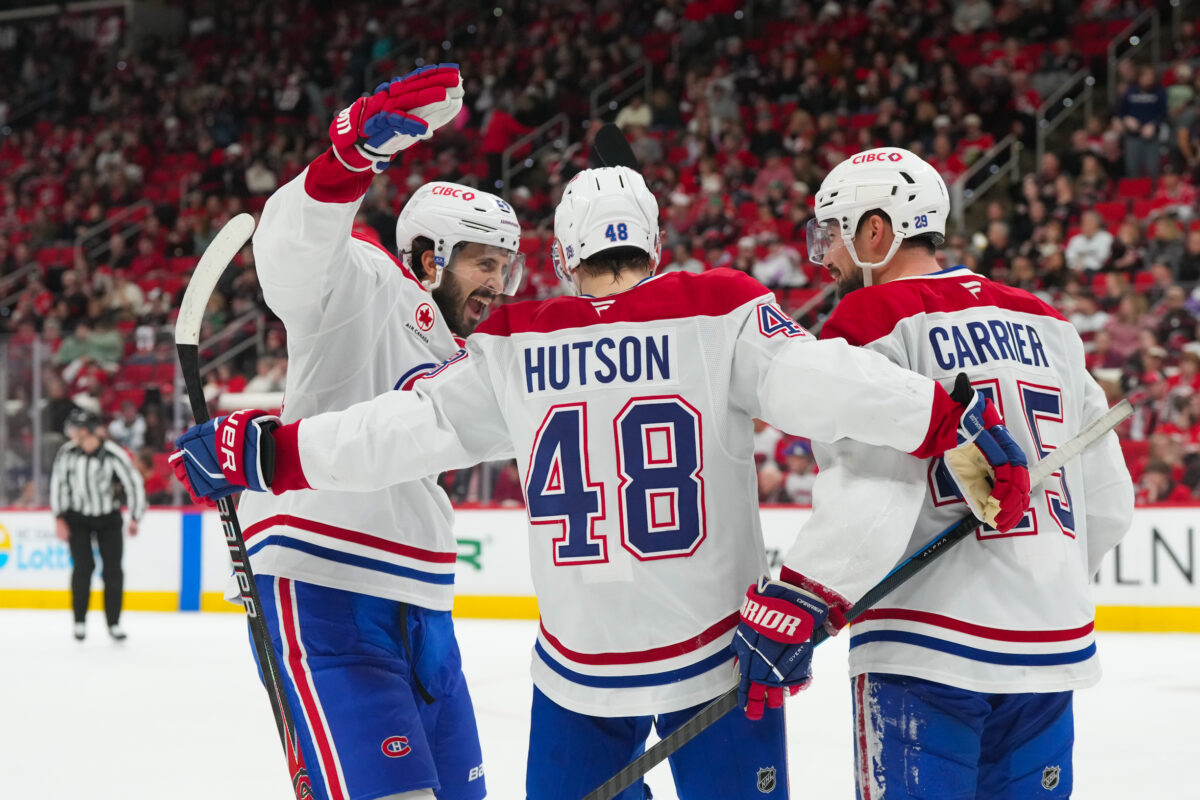 Montreal Canadiens defenseman Lane Hutson celebrates his empty net goal with center Phillip Danault and defenseman Alexandre Carrier against the Carolina Hurricanes (James Guillory-Imagn Images)
Dobson brings a different but equally important element. He’s the stabilizer: big minutes, physical, reliable in all situations, and capable of contributing offensively without cheating defensively. Dobson gives the Canadiens something they’ve lacked for years: a true right-shot anchor who can match up against top competition.
Matheson remains a crucial piece despite being older than the rest of the core. His skating, transition game, and experience allow him to support younger players while still playing big minutes. He bridges the gap between the present and the future, and his game has aged well. He also took huge steps defensively.
Guhle rounds out the core as the defensive conscience. He’s physical, composed, and comfortable playing against elite forwards. Guhle may not always show up on the scoresheet, but his value becomes obvious in tight games and playoff-style hockey.
Related: 3 Players the Canadiens Need More From to Finish the Season
Xhekaj and Struble currently occupy depth roles as sixth or seventh-defensemen. Both bring physicality and energy, and both have proven they can survive NHL minutes. That said, their long-term spot in the lineup is far from guaranteed. As the organization continues to develop higher-ceiling prospects, those depth roles will eventually be up for grabs.
Continuity and Internal Pressure
One of the biggest issues that plagued the Canadiens for years was constant turnover on the blue line. Pairings changed, roles shifted, and there was never a sense of continuity. That’s starting to change. Continuity doesn’t mean stagnation; it means allowing players to grow together while maintaining internal competition. That’s exactly what Montreal is building.
Adam Engstrom and David Reinbacher need to put some pressure on those guys in front of them. Engstrom has already shown he’s close. He played a few NHL games this season and looked comfortable, and he’s been very good with the Laval Rocket. His mobility, decision-making, and calm puck movement fit the modern NHL perfectly. He’s pushing for a spot sooner rather than later.
Reinbacher, meanwhile, is finally enjoying a healthy season. After dealing with setbacks early in his development, he’s starting to find rhythm and confidence. His profile as a right-shot, two-way defenseman with size and structure makes him a natural long-term replacement or upgrade within the group.
That internal pressure is key. It forces players to stay sharp, keeps competition healthy, and ensures the organization doesn’t have to rely heavily on external acquisitions to fix holes.
Being Set Early Is a Massive Advantage
Perhaps the most underrated aspect of this blue line is timing. Having your defensive core established this early in a rebuild is a huge advantage. It allows management to focus on other areas, forward depth, scoring support, and long-term goaltending, without constantly worrying about the foundation.
Contractually, the situation is even better. The core four, Hutson, Dobson, Matheson, and Guhle, are locked in until at least 2031. That kind of cost certainty and long-term control is rare, especially for players capable of playing top-pair minutes.
It gives the Canadiens flexibility. They can be patient. They can take calculated risks elsewhere in the lineup. When the team is ready to take a real step forward, the blue line won’t be a question mark; it will be a strength.
If development continues on its current path, Montreal’s defense won’t just be good. It could be among the league’s best for years to come.
