
DETROIT — Things aren’t going so hot for the Ottawa Senators right now.
The Senators entered Sunday’s game in Detroit having lost five of their last seven, including blowing a two-goal lead in the final five minutes of regulation one day prior against Montreal. Their goaltending has been among the NHL’s worst, and on Sunday they turned to veteran James Reimer, who was making his first start of the season after signing in Ottawa this week. Which is all to say: The Detroit Red Wings were catching the Senators at a good time.
And yet, over the last few years, every game against Ottawa has felt like a test for the Red Wings, both physically and emotionally. There’s of course the infamous two-game set in Ottawa that helped torpedo Detroit’s season three years ago, and a scary injury to Dylan Larkin the following season. Last season, all four games between the teams were decided by one goal — and the Senators won three of them en route to the playoffs.
For two teams who were on parallel rebuilding timelines for many years, it’s made for a budding rivalry.
“The games are always emotional against this team,” Red Wings coach Todd McLellan said. “And tonight (that) was the case as well.”
True to form, the score was tied after 60 minutes. But after Alex DeBrincat scored 36 seconds into overtime, the Red Wings emerged with a 4-3 win, moving to 2-0 on the season against the Senators and passing an important test in the process.
Here are five thoughts on how it all played out.
1. The Red Wings have battled slow starts for much of the season, and Sunday they dug an especially quick hole, going down 2-0 in the first 5:05.
First, it was Drake Batherson cleaning up a rebound after John Gibson made a pair of saves in tight, and then — after the Red Wings took a penalty just 21 seconds later — it was Dylan Cozens on the power play, beating Gibson with a slick move to the backhand in the slot.
“We weren’t, obviously, too pleased with our start,” McLellan said. “We had a poor sort out coming into our end and left the net-front wide open, and then the penalty kill — complete control and we don’t get the puck out; all of the sudden you’re scrambling.”
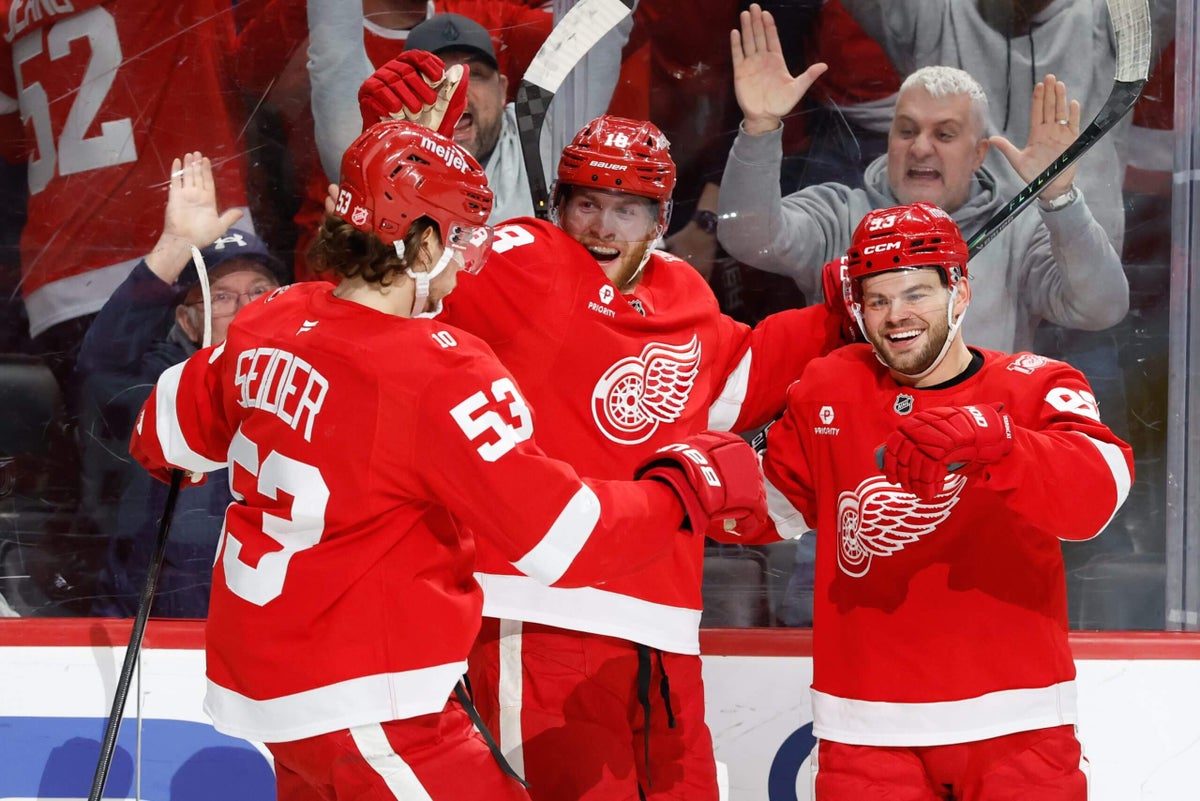
This season’s Red Wings, though, have shown to be more resilient than past years’ teams. Detroit got its own look on the power play shortly after going down 2-0, and Axel Sandin-Pellikka took advantage with a goal from the point. Lucas Raymond scored a pretty goal on the rush early in the second. And James van Riemsdyk had the highlight of the night, going between his legs at the net front on a power play late in the second to give Detroit a 3-2 lead.
JVR between-the-legs beauty! #LGRW pic.twitter.com/LCU4ua59sz
— Detroit Red Wings (@DetroitRedWings) January 18, 2026
The Red Wings surrendered that lead with another power-play goal against in the final minute of the second, but it didn’t unravel them, as both sides played a fairly even third period before DeBrincat won it for Detroit in three-on-three.
2. Physicality is a huge part of Ottawa’s identity, and it’s a big reason they’ve had success against the Red Wings in recent seasons.
Detroit doesn’t have a Brady Tkachuk, whose physicality sets the tone for the Senators’ game. And in fairness, neither do plenty of other teams. Tkachuk’s a unique player as someone who brings that hard edge while also being a legitimate All-Star talent.
But the key for the Red Wings is finding a way to not get pushed around. And they did that.
Ottawa took its shots early — first with Tkachuk going after Elmer Söderblom near the Senators bench in the first period, leading to a huge scrum and five penalties, and then with Ridly Greig clipping Raymond on a fly-by midway through the second. Raymond missed the second half of that period due to “some protocol that we have to go through,” McLellan said, which left Detroit without its leading scorer until the start of the third period.
There wasn’t a big, cathartic fight at center ice for retribution — though Söderblom did return the favor on Greig, taking an interference penalty on a nearly identical play to the Raymond hit, which the Senators capitalized on with a power-play goal. And Detroit didn’t score on either power play created by Tkachuk and Greig (though the Red Wings did on two others, including a Nick Cousins elbow). But the key was they didn’t get pushed out of the game or deterred from the harder areas of the ice. They didn’t get emotionally hijacked. And they came out with the win.
Again, that’s a sign of growth for this group.
“I think we’ve done a lot better job of it,” DeBrincat said. “I think today was great. I think we’re sticking up for each other. It doesn’t always have to be a fight, but getting in there, power play made them pay on that first penalty, and I think that was a big momentum swing there.”
3. I still think the Red Wings could stand to add some edge at this trade deadline, primarily in a top-four blueliner but also in a forward who can score in the hard areas of the ice.
They have some scorers who can do damage from distance, and it was important that DeBrincat and Raymond did so Sunday. But you do wonder whether the Red Wings’ chances Sunday would have still amounted to four goals if they had been facing a playoff-caliber No. 1 goaltender. Finding another forward who can score in the hard areas of the ice would help with that.
That being said, Marco Kasper showed a lot of that ability over the second half of last season, and he appears to be finding his game once again. After a quiet start to the season, with just six points in his first 47 games, he had a two-point game Friday and then another assist Sunday, setting up Raymond. He was moved up to Detroit’s top line midgame and was noticeable for most of the game again.
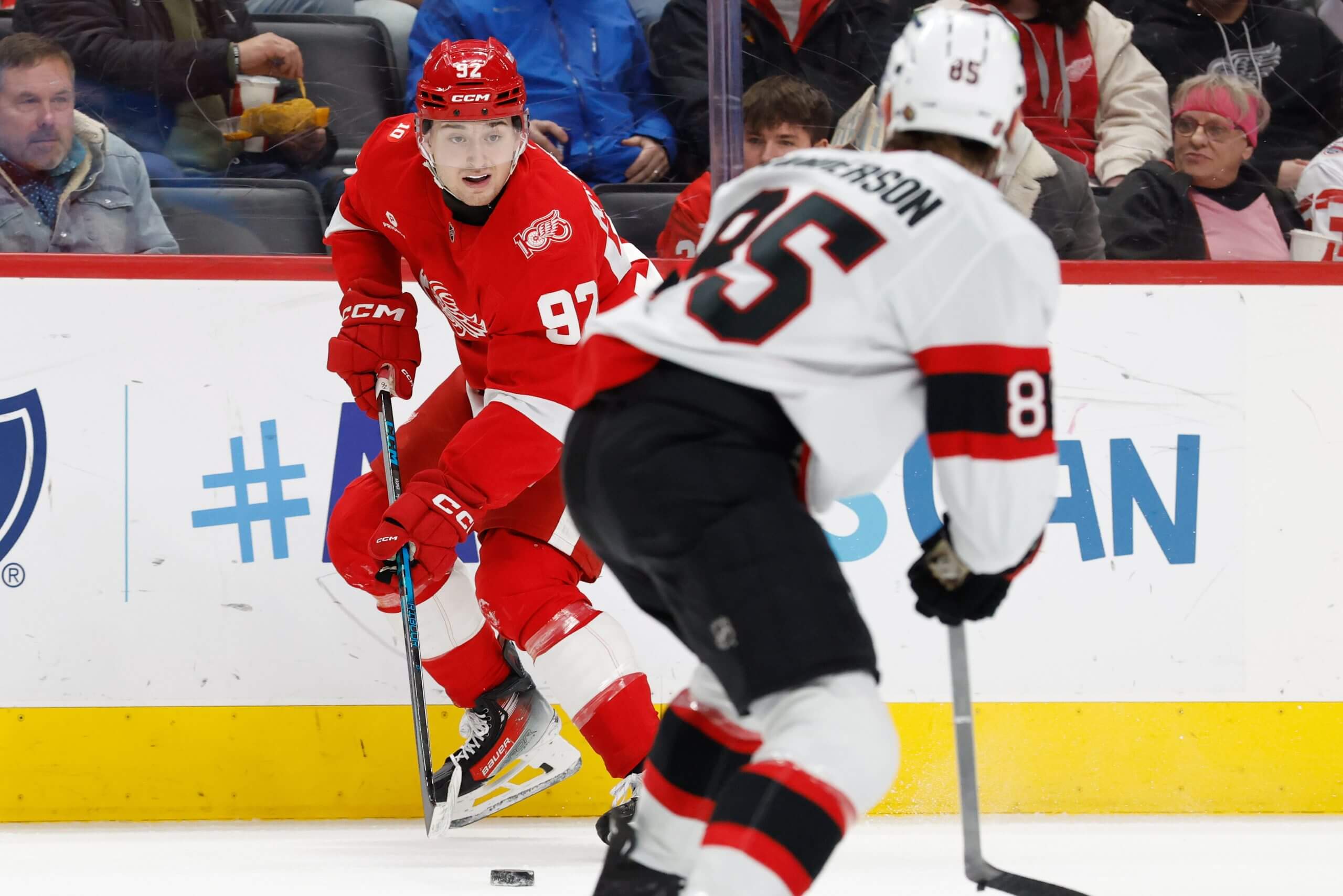
Marco Kasper is starting to find the same form he finished last season with. (Rick Osentoski / Imagn Images)
4. Perhaps more subtly, I thought Söderblom was quite good as well. His penalty on Greig did cost Detroit a goal, but his physicality and ability to play below the goal line both stood out, which is really the core of his recipe for success.
“Not just tonight, but since he’s come back into the lineup he looks like the player that we need, over and over and over again,” McLellan said. “And give him credit, he sat with the coaching staff, kind of clarified some things, he worked really hard during his break, and now he’s hungry and wants to stay in the lineup.”
If those two young players can consistently establish themselves in the hard areas of the ice down the stretch, it really changes the look of Detroit’s lineup for the better.
5. Van Riemsdyk and Andrew Copp have both gotten plenty of attention for their surges over the last two months, giving the Red Wings crucial secondary scoring. And they both were again a big part of the story: van Riemsdyk scoring the pretty goal to give Detroit its first lead, and Copp with two assists, including on the overtime winner.
Both are the kind of savvy veterans the Red Wings are going to need to rely on as the games get harder, and neither is showing any signs of slowing down right now. Copp is up to 30 points in 50 games and has a chance to threaten his career high of 53 (2021-22) with a big finish.