
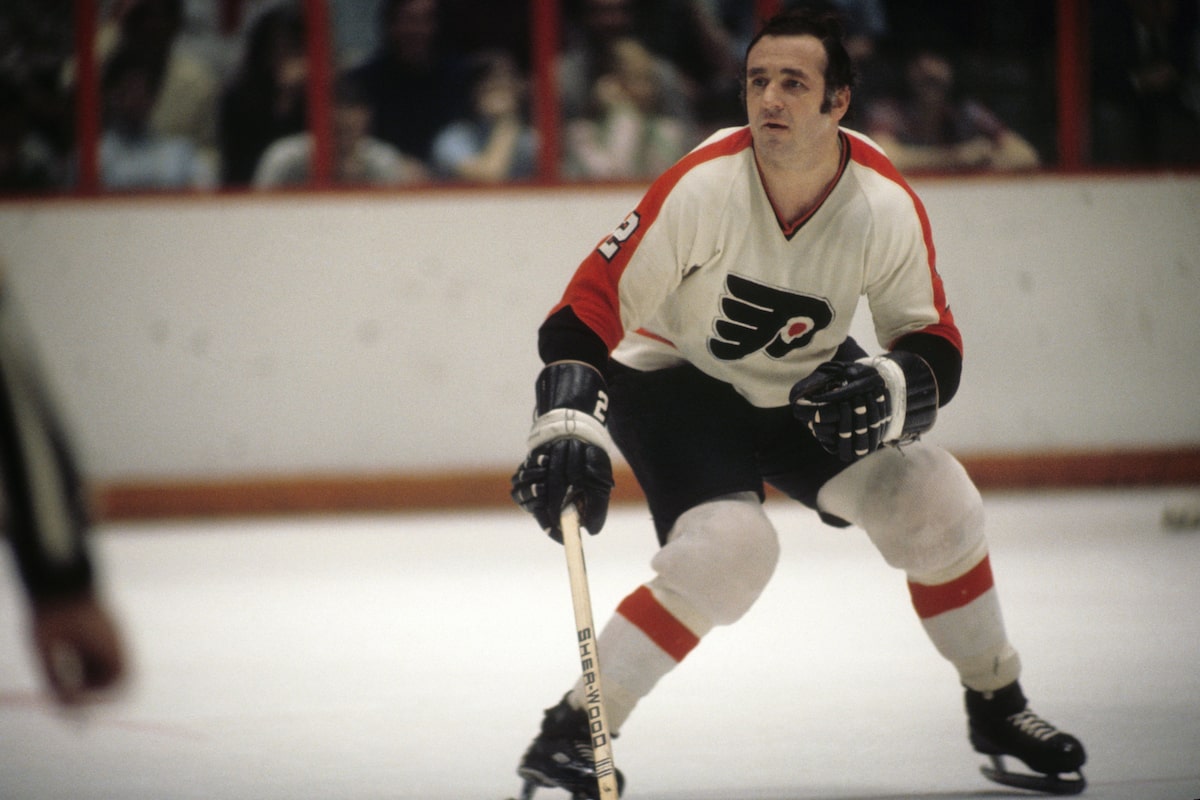
Ed Van Impe of the Philadelphia Flyers skates during a circa 1970s game at the Spectrum in Philadelphia. Mr. Van Impe was a stalwart on Philadelphia’s blueline when the Flyers claimed Stanley Cup championships in 1974 and 1975.B Bennett/Getty Images
Ed Van Impe skated from the penalty box on a beeline for a Russian opponent. He caught Valeri Kharlamov with a right forearm and possibly an elbow to the head, leaving the superstar prone on the ice.
The check thrown by Mr. Van Impe, who has died at 84, sparked an international incident, heating up the Cold War.
Referee Lloyd Gilmour did not call a penalty even as Soviet players demanded one. In protest, the Red Army coach pulled his team from the ice. The referee assessed them a minor penalty for delay of game. The Soviets then retreated to their dressing room.
While 17,077 fans at the Spectrum in Philadelphia booed, a television audience heard Bob Cole deliver one of the most famous calls in a century of hockey broadcasting: “They’re going home! They’re going home! Yeah! They’re going home!”
The Soviets stewed for almost 20 minutes before returning to play, likely after being told there would be financial penalties for not completing the game as part of Super Series ’76, an eight-game exhibition series pitting the Red Army and the Soviet Wings clubs against eight National Hockey League teams.
Mr. Van Impe’s body check at 11:21 of the first period of an exhibition game on Jan. 11, 1976, is remembered today as an exemplar of the pugilistic mayhem of the Philadelphia Flyers, a team nicknamed the Broad Street Bullies for the street address of their home arena.
The 5-foot-10, 205-pound (1.78-metre, 92-kilogram) defenceman was far from the most felonious player on the Flyers, a team of roughhouse recidivists with such nicknames as Moose, Battleship and The Hammer.
For his part, Mr. Van Impe denied he had committed a foul on the Russian forward.
“He was looking down to pick up the puck,” Mr. Van Impe said after the game. “And when he looked up, I was there.”
The Flyers opened the scoring just 17 seconds after play resumed on their way to a 4-1 win, the only victory by an NHL team in the Red Army’s four-game exhibition series, which notably included a 3-3 tie with the Canadiens at the Forum in Montreal on New Year’s Eve, 1975.
Mr. Van Impe was a stalwart on Philadelphia’s blueline when the Flyers claimed Stanley Cup championships in 1974 and 1975, the apex – or nadir, depending on one’s opinion of violence in hockey – of a tough-guy era in pro hockey.
Philadelphia sportswriter Chuck Newman once wrote that Mr. Van Impe “speaks with the flair of an English lord and plays hockey like the Marquis de Sade.”
A stay-at-home defenceman known for his bruising body checks, Mr. Van Impe also had a reputation for using his stick to hook, slash, spear and otherwise pester attacking forwards. His deft stickwork was reminiscent of swordplay, earning him the nickname Zorro.
Such shenanigans often caught the disapproving eye of the referee, making the penalty box as familiar to Mr. Van Impe as a second home.
The defenceman skated in the NHL for 11 seasons, an achievement considering he spent six full seasons in the minor leagues where he gained more attention from referees than scouts.
Edward Charles Van Impe was born in Saskatoon on May 27, 1940, an only child for the former Lillian Rose Hillert and François (Frank) Joseph Van Impe, a Belgian-born cattle buyer.
The boy got his first pair of skates at age six from an older cousin, though he had to stuff material in the boot to make it fit.
After four amateur seasons with the Saskatoon Junior Quakers, he was invited to the 1960 training camp of the NHL’s Chicago Blackhawks, after which he was assigned to the Calgary Stampeders of the Western Hockey League.
In five seasons with the minor pro Buffalo Bisons, Mr. Van Impe became known as an unrepentant scofflaw, leading the American Hockey League in penalty minutes with 196 and 193 minutes in successive seasons, or the equivalent of more than three full games. In one 1962 match in Buffalo against Baltimore, the rugged defenceman was sentenced to five minors, one major, one misconduct and one game misconduct for a total of 35 minutes, setting a new league record for malfeasance. He was also fined $75.
After his first season in Buffalo, the Toronto Maple Leafs grabbed his rights for $20,000 in the interleague draft, immediately assigning him to a minor-league team operated by the notorious Eddie Shore. When a disgruntled Mr. Van Impe reported late to camp, he was fined $250 and offered a $300 pay cut to his salary. He quit the team after two practices. Chicago regained his rights.
Though he won a Calder Cup championship with Buffalo in 1963, the rugged rearguard began to despair of ever being called up by the parent club. To his surprise, he made the Blackhawks as a fifth defenceman after training camp for the 1966-67 season by beating out John Miszuk, a Polish-born Displaced Person who only learned to play hockey at age 12 after coming to Canada. Mr. Van Impe then had the good fortune to be paired with Pat Stapleton, a slick, puck-rushing defenceman whose style complemented Steady Eddie’s preference to stay close to his own goal.
“My job’s to stop goals being scored,” he once said, “not score myself.”
When the NHL doubled in size for the 1967-68 season, Chicago left Mr. Van Impe unprotected in the expansion draft. He was taken in the third round, No. 16 overall, by the Flyers, the expansion franchise’s first skater taken after goaltenders Bernie Parent and Doug Favell.
Mr. Van Impe was named team captain in his second season with the club. Two days later, he was on the ice for at least three of the six goals scored by Red Berenson when the St. Louis Blues humiliated the Flyers 8-0 at the Spectrum. Despite that unpromising start to his captaincy, Mr. Van Impe remained captain until being demoted to alternate with three other skaters at the start of the 1972-73 season. Bobby Clarke was then promoted to captain three months later.
The Flyers defeated the Boston Bruins in six games to claim the Stanley Cup in 1974, becoming the first of the expansion teams to win the NHL championship. Mr. Van Impe spent much of the season paired with rookie Jimmy Watson of Smithers, B.C., whose brother Joe was also on the club.
“You can‘t just be lucky, you have to be good,” Mr. Van Impe said after winning the Cup. “Our sense of good is hard work.”
The Flyers repeated the following season, the last team to win the Stanley Cup with a roster of players all born in Canada.
The defenceman saw less action in the 1975-76 season before being traded to Pittsburgh late in season. He skated in 22 games for the Penguins over two seasons before retiring.
In 703 NHL games, he scored 27 goals with 126 assists while accumulating 1,024 penalty minutes, the equivalent of more than 17 complete games. He also scored one goal and 12 assists with 130 penalty minutes in 66 playoff games.
Early in his hockey career, he spent summers driving a concrete mixer and working in public relations for a brewery in Western Canada. He later operated a skating rink in Pennsylvania before opening an insurance brokerage and a financial services company.
He was inducted into the Flyers Hall of Fame in 1993 and the Saskatchewan Hockey Hall of Fame in 2019.
Mr. Van Impe, who retired to Nanoose Bay on Vancouver Island, died on April 29. He leaves his wife, the former Diane Dick. He also leaves sons Howard and Gregory. He was predeceased by a daughter, Melanie Lynn Van Impe, who was killed in a car accident in 1990, aged 17.
It is a point of pride for hockey players to return to the ice as soon as possible after suffering an injury. In a 1969 game, the defenceman dropped to a knee to block a shot by Wayne Muloin of the Oakland Seals. The puck caught Mr. Van Impe square in the mouth, knocking out five upper teeth and cracking one lower tooth that was later pulled. The defenceman took 13 stitches to his tongue and another 22 to his lips and gums before returning to play in the third period.
“It’s all part of the job,” he mumbled in a soft whisper after the game.
You can find more obituaries from The Globe and Mail here.
To submit a memory about someone we have recently profiled on the Obituaries page, e-mail us at obit@globeandmail.com.