

Get Starting Point
A guide through the most important stories of the morning, delivered Monday through Friday.
Burke, then in his mid-60s, sat through or directed hundreds of these pre-draft chats in his years as an NHL GM and front office executive. Much of it, indeed most of it, is boilerplate, full of stock questions and stock answers. Some kids are just different. Some kids pop.
“Landeskog’s a great example,” noted Burke, who was running the Maple Leafs with Dave Nonis as his GM, when they interviewed the 18-year-old Gabriel Landeskog prior to the 2011 draft. “When we finished his interview I said, ‘Davey, we should just hire him to conduct the rest of the interviews for us.’ ”
Minten could tell during his interview, the more he talked and answered questions, Burke’s focus changed.
“Progressively, as it went on,” mused Minten, smile growing wider, “he kind of started sitting up and paying more and more attention, that kind of thing. And I remember at the end, he said something like, ‘Make sure you tell your parents they did a good job raising you,’ or something like that.”
Nearly four years later, Burke recalls that session being, “one of the best interviews I’ve had in my life … really, the kid’s a delight. When it was over, I remember thinking, ‘This is a kid you wish you could draft three times.’ I just fell in love with him.”
Burke, to this day, Burke places the Minten interview in a class that includes Trevor Linden, Brad May, and Landeskog, the latter of whom went No. 2 overall in 2011 to the Avalanche.
“No question, I’ve got Minten in that handful of guys,” said Burke, whose most recent front office job was running the Penguins with Ron Hextall his GM, “Guys that leave you thinking, ‘I [have to] get him on my team somehow.’ ”
The Bruins acquired Minten last March from the Leafs — who made him the 38th pick in that ’22 draft — in the deal that sent veteran defenseman Brandon Carlo to Toronto. Headed into Saturday’s faceoff against Montreal, Minten’s stat line through 51 games stood at 12-11–23. He has been adding points of late, in part because he’s seeing regular duty on the Bruins second power-play unit, and also getting more ice time as he earns increasing trust from the coaching staff.
“He’s a special kid,” said Bruins coach Marco Sturm, in a recent casual conversation about what makes coachable players. “He comes in and just gets it. You tell him once and he gets it.”
Quick studies are a coach’s dream.
More often, noted Sturm, a coach has to make his point, explain it to the players, usually drill it in via use of video. With Minten, said Sturm, snapping his fingers to emphasize his point, “He just gets it.”
From a reporter/beat guy’s standpoint, I asked Minten recently about what a half season of fulltime NHL play has shown him where his game needs to grow — elements beyond the stock, boilerplate answer of simply adding consistency.
“Oh, that’s where I was going to go,” he said, pausing, “but if you’re asking a little more specifically, well … ”
In short order, he came up with a “to-do” list that included: 1. Improving his faceoff win percentage; 2. Identifying on-ice locations for high-percentage scoring chances and converting them; 3. Strengthening his 6-foot-2-inch, 205-pound frame.
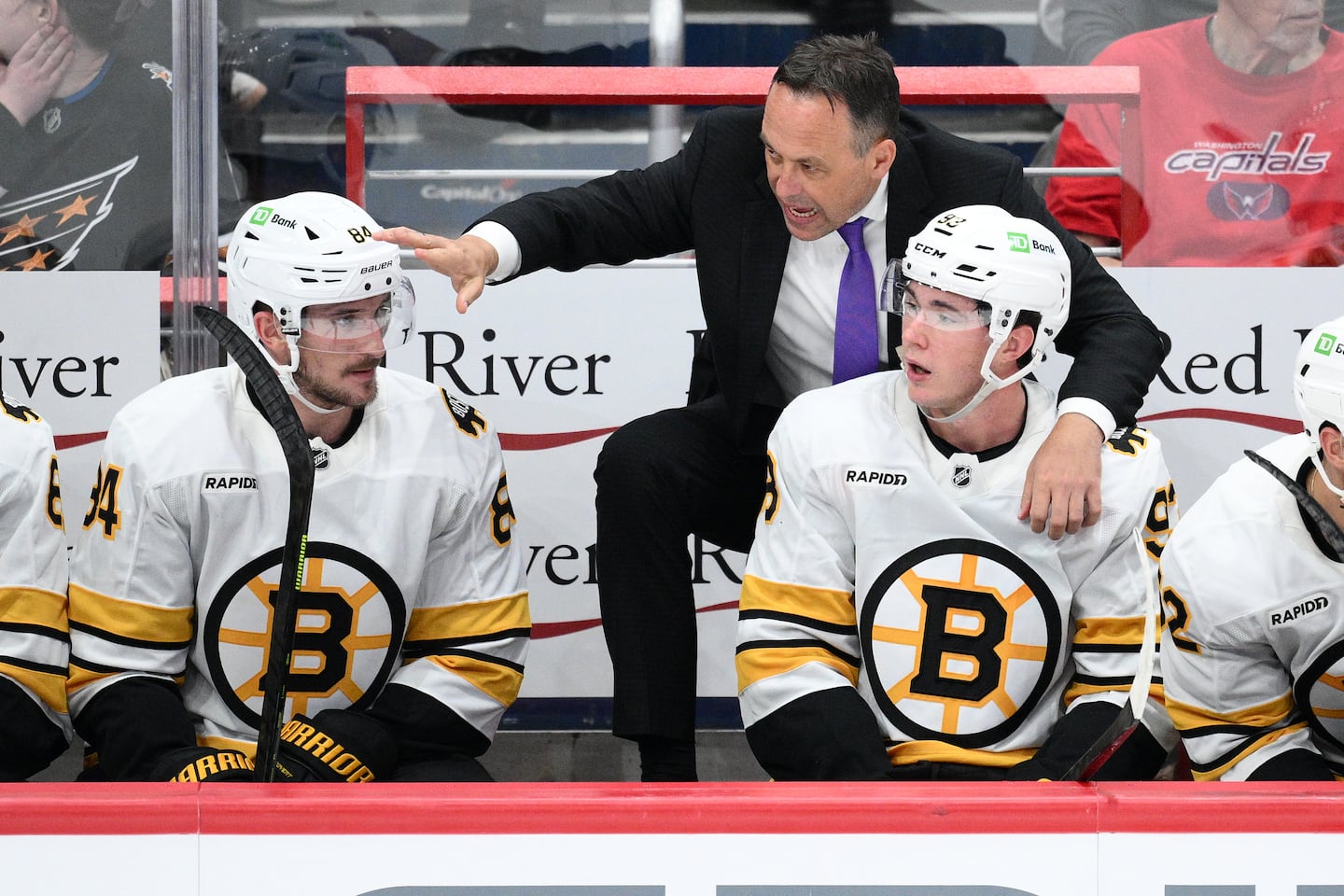 Marco Sturm has leaned on Fraser Minten in his first season as Bruins coach and the forward’s first full NHL campaign.Nick Wass/Associated Press
Minten on:
▪ Improving faceoffs: “As a young guy, that’s how you get your minutes up from, say, the 13-14 minute range to 17-18. OK, you’ve just had a 15-second shift, and now there’s a faceoff in the ‘D’ zone, on your weak side … well, if you’re not above 50 percent on your faceoffs, you’re coming off the ice for a righthanded guy or an older guy. So try to get reps on those after practice and really dial in on faceoffs.”
▪ Shooting spots: “There’s only so many areas you’ll get space for an offensive opportunity. Unless you’re one of the elite guys who can score from range — [Austin] Matthews, [Alex] Ovechkin, Geeks [Morgan Geekie]. You’ve got to go in high-danger spots for rebounds, tipping pucks, one-timing. So working on that, getting shots off quick.”
▪ Size: “In the weight room — building up strength and conditioning, try not to have any falloff during the season. To be physical and strong on pucks.”
“There’s more, obviously,” he added, “but … ”
Minten, 21, suited up Saturday night for only his 77th NHL game. There remains much for him to learn, though there’s a sense when talking with him that he’s not one of these kids who’ll one day be left saying he didn’t know what he didn’t know. As Sturm noted, he gets it.
Bruins assistant coach Chris Kelly, his own game founded in wisdom and intelligence, gave Minten early in training camp a blueprint that helped structure his approach.
“His advice for a young guy coming into the league,” recalled Minten, “was, ‘Show me that you’re not going to hurt me before you show me how you’ll help me.’ ”
That mentality has stuck with the rookie.
“So, do the defensive things, don’t make any positional mistakes,” said Minten, asked how he interpreted Kelly’s message. “Be reliable, hard working, defend — and then, after doing that, show me you can make a play off the rush, that you can score, contribute. Show me you can kill penalties before you show you can help me on the power play. That really clicked for me, something where I said, ‘OK, that’s really smart.’ ”
Minten, by the way, followed up with his parents about the kind words Burke sent their way that day of the interview.
“Yes, I did,“ he said, big smile growing wider.
And?
“They said, who’s Brian Burke?”
Burke, whose days in Vancouver included masterminding the deals that landed twins Daniel and Henrik Sedin as franchise cornerstones, took the parental snub in stride.
“OK,” Burke said, “I should have drafted three Sedins, I guess.”
EMOTIONAL TOLL
Ullmark details battle with anxiety
Some three weeks after initiating a leave of absence with the Senators, ex-Bruins netminder Linus Ullmark opened up on Monday about his ongoing mental health struggles in a TSN report by Claire Hanna.
The 32-year-old Ullmark, who recently resumed on-ice workouts in Ottawa but has yet to resume game action, noted to Hanna that he is not ready to get back in the crease. His time off, he told her, has been “just a step along the way.”
Some of what he has been dealing with, Ullmark recounted, goes back to his days with the Sabres, specifically around the COVID-return season of 2020-21. He touched on it briefly in Hanna’s report, but he went into it more extensively during my visit to Sweden in the summer of 2021, in the days after the Bruins signed him as an unrestricted free agent.
Ullmark, looking forward that summer to his fresh start with the Bruins, detailed how isolated and lonely he felt while living in a suburban Buffalo hotel during the prior season. Because of COVID, the start of the NHL’s truncated 56-game 2020-21 schedule was delayed until January, with Ullmark and wife Moa deciding it would be best for her to remain in Sweden with their two young children.
The Sabres, again without a playoff berth, were finished by the start of May.
“Part of what made it hard was just the time difference,” Ullmark told me during our series of chats over a couple of days near his home in Ornskoldsvik. “You have your teammates to talk to, of course, and that’s good. But after a game, back in the hotel room, I’d want to talk with someone back home and it would be, what, maybe 4 or 5 or 6 in the morning? You’re not going to call then and wake everyone up. They’re asleep. It’s the middle of the night there. So it got to be some long nights. It was hard.”
In his interview with TSN, Ullmark also shared his regret in not returning to Sweden to attend his father’s funeral, also during his time in Buffalo. His father’s alcoholism years before, he explained, had him on the cusp of quitting hockey in the years before he moved to North America at age 22.
“Lots of weird feelings and thoughts pop into your head,” said Ullmark, noting how not being able to experience closure with his father’s passing had him wondering perhaps if his dad was still alive.
It all made him feel, said Ullmark, like he was “living a weird dream.”
In December, after getting pulled amid a loss to Toronto, Ullmark felt overwrought by anxiety. Careful not to label it a panic attack, he related how the anxiety built that night both prior to and during the game. Soon after the final horn (Dec. 27) , he connected with the NHL/NHLPA Players’ Assistance Program, setting in motion his leave of absence.
Anxiety, he described, is “like a boiling kettle … it will boil over sooner or later and you never know when it’s going to be.”
Making matters more complicated during his time away, relayed Ullmark, has been ongoing social media speculation about what triggered his taking leave. The rumors, specific to Ullmark’s family life, eventually led an angry Senators captain Brady Tkachuk to repudiate them in a brief rant to Ottawa beat reporters.
“It’s OK for people to critique our on-ice performance. But when it gets into family, it’s pretty f***ing bulls***,” said Tkachuk. “It’s embarrassing that it got to the point that it did. And, yeah, I can tell you for free, I’m not happy about it one bit. It’s just not true. It’s a bulls*** story.”
General manager Steve Staios, long ago a Bruins defenseman, also was compelled to issue a team statement, referring to those who spread rumors as “the lowest forms of trolls and sick people who scour the internet.”
For Ullmark, trying to sort his mental health and resume his playing career, the scenario delivered more clouds, uncertainty, and obstacles.
“It took less than 24 hours after my absence of leave [for others] to try to find reasons to why I’m gone,” he told Hanna, “saying that I am a homewrecker, a person that no one likes in the team. And I can’t defend myself.”
Ullmark, now in year No. 1 of a four-year, $8.25 million-per-year contract extension, toils away now in practice, the goal duties shared by Hunter Shepard and the recently signed veteran, James Reimer.
For others suffering with anxiety, Ullmark suggests taking walks, preferably while not plugged into music or other media. Also, he said, be up front with others about how you feel. Find the person you trust the most, he said, and talk to them.
“It’s OK not to be OK,” he said. “It’s OK to feel how you feel.”
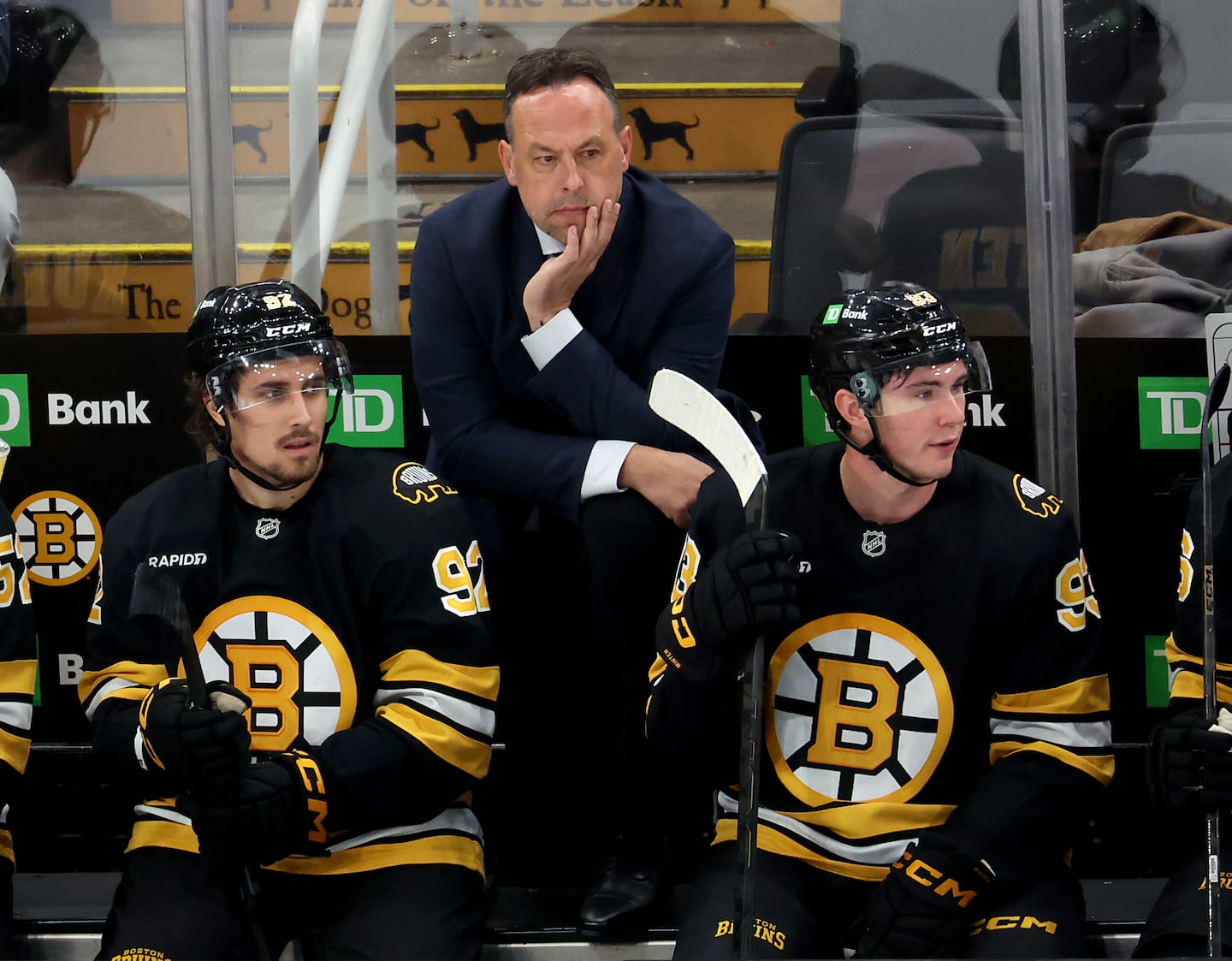 Bruins coach Marco Sturm believes distinct differences in the youth hockey setups of North America and his native Germany leads to a lack of burnout among young German players. Ken McGagh for The Boston Globe
ON-ICE PERSPECTIVE
Sturm: No youth burnout in Germany
Marco Sturm spent his youth playing at rinks in and around his hometown of Dingolfing, Germany, world headquarters of BMW. As his game matured, the search for better competition meant longer commutes to different rinks, a common lament for amateur players (and their parents) here in North America.
Another frequent lament here: The burnout of young, often talented players, is not common in Germany, said Sturm. Even though, by his telling, young players in Germany and other European countries are on the ice every day, typically creating a heavier workload than young players in the States and Canada.
As a youth coach in Europe, he said, “You work way more with the kids than here.”
So why is there no burnout?
“Burnout … they don’t burn out,” he mused. “I think burnout here, when I hear it, it’s not just from hockey. There’s other things going on. In Europe, there’s a lot of small towns, small organizations, and it’s easy to focus on one thing.“
In his estimation, size matters.
“I feel like everything is big in America, right?” he said. “So there’s a lot more going on for those kids these days, and not just hockey — and it might be the pressure in school. I don’t know if we have that pressure like the kids have here. So there’s a lot more to it.”
When a reporter noted that what Sturm described sounded more like a community-based approach to the game, he added, “Absolutely … absolutely.”
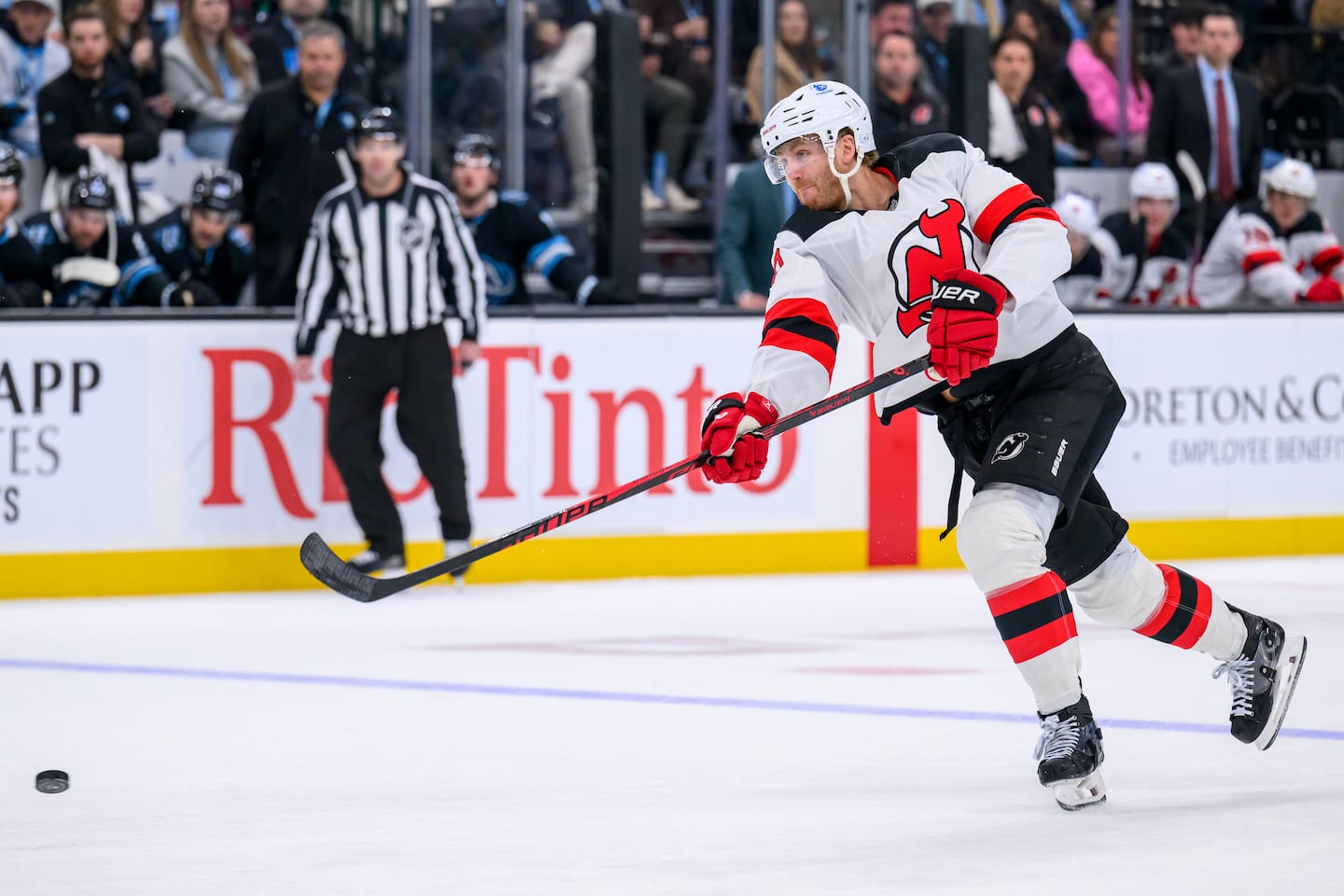 Trade talk has swirled around veteran Devils defenseman Dougie Hamilton, but his $9 million annual salary could be a real sticking point. Tyler Tate/Associated Press
If the Devils want to wheel ex-Bruins defenseman Dougie Hamilton, it will be all the harder now after placing backliner Luke Hughes on long term injured reserve on Wednesday. Now 32, Hamilton’s slumping game led him to be scratched earlier this month by coach Sheldon Keefe, immediately sparking trade rumors. An always-coveted right-shot D, Hamilton has two-plus years remaining on a deal that carries a $9 million AAV. He clicked for a career-high 74 points in his second year in New Jersey (2022-23). To get him gone, general manager Tom Fitzgerald likely will have to retain some salary or sweeten the pot with a draft pick or two … Following Tuesday’s listless 6-2 loss in Dallas, the Bruins are 2-3-0 in matchups that come at the end of road trips of two or more games. One of the wins, a 3-1 trimming of the Islanders on Nov. 26, came on a night when the Bruins were outshot, 44-14, their greatest shot disparity of the season … The Bruins will be at Madison Square Garden Monday night (weather permitting) to face the Rangers. The Blueshirts have yet to start dealing off parts, but it’s coming — be it before the Feb. 4 Olympic trade freeze or the annual trade deadline on March 6. Doubtful they would consider moving standout defenseman Adam Fox, but his full trade protection begins to scale back after next season. He played at Harvard. His agent, Matt Keator, is in Boston. At the very least, it would make for an interesting conversation between GMs Chris Drury and Don Sweeney. Keep in mind, from a Bruins perspective, Manhattan’s allure is such that it sometimes can induce players to consider surrendering their no-move/no-trade clauses.
The Patriots and Broncos are bound for the AFC Championship game. Ben Volin and Tara Sullivan break down the NFL playoff games and more. Watch the full episode.
Kevin Paul Dupont can be reached at kevin.dupont@globe.com.