
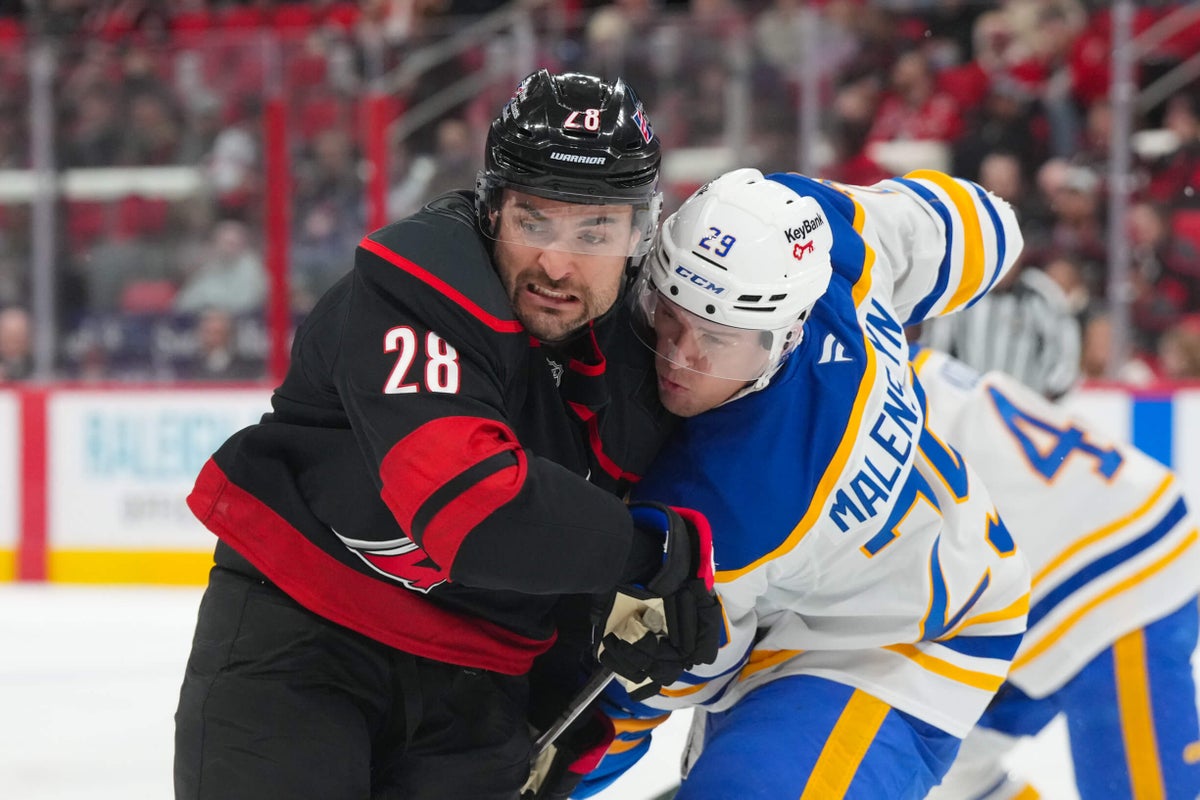
Carolina Hurricanes forward William Carrier beat New York Rangers forward Alexis Lafreniere to a puck in the neutral zone and pushed it into the Rangers’ zone. New York defenseman Braden Schneider denied Carrier’s effort to push the puck deeper into the zone, but Carrier again outmuscled Lafreniere and won the puck back to K’Andre Miller.
A pass, a shot and a fortunate bounce later, the puck was past the seemingly impenetrable goalie Igor Shesterkin and in the net, the tying goal for the Hurricanes in the third period of their overtime win over the Rangers on Dec. 29.
Good things happen when you stand in front of the net pic.twitter.com/Lh6JtyjDRd
— Carolina Hurricanes (@Canes) December 30, 2025
There was no point awarded to Carrier — there often isn’t for a forward who has never exceeded 25 points in a season in his decade-long NHL career — but his teammates acknowledged his pivotal role in a play that allowed Carolina to secure a point in the standings and earn another in overtime.
“Will did a great job getting on the wall there, keeping it in,” said linemate Jordan Martinook, whose net-front presence on the play resulted in the puck bouncing in off him.
If coach Rod Brind’Amour has the physique of an award-winning bodybuilder and Andrei Svechnikov the chiseled body of a Greek statue, Carrier is the brawny foot soldier — square jaw, steely glare and the resolve to always keep pushing forward, shift after shift, game after game.
“I think anytime Will’s out there, you notice him,” Brind’Amour said recently of Carrier. “He’s one of the more physically imposing players around. And I guess at the end of the day, no matter how many shifts he has, you seem to notice every one of them for that reason. It’s a guy knowing his game and really excelling at it.”
The 31-year-old Montreal native, who has six goals and five assists in 41 games this season, has carved out an NHL career as the type of crash-and-bag forward defensemen hate playing against. He’s 6-foot-2 and 214 pounds, but that doesn’t fully illustrate what a handful Carrier is on the ice.
“He’s the strongest guy I’ve ever played with,” said Mark Jankowski, who has been centering Carrier on Carolina’s fourth line of late. “When he has the puck or any sort of battle — stick battle, anything — it’s incredible. Just in practice, when you’re going to battle against him, in my career so far, he’s the hardest guy to go against.”
Carrier’s strength is complemented by the consistency in his play. While his point totals throughout his career are modest — he’s cracked double digits in goals once and eclipsed 20 points twice — his north-south play and determined effort make him someone his coaches and teammates can count on regardless of where he is in the lineup.
“He’s a guy that comes to work ready to go and takes care of himself and works hard and follows our identity to a ‘T,’” Hurricanes captain Jordan Staal said. “Just hard-working, forechecking, hard to play against, being smart at the right times and just constantly putting the pressure on. He’s been a great addition.”
That addition came two summers ago, when Carrier signed a six-year, $12 million contract to leave Vegas and come to Raleigh.
“He’s just very consistent, and his game does not waver,” Brind’Amour said of the reasons the team targeted Carrier at the opening of 2024 free agency. “And that’s something we really value in our team, and it’s also hard to play against. That guy is hard to play against and very effective. So that’s a pretty easy signing on our part.”
One would think the security of a long-term deal for a bottom-six player was the driving force behind Carrier’s decision to sign with Carolina. Not true.
“I wanted to win,” said Carrier, who won the Stanley Cup with Vegas in 2023. “They’ve had a great team here since five, six years. They win 50 games a year. And there’s a reason for it. And we could tell by the way they play. You want to pick a team that plays the way you want to play. It needs to fit with it, and I think it was a perfect fit.”
The wear and tear of playing for a Western Conference team also made moving east attractive to Carrier and his young family.
“I’m home a lot more, I’ll be honest with you, with the family and less travel,” he said. “Guys here screw around about the travel and stuff. It’s nothing like that out west. Out west, it’s terrible. You’re gone for two weeks every two weeks, right?
“So it’s great. I’ve been home, and the family’s enjoying it and it’s not that far. My parents can watch every game. I’ve been loving it, to be honest with you, and the wife is happy. So it makes a happy life around here.”
Even without the grind of more grueling travel, Carrier has continued to battle the injury bug in his first season and a half with the Hurricanes. Carrier has played more than 70 games just once in his career, and no more than 56 in the last three seasons. That included playing 43 games during last year’s regular season, though he did play in all 15 of Carolina’s playoff games.
“He’s been banged up a little,” Brind’Amour said. “I think that’s plagued him a little bit over his career, but it’s the way he plays. He knows one way to play, and that’s what we love about him.”
Carrier’s 98 hits are tops on the Hurricanes, and his willingness to punish opposing defensemen leads to turnovers and scoring chances for his linemates.
“They’re kind of checking their shoulders to see if it’s him coming back,” Jankowski said of defensemen facing Carrier on the forecheck. “Or even if they don’t have time to check their shoulder, they’re just already looking to get the puck away and just maybe throw it away or make a bad play or something like that. So once you get that implanted in their mind, which he does, it’s beneficial to us.”
Which is why his teammates love playing with him. While Carrier has been playing primarily with Jankowski of late, he’s spent nearly 600 of the 900-plus five-on-five minutes he’s played since joining the Hurricanes alongside Staal and Martinook.
“He’s simple and direct and strong as an ox,” Martinook said. “When he gets people on his back, you can’t really get him off the puck. And I think that’s what works so well with me and Jordan. When our line’s going well, we’re playing in the O zone, we’re wearing teams down, and he’s as good as anybody at doing it. He’s conscious defensively, so we can play against really anybody.”
Adding Carrier also meant bringing another player into the room who has won the Cup — “the more the merrier,” Staal said.
“I’ve lost one, I’ve won one,” Carrier said of his two trips to the Stanley Cup Final. “Big moments — in playoffs, it’s a whole different game, right? So you’ve got to show up and every detail counts. One screwup, and it’s in your net. So it’s all about detail, and my games kind of dialed in for that.”
He’s also an addition that reinforces the Hurricanes’ culture of hard work and determination, something that can be past on to the next wave of Carolina players.
That includes defenseman Charles Alexis Legault, a Montreal native who is nine years younger and grew up blocks from Carrier’s home. Carrier said Legault “played it cool” when talking to a player he looked up to in his youth.
“I guess my name was kind of big right when he grew up,” Carrier said. “He told me that, ‘When I grew up, your name was all over.’ We grew up in the same little — we’re from Montreal, but these little towns and a couple streets down.”
Carrier already ranks third since relocation among Quebec-born players with 84 regular-season games played with the Hurricanes, trailing only Martin Gelinas (348) and Kevin Dineen (121). If he can stay healthy, he could surpass Gelinas by the time his contract expires in 2030.
It’s not something he’s concerning himself with, instead focusing on keeping the Hurricanes near the top of the standings.
“And try to win another Cup,” he said. “I mean, it’s always the goal year after year.”