

The NHL trade deadline is not the time to build a playoff-caliber roster. Ideally, it’s an opportunity to find a missing piece that solidifies a team’s contender status.
Artturi Lehkonen was that piece for the Colorado Avalanche in 2022. And in 2020, it was Blake Coleman and Barclay Goodrow for the Tampa Bay Lightning.
Unlike Lehkonen, Coleman and Goodrow hit the free-agent market after their back-to-back Stanley Cups. While some teams paid up for their championship-caliber service, others have tried to look under the radar for their own versions of this archetype.
The basic framework is someone who can drive play up the ice, contribute offensively and be defensively responsible. The best-case scenario has this player capable of absorbing matchup minutes and playing in all situations, but it all depends on team need (and the market). In seasons past, that has looked like deadline additions Andrew Copp, Tyler Motte, Vlad Namestnikov, Brandon Hagel, Oliver Bjorkstrand and Yanni Gourde, among others.
Figuring out this year’s version of that player is tricky because the playoff picture is still in flux. In the West, there are three confirmed sellers so far: the St. Louis Blues, Calgary Flames and Vancouver Canucks. In the Eastern Conference, only one team (the New York Rangers) has officially bowed out of the postseason picture. So while there are Blake Coleman-lites for contenders to consider, between the playoff fringes and bottom of the standings, it all comes down to which teams ultimately step back and sell in the next few weeks.
Rentals
Kiefer Sherwood, a pending unrestricted free agent who brings a lot of grit, physicality, and goal scoring to a lineup, was already traded to the San Jose Sharks in exchange for two second-rounders and a prospect. There are bound to be other rental options on the move over the next few weeks.
The Columbus Blue Jackets are 5-1-0 since Rick Bowness took over behind the bench. But if a coaching change isn’t enough to push this team into the postseason picture, Columbus has at least two veterans to flip: Boone Jenner and Charlie Coyle.
Jenner sits No. 17 on the trade board as a hard-nosed option for playoff teams. He is a versatile player who can slot anywhere in a lineup, in any situation, against any opponent. Jenner hasn’t been as strong defensively relative to his teammates over the last two years, but has picked up the pace offensively to offset that. On the Blue Jackets, he can be found in the top six; on a contender, he should slot into a more fitting middle-six capacity.
Coyle, on the other hand, has been extremely sound in his own zone this year. Last year’s trade to Colorado helped get his game back on track after a tough start to 2024-25 in Boston. But he has really kicked his game up a notch in Columbus this season. The Blue Jackets are generating more quality chances (and converting on them) in his minutes. But what stands out even more is how little the team is giving up, despite playing some of the most challenging usage in the league; Coyle’s plus-3.6 Defensive Rating ranks 11th among all forwards. That shutdown play and production could help stabilize a contender’s center depth.
The Boston Bruins are actually in the playoff picture, but are in a slightly different position as a team that kicked off a retool last spring. The big question is whether management will continue that process or buy based on the team’s better-than-expected first half.
So if Boston slides out of a playoff seed or decides to sell anyway, Viktor Arvidsson is a player to watch. He was a reclamation project for the Bruins after a down year in Edmonton. While he isn’t getting as many puck touches in his own zone this season, he has been a lot more effective offensively between his rush game, forechecking and overall ability to generate scoring chances. So while he doesn’t have the same defensive chops as a Coyle or even a Jenner, a contender could view him as a disruptive winger who can float around a top nine.
While the Bruins and Blue Jackets weren’t exactly expected to be contenders this year, the Maple Leafs were, and their 11th-place standing in the East adds a bit of a curveball to the deadline. The chances are slim, but say management recognizes how low this team is on trade assets and takes a proactive approach. Someone like Bobby McMann could generate interest for teams looking for some middle-six help.
Shift west, and there is a former Maple Leaf on the trade board in Michael Bunting. He isn’t quite of the Coleman mold, since he isn’t stout defensively or an all-situations threat. But if none of the aforementioned players end up available, a thin market could force teams to get more creative. If Bunting can channel some of last season’s forechecking, this year’s scoring and his ability to jump up and complement top-line players, the Nashville Predators winger could be of value at the deadline.
Another forward in the $4 million range is Ilya Mikheyev in Chicago. While he could never live up to the hype of the four-year contract the Canucks signed him to back in 2022, he did rebound with the Blackhawks over the last two years. Mikheyev is the kind of player who could slot onto a playoff team’s third line and help facilitate play. He brings an element of speed, which helps him break out of his own zone with control to spark offensive sequences. He can speed into the offensive end to recover dumps-ins, forecheck and chip in secondary scoring. Plus, he can be trusted to limit scoring chances against on the penalty kill.
Two playoff runs
One of the most valuable parts of the Coleman trade in 2020? The fact that the Lightning invested in two playoff runs with him (which ended in two championships).
And that opportunity is there again, if anyone can offer the Flames a deal that moves the needle enough. Cost is going to be a big part of the conversation, because a 34-year-old Coleman likely won’t bring back the same as a 28-year-old Coleman (unless the market inflates with too many buyers and too few sellers) and the Flames can always punt this to next deadline.
Six years later, he is still an ideal option despite a pricier cap hit ($4.9 million) this time. Coleman can go head-to-head with the opponents’ best and put up positive results; the Flames generate more chances and allow less back with him on the ice at even strength, and trust him to play on their top penalty-kill unit. And despite that workload, his scoring rate is slightly above his career average. The third line is likely still the sweet spot for Coleman on a contender, but he has the chops to jump up and play wherever asked.
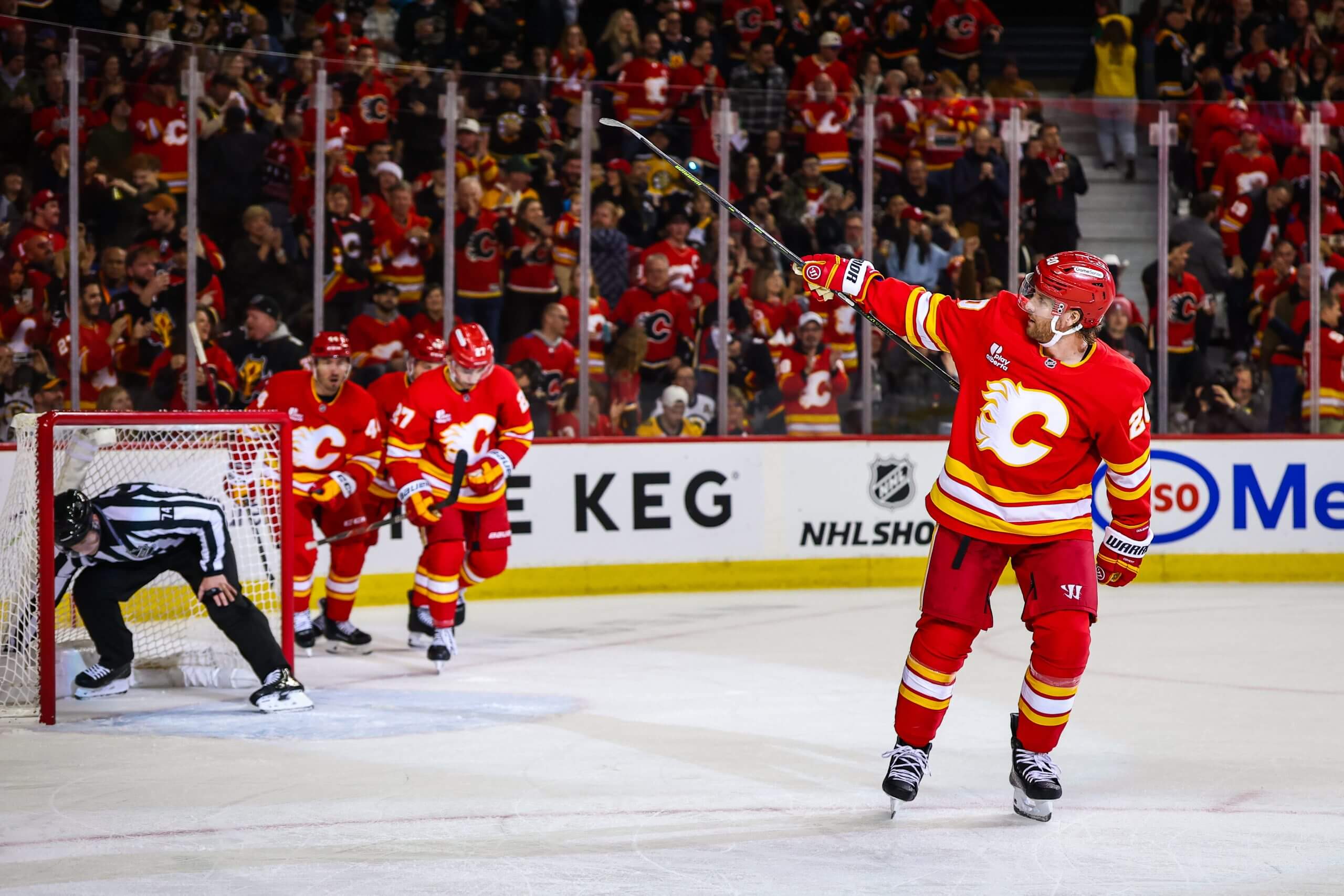
Blake Coleman is scoring at slightly above his career average this season for the Flames. (Sergei Belski / Imagn Images)
Like the Flames, the Blues are positioned to sell at the deadline to start reloading for next season. Pius Suter should generate some interest as a center who can contribute to two playoff runs.
Before getting sidelined with injury, the scoring wasn’t as potent for Suter this season for two reasons: he isn’t shooting 18 percent anymore, and the team isn’t converting on their chances in his minutes at five-on-five. The Blues are shooting less than seven percent with Suter on the ice, which explains the gap between his expected goals rate of 3.17 per 60 and scoring pace of 1.99 goals per 60. But the substance is there below the surface on both ends of the ice; Suter’s teams generally allow fewer quality chances against in his minutes, and that extends to short-handed situations. So while he isn’t flashy or a big puck-mover, he is a stabilizer who could help solidify a team when the pressure rises.
Playoff teams that don’t need a penalty killer, or don’t want to pay up for a center, could turn to Nino Niederreiter. The Winnipeg Jets’ playoff odds have absolutely plummeted this year, so management may want to start thinking about next season early. With a utility player like Alex Iafallo under contract for another two seasons, that could give the team reason to flip Niederreiter. His scoring may be down, but his year-to-year consistency is still a standout; he can shoulder a tough workload and help move the needle on both ends of the ice. Niederreiter can skate the puck out of his own end and can be counted on to make little plays that extend offensive zone time.
Michael Amadio is another player of that mold: a third-liner who can help transition his team out of danger while facing off against the opponents’ best. While he hasn’t contributed as much to the Ottawa Senators’ scoring chances this year, he 1) has a pretty solid track record from the last few years in both Ottawa and Vegas, and 2) has a more team-friendly $2.6 million cap hit that may not require as much work to fit.
That’s if the Senators sell; as low as their playoff chances may be, this team isn’t in as dire a playoff window, with as loud a ticking clock — unlike the Los Angeles Kings.
The Kings have an 82 percent chance of reaching the playoffs, but another Round 1 appearance (and exit) can’t be the goal anymore. Between playing in a weak Pacific Division and this being Anze Kopitar’s last season, they have motivation to stay in the race. But it wouldn’t hurt for management to shake things up, either. If that became the direction, then someone like Warren Foegele could have some trade value; the 29-year-old has a manageable $3.5 million cap hit for another year.
That said, an acquiring team would have to hope that a change in environment would help Foegele bounce back. It’s more than just a scoring dip that raises some red flags: his speed bursts are down and so is his transition game. Those are both key parts of his attack; Foegele generally can be counted on to help shift his team from defense to offense. And once in the offensive end, he can pressure opponents to keep the play in the zone. His forechecking ability hasn’t faded, which is promising. Maybe away from the Kings, he can get back to his speedy strengths to provide true third-line value again or jump up higher as needed.
Most contenders aren’t in the market for a mid-season reclamation project, even if this one could bring back immediate returns with Foegle’s track record in mind. But it’s a reminder of how slim the options could be, depending on how the playoff picture unfolds over the next few weeks.
Data via Evolving-Hockey, HockeyViz, HockeyStatCards, All Three Zones and Natural Stat Trick. This story relies on shot-based metrics; here is a primer on these numbers.