
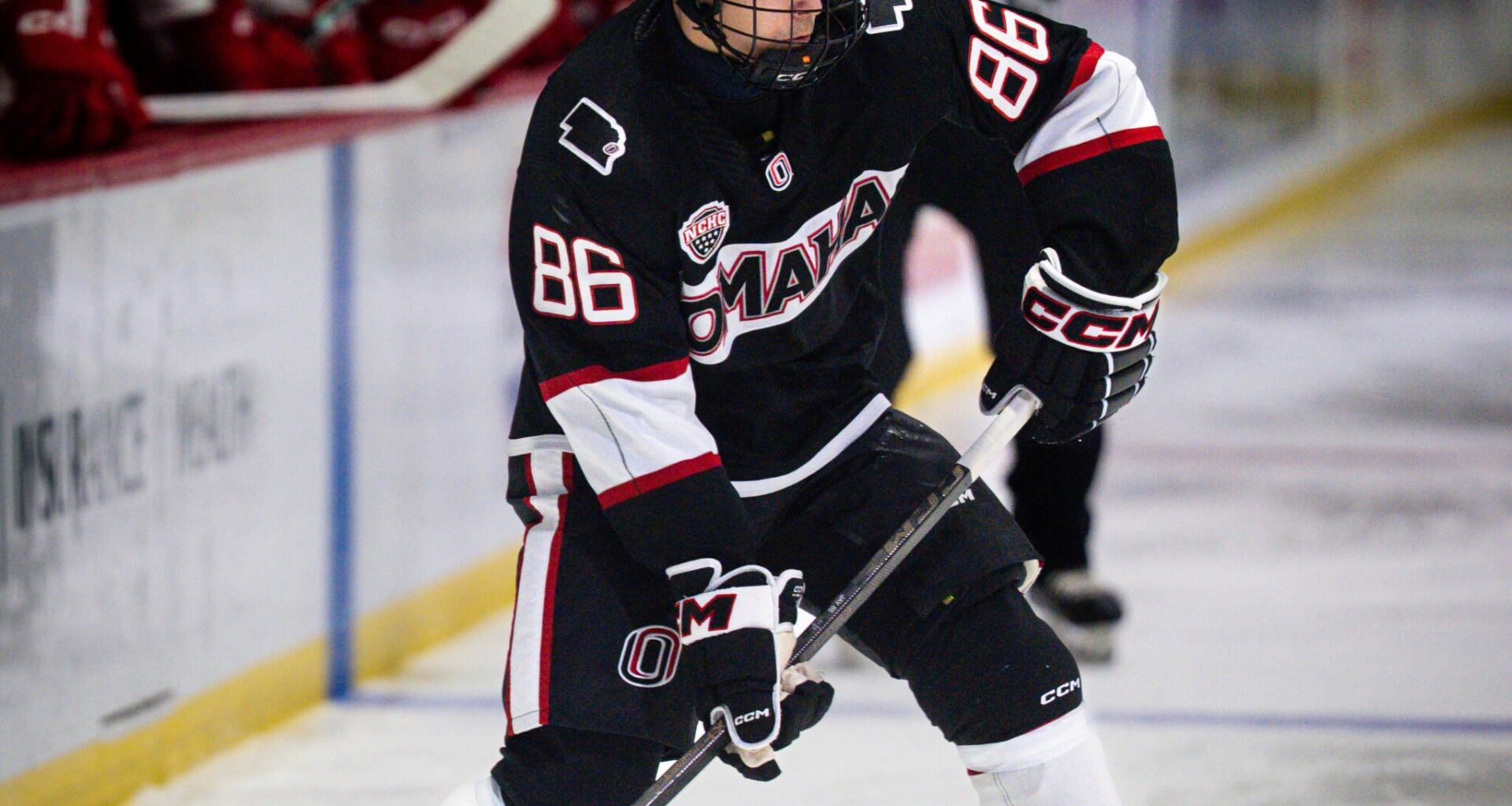
General manager Don Waddell and the Columbus Blue Jackets took a chance on Jérémy Loranger in the 2025 NHL Draft, trading up to grab him 198th overall in the seventh round. Early on, it looks like a smart choice. Loranger is off to a solid start with the Nebraska-Omaha Mavericks (NCHC) in college hockey. Among the 10 collegiate prospects in the organization, he has been one of the more intriguing names to follow.
Related: Columbus Blue Jackets Prospect Report: Midseason College Check In
Omaha has had an up-and-down season. Mike Gabinet and his staff leaned heavily into the USports/new Canadian Hockey League (CHL) transfer routes and have struggled to find consistency with their roster. They have picked up some big wins over Minnesota Duluth, UMass, Minnesota State, St. Cloud State, and Colorado College, but have not been able to sustain momentum in NCHC play. As of Jan. 26, they sit at 9-17-0 overall and 5-11-0 in conference play, tied for last in the NCHC standings with Colorado College.
Loranger is one of only two NHL draft picks on the Mavericks roster, along with Washington Capitals prospect Brett Hyland. Against the Miami RedHawks earlier in January, Loranger skated on the second line at right wing with Samuel Huo (C) and Trevor Wong (LW). Miami swept the series and exposed several of Omaha’s weaknesses, and Loranger did not generate much offense, just as the team did not.
However, he is still impressive with his speed, competitiveness, and willingness to get to the net front. He played chippy, got into it with Miami players both nights, and finished Friday with two penalties, including an interference call on the power play and an unsportsmanlike conduct penalty after a late scrum with RedHawks’ forward Ryan Smith.
Adjusting to College Hockey
Before the series, Loranger talked about how his season has gone so far. “It has been ups and downs,” he said. “It started rough. I had an injury in the first game of the year that lasted longer than it was supposed to. That was a problem for a while, but now that I am back, I feel more comfortable and confident on the ice.”
The jump from the British Columbia Hockey League (BCHL), where he put up a massive 119 points in 62 games in the 2024-25 season for Sherwood Park, to the NCAA is one of the bigger leaps a young player can make. The 2024-25 BCHL MVP said the difference is obvious every night. “It is a more mature game. More physical, and the guys are bigger, stronger, and older. It is a step up from the BCHL, and the transition game is a lot faster. The guys have more experience and know what it takes to win.”
Through 18 games played, Loranger has put up four goals and six assists, averaging 0.56 points per game. Only three of those points have come in NCHC play, which speaks more to the strength of the conference than anything else. He did score two big goals earlier this season at Augustana, one of the tougher teams in an underrated CCHA.
He is averaging 12:47 of ice time per game and has earned a spot on Omaha’s top power-play unit, where he moves around the middle of the formation and works the slot. He also screens well on shots in from the outside and gets to rebounds. “I think the unit is getting better and better together,” he said. “For myself, on the power play, I think it is one of my strengths. I can produce there and score some goals from the slot.”
His timing without the puck is one of his best traits, and the puck seems to find him because he is consistently in the right spots.
In all situations, his speed stands out. He uses it to draw penalties, pressure defenders, and create turnovers. He is also not afraid to go to the hard areas in a physical league like the NCAA despite being 5-foot-10, 170 pounds. “It is just who I am,” he said. “If I want to make it to the NHL and play for Columbus one day, I need to be competitive and go to the hard areas where goals are scored. That is in front of the net and being there at the right moment.”
Blue Jackets Development Path
Being drafted by Columbus last summer was a big moment for him. “It was a dream come true,” he said. “It was fun to be there at the development camp, meet all the people, and get to know everyone. You feel better once your first year of development camp is done. If they have me go back next summer, I will feel way better and more confident.”
He worked closely with development coach Anthony Donskov at camp, focusing on details that translate to higher levels. “It was the development aspect of the game and more of the skills side. Wall plays, details of the game, things you work on as you get older.”
As Omaha continues through the second half of this season, Loranger knows what he wants to build on. “I need to be more consistent,” he said. “If I am not able to produce one night, how can I help the team in a different way. Defensively, having a good stick all game and getting turnovers for my team.”
Loranger is definitely going to need some time. He is still only 18 years old, which is on the younger side for college hockey, and the adjustment curve can be tough for players his age. With that in mind, it would not be surprising to see him stay in school for two-to-three more seasons as he continues to round out his game before moving to pro.
