
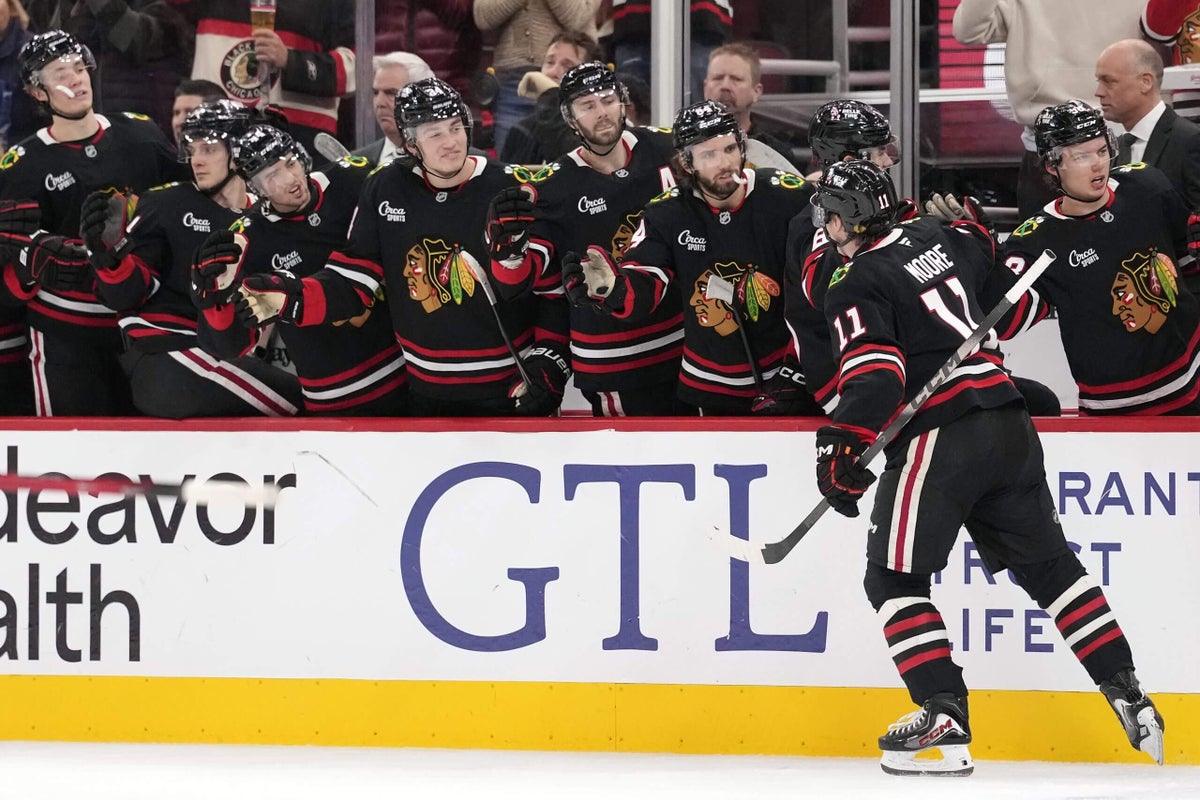
ST. PAUL, Minn. — Connor Bedard is about seven months younger than Oliver Moore, but when the Chicago Blackhawks superstar talks about his rookie teammate, he marvels at the guy’s perpetual-motion motor as if he were some wizened, grizzled vet.
“He’s just got so much energy,” Bedard said of Moore. “He’s never tired or anything. He’s always buzzing around and he just works so hard to get pucks. And he’s always beating guys to pucks, too. That’s the biggest thing. He’s a great player. He thinks the game well and he’s going to be unreal for us.”
Bedard already knew Moore could skate like the wind. And anyone who’s ever talked to Moore knows he’s got that boundless energy and enthusiasm. But even after playing alongside him for nine games last spring and throughout training camp, Bedard didn’t know one key thing about Moore:
He’s a center.
“Turns out he’s played center his whole life,” Bedard said.
Indeed, Moore was drafted as a center out of the U.S. National Development Team, and he played center at the University of Minnesota, too. But like so many other young centers, Moore got his first taste of the NHL on the wing. It’s just easier there. Fewer responsibilities, less to think about, more opportunities to jump in the play offensively.
But when Bedard and Frank Nazar went down with injuries in December, Blackhawks coach Jeff Blashill had little choice but to move Moore to center. Little did Blashill know it would unlock Moore, and potentially his whole lineup. Moore has been a different player since the move — more aggressive offensively, more tenacious on the puck, more involved at both ends. And Moore’s emergence as a viable center allowed Blashill to bump Nazar up to Bedard’s wing Tuesday in Minnesota, an attempt to jumpstart Bedard that paid almost immediate dividends in a 4-3 shootout loss to the Wild.
Bedard and Nazar haven’t played much together this season — about 23 minutes total at five-on-five entering Tuesday’s game — but they looked like they had been together for years. The two were circling the offensive zone like sharks and connected for scoring chances that few others on the roster could make. They combined for 12 shots on goal and seven scoring chances, including four high-danger looks for Bedard. With savvy veteran Teuvo Teräväinen on the right wing, the trio out-attempted (16-6) and out-chanced (9-3) the Wild handily.
They created the opening goal of the game — Teräväinen whacking in a Louis Crevier slap pass to Bedard, who outmuscled Quinn Hughes for the puck before Teräväinen finished the job. In the second period, Nazar threaded a nifty pass through the goalmouth to Bedard, who was barely stopped by Jesper Wallstedt (the play had to be reviewed just to be sure). And in the third period, Nazar used his speed to catch up to a slick Bedard saucer pass to get a good chance on Wallstedt. It was as dangerous a line as the Blackhawks have had all season.
“Bedsy and Frank, I haven’t seen them play lots together,” Blashill said. “I thought they were really good together. They showed a lot of skill, they fed each other in good spots. Obviously, they scored with (Teräväinen). That was a real dynamic line.”
“I thought we played really well,” Nazar added. “It’s easy to play with two guys as smart and skilled as them. We had a ton of shots. … A lot of great chances. (We’ve) just got to execute on them.”
Without Moore at second-line center, Blashill probably can’t create that line. Moore’s move has extended the Blackhawks lineup and given Blashill more options.
“There’s probably truth to that,” Blashill said. “Maybe (Ryan Greene). … It’s hard to say whether it’s a position-specific thing, when (Moore has) played really well and when he hasn’t, because I haven’t seen a big enough sample size of both. But there are definitely parts of his skillset that make him look like a potential long-term center.”
The Blackhawks had centers all over the place against the Wild. The top line had Bedard and Nazar (and Teräväinen, who broke into the league as a center). The second line had Moore and Greene. The third line had just Jason Dickinson, but the fourth line was a trio of guys who can play center — Ryan Donato, Nick Foligno and Landon Slaggert. Even healthy-scratch Colton Dach was drafted as a center. And more are coming. The prospect pipeline is positively packed with pivots — Anton Frondell, Sacha Boisvert, Mason West, A.J. Spellacy and John Mustard, to name a handful.
The way the Blackhawks see it, the more, the merrier.
“It’s easier to switch to wing than it is for a wing to switch to center,” Bedard said. “It definitely helps. Mooresy is someone that can play all over. We’ve got a lot of guys who can play center, and that’s obviously a positive. You can’t have too many centers.”
Moore downplayed the significance, but Nazar’s move to the wing was a clear vote of confidence in Moore’s long-term future down the middle from Blashill.
“That’s where I’ve been most comfortable,” Moore said. “When I’ve been at center, I’ve been at my best this season so far. I think that’s where I can help the team win the most. Right now, I think that’s what he sees.”
The versatility of the forwards in the lineup makes each line a little more dangerous. Nazar and Bedard are both right-handed shots (and Nazar took all of Bedard’s faceoffs as Bedard recovers from his shoulder injury), but Moore is a lefty and Greene a righty, which allows the Blackhawks to always have their faceoff man on their strong side.
There can sometimes be a little chaos and confusion when players are out of their typical position. If both natural centers play like centers and find themselves down low in the defensive zone, there are fewer outlets to exit the zone. And against an odd-man rush, even the slightest hesitation in sorting can be the difference between breaking up a play and giving up a goal.
But Bedard didn’t think that’d be an issue for him and Nazar, both of whom are very vocal on the ice. It’ll take a little extra communicating on some shifts, sure, but for the most part, whoever’s back first becomes the nominal center until they clear the zone. Besides, more defensively aware forwards is never a bad thing.
Of course, the best defense is always a good offense.
“Once we’re in the O-zone, it doesn’t really matter,” Bedard said. “So hopefully we don’t have to figure that out much.”