
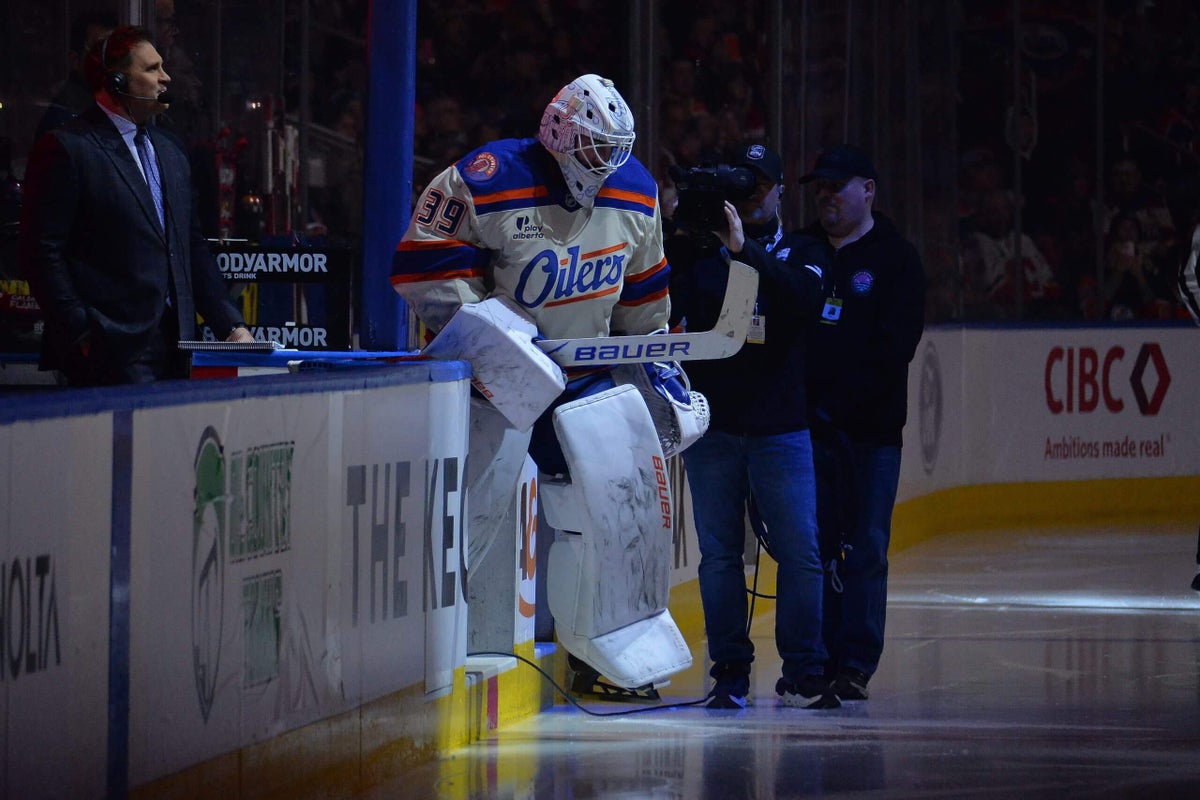
It was an ordinary save, but one Connor Ingram might remember forever.
The Edmonton Oilers were hosting the Vegas Golden Knights on Dec. 21 at Rogers Place, and Ingram was playing in his first NHL game in nearly 10 months. At times, Ingram, 28, had wondered if he’d ever enter a crease at this level again, especially after his second stint in the NHL/NHLPA player assistance program. He spent several months in the spring undergoing therapy after the loss of his mother, Joni, in December 2024. Then he was put on waivers by the Utah Mammoth in September and dealt to Edmonton in December, his career still flux.
But here Ingram was, back in net, under siege on a Vegas power play.
A pass came across to Knights forward Pavel Dorofeyev, and Ingram caught his left post, bumped back out a little bit and made a shoulder save.
On the next whistle, Ingram sat back in his net, put his head down and took a deep breath.
“Holy s—, Connor,” he remembers thinking. “You can still do this. Let’s go. Let’s go.
“This is still the same that it’s always been. Let’s go play hockey.”
Ingram certainly didn’t expect his next shot to be with the two-time-defending Western Conference champions, Connor McDavid and company. But he’s been enjoying the ride — and doing his part, with a 6-3-1 record, .905 save percentage and 2.46 goals-against average heading into Saturday’s game against the Minnesota Wild, allowing three or fewer goals in 10 of his 11 starts while splitting the net with Tristan Jarry. Ingram is living out of a downtown hotel.
His wife, Sarah, is bouncing between their place in Bakersfield, Calif. (where Edmonton’s AHL team is), juggling their two dogs.
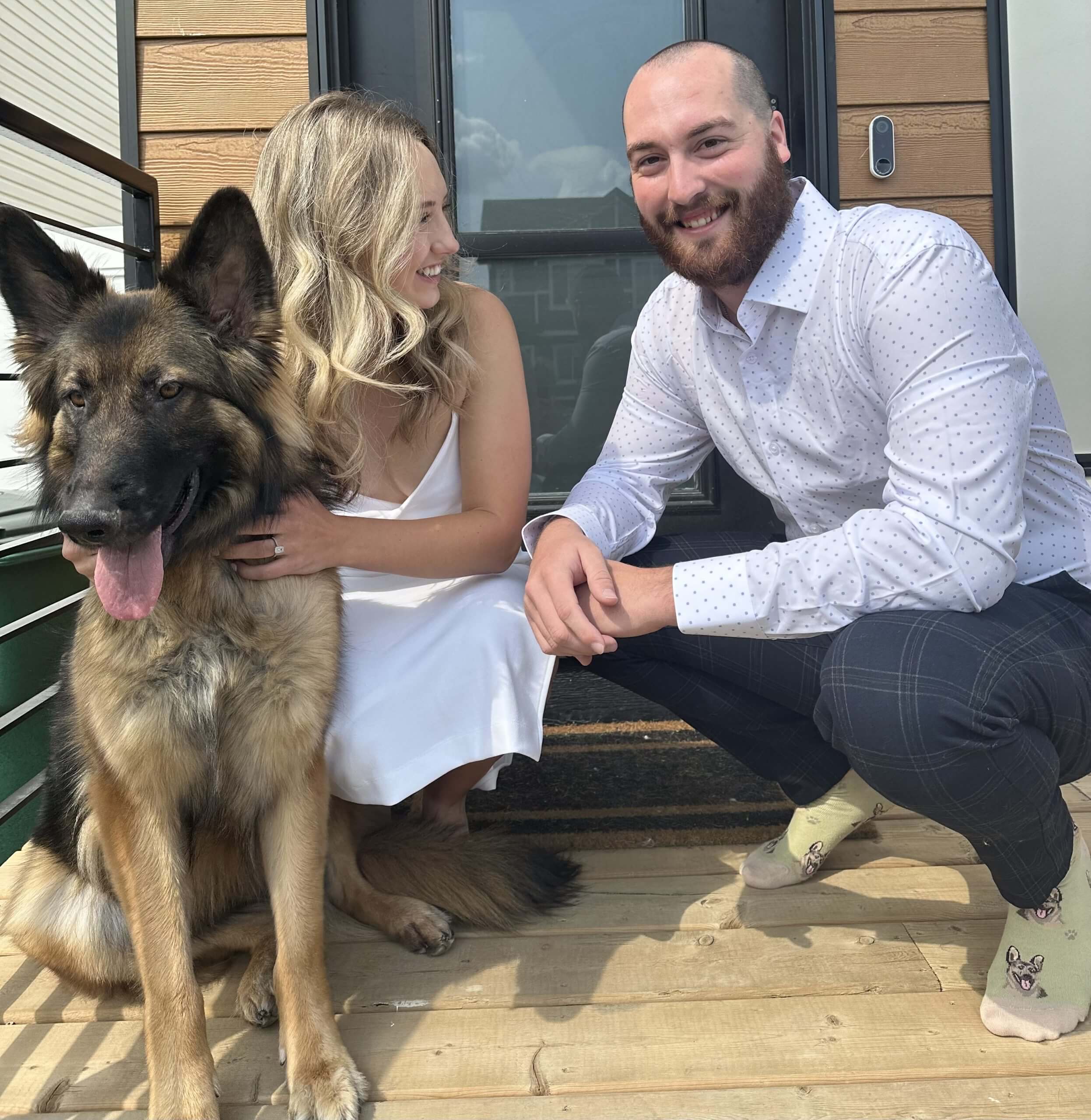
Sarah and Connor Ingram with one of their dogs. (Photo courtesy of Connor Ingram)

Nothing was ever promised, so everything is appreciated.
“It’s been pretty wild,” he says. “For a long time there, I think people around me believed in me more than I did. Now it’s trying to get back to that — that belief that you can still do this, and this is why you do it, and this is how you do it. So let’s get the job done.”
Ingram has a photo on his phone from a game in Chicago on Feb. 25, his last one with the Mammoth.
“Knowing that might be it,” Ingram says.
The goaltender entered the NHL/NHLPA player assistance program not long after, hoping it would help him cope with the death of his mother the previous fall. He had been white-knuckling it for too long.
Ingram didn’t play that night in Chicago. He had given up four goals in a loss in Los Angeles two games earlier. But the image shows him walking off the ice at the United Center, handing his stick to a fan holding an Arizona Coyotes flag.
He remembers that she started to cry once she got it.
His emotions were spilling over, too.
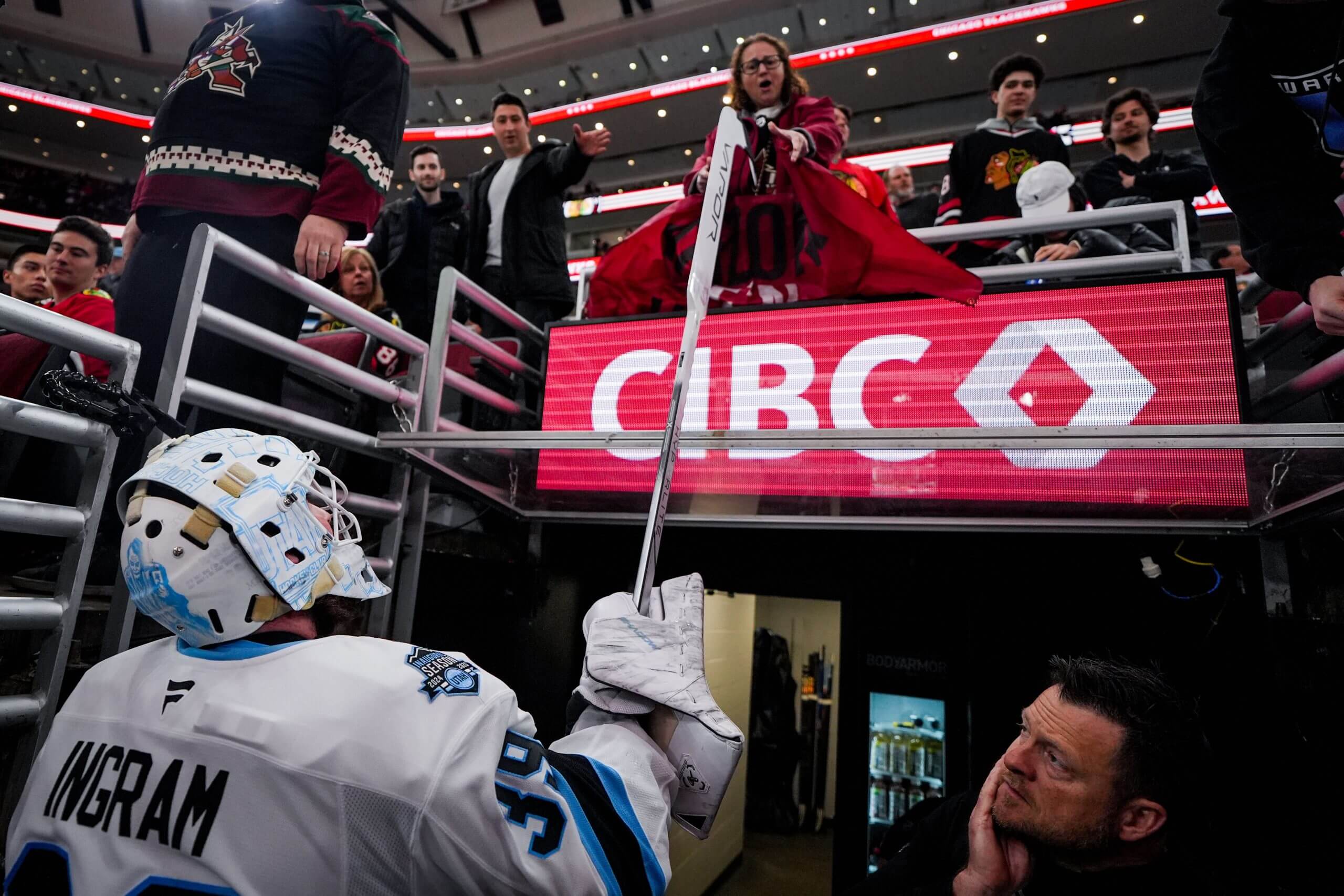
Connor Ingram hands a stick to a fan at the United Center. (Photo courtesy of Connor Ingram)
Ingram’s mother, Joni, was diagnosed with breast cancer in April 2024. Ingram went to Utah and played the first half of the 2024-25 season knowing she was dying. Eventually, her health deteriorated to the point that Ingram left the team to see her back home in Saskatoon, Saskatchewan.
“It was really hard,” he says. “The rest of my family got to be there for her the last four or five months and got to see her whenever they wanted. And unfortunately for me, I had a job where that wasn’t an option.”
Joni was the mother of four boys. Ingram is the youngest. They were always on the go, spending time together in the van on the way to hockey.
“She was there after all the good or bad days,” he says.
Sarah Ingram will never forget the first time she met Joni. Ingram was playing for the Nashville Predators’ AHL affiliate, Milwaukee, during the 2021-22 season, and they were in Manitoba. Sarah, who lived in Kelowna, British Columbia, at the time, flew to town for the weekend to watch him play. She sat between his parents, Joni and Brent.
“She was the most nervous watcher I have ever seen,” Sarah says. “I felt so bad because she was so badly trying to get to know me and was just the kindest soul, but anytime the puck crossed the blue line into their zone, she had to look away. She couldn’t watch. They’d get a shot and she’d just jump. His dad actually told me after the fact that she never sat in the seats to watch Connor’s games, ever. She would pace the concourse or would sit in the bathroom. So it meant a lot to me she was putting herself through that to sit there through the nerves, watch him play and get to know me. But honestly, it perfectly sums up the person she was. She wanted everyone to feel loved and appreciated.”
Joni was able to attend the couple’s wedding in August of 2024, four months after her diagnosis. They discussed moving the wedding to Canada to make it easier for her, but Joni was good to travel to Nashville for the milestone moment.
“She was determined,” Sarah says. “She wasn’t going to let treatments stand in her way of making it.”

Connor and Sarah Ingram at their wedding with his parents, Joni and Brent. (Photo courtesy of Connor Ingram)
There wasn’t an official mother-son dance, but there was a picture of Joni and Connor dancing that the couple now treasures.
“A beautiful photo,” Sarah says.
Ingram took time away from Utah in November of that year, when his mother was really sick. She died on Dec. 3, 2024. Ingram returned to the lineup about a month later, but he wasn’t handling everything well and was dealing with depression. Sarah was his rock. There were times she was so worried about him that she’d insist on being with him in the car on the way to the rink and back.
“Genuine fear that he might crash his car,” Sarah says. “Very dark, but very real things. There were genuine concerns, and when it’s the person you love the most in the world, I would do anything to keep him safe.”
“There’s dark days and, especially with depression, there’s days where you don’t feel like doing anything, and you’re definitely a little bit of danger to yourself,” Ingram said. “(Sarah) has been around me enough to know when that was happening.”
Ingram, who had previously entered the NHL/NHLPA player assistance program in 2021 for help with obsessive-compulsive disorder and anxiety, knew how much help it could be. He entered the program in March, getting therapy in Utah three times a week.
“I probably wasn’t going to make it unless I did it,” Ingram says. “I definitely wouldn’t be playing hockey anymore.”
The Mammoth put Ingram on waivers on Sept. 17, telling him he wasn’t in their goaltending plans for the season. He went unclaimed. On Oct. 1, Utah found a new home for him, sending him to Edmonton for future considerations and retaining $800,000 of his $1.95 million cap hit for this season, the last one in his contract.
Ingram appreciates the fresh start. He also praised the staff and team in Bakersfield for helping him “get my feet back underneath me.” His numbers weren’t great, going 4-5-2 with an .856 save percentage. He said there was a learning curve playing in the AHL for the first time in years.
But when Jarry got put on injured reserve in mid-December, Ingram got the call. And with eight quality starts in his first 11, he seems to have supplanted Calvin Pickard in a tandem with Jarry.
Could Ingram be part of the answer for a franchise that has been looking to solidify its goaltending for years?
“I don’t know if it’s the answer,” Ingram says. “It’s awesome to be around, and you see a team with a history like this — a team that’s gone to back-to-back Cup Finals. We’re right there. If they want me to walk to Calgary tomorrow, if that’ll win hockey games, I’ll put my boots on the ground and get on the road.”
This is a goalie who’s played 50 games in a season — his breakout year with the then-Coyotes in 2023-24, when he won the Masterton Trophy. He feels capable. And when he’s able to perform, as he has for a good part of this run with the Oilers, it all comes back to him. Like on the Dorofeyev save.
“It’s such a confidence-based position,” Ingram says. “And just a moment like that where I could take a step back and go, ‘Damn, you still got it.’”