
This article is part of our NHL Arena Rankings series, in which we rank all 32 current rinks and present stories about memorable rinks of the past and present.
COLUMBUS, Ohio — Much like with their play on the ice, the Columbus Blue Jackets stumbled out of the starting gate in 2000 when it came to marketing the franchise — not just to locals, who were new to the NHL, but the rest of the hockey world, which was unfamiliar with Columbus.
The team nickname was always rooted in the Civil War. Ohio was a major force for the Union Army, and the blue jackets worn in battle by Union soldiers were sewn and stitched in Columbus, close to where Nationwide Arena now sits. But some at the top of the Blue Jackets organization were worried about trivializing war, even one that occurred nearly 150 years earlier. So the true meaning of the nickname didn’t register with some fans, even in central Ohio.
It took nearly a decade before the Blue Jackets decided to fully embrace their Civil War connection, and it coincided with the arrival of a Civil War-obsessed coach. But why just tweak your brand, when you can blast your way to a new identity?
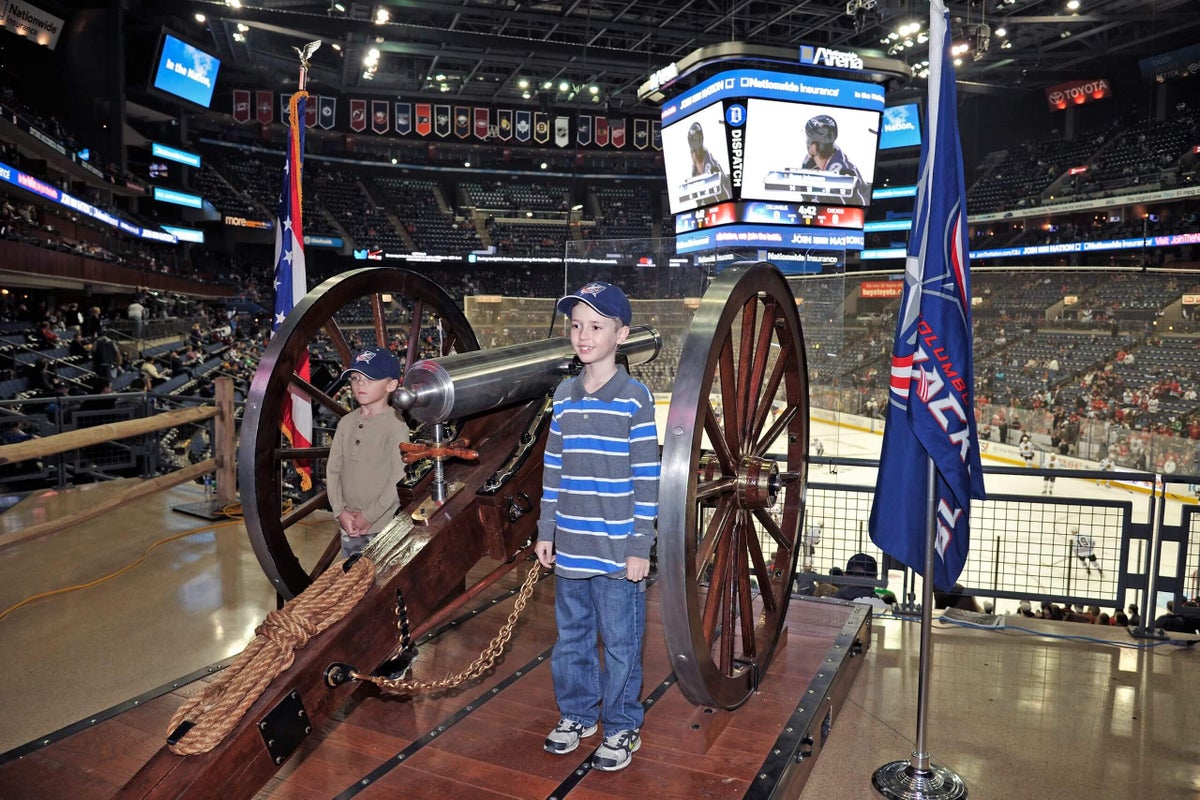
Since 2007, the Blue Jackets have celebrated the start of every game, the scoring of every Blue Jackets goal and every win in Nationwide Arena by blasting a Civil War-era cannon — an 1857 Napoleon Field Gun, to be exact.
It rattles the rafters. It scares the hell out of opposing players and unsuspecting fans. It is loved by Blue Jackets fans and loathed by almost everybody else in the NHL. But it’s the first thing every fan looks for when they first visit Nationwide Arena. Lengthy lines form each game for pictures.
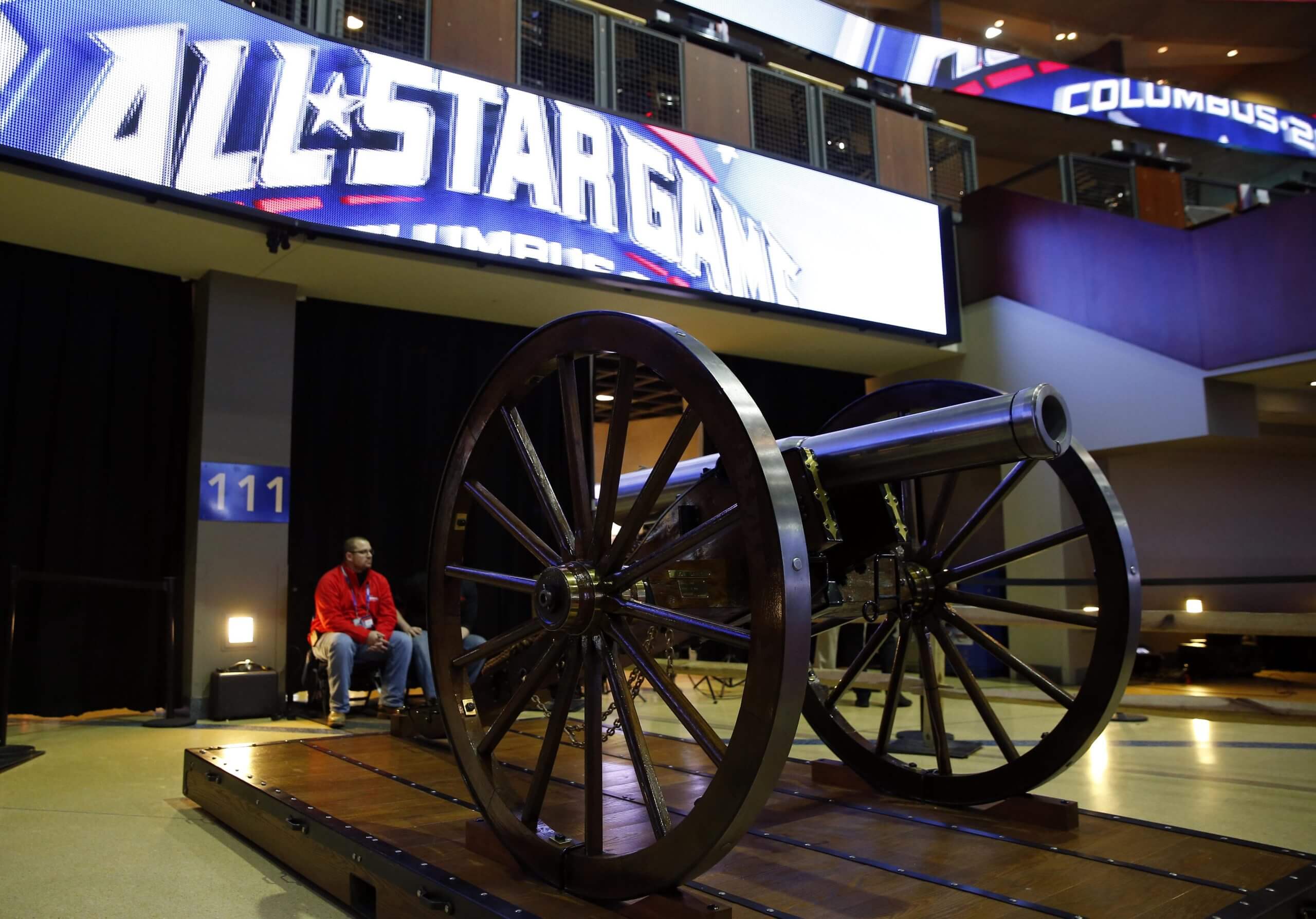
The cannon has been a Blue Jackets staple since 2007. (Russell LaBounty / Imagn Images)
The cannon quickly found its way onto the Blue Jackets’ jersey, and not just on their unique third sweater but with a permanent patch on the shoulder of their regular homes and aways. There are “cannon” trinkets, T-shirts and tattoos.
When the Blue Jackets played the Detroit Red Wings in an NHL Stadium Series game one year ago, the cannon was brought with great ceremony a few miles away to Ohio Stadium, where 94,751 fans couldn’t wait to hear its boom resonate in that Gothic masterpiece stadium built in 1922.
The Blue Jackets have never had much success on the ice, winning just one playoff series in their history. They’ve been called the most irrelevant franchise among the four major pro sports in the U.S., and as offensive as that is for some in Columbus to hear, it’s hard to argue.
But everybody knows the cannon. It’s the boom that makes your ears ring and the blast that has become a signature part of the Blue Jackets franchise.
Legendary NHL coach Ken Hitchcock has more life passions than just the puck. He is a proud Canadian, but has been fascinated by the Civil War ever since he coached in Philadelphia, just a few hours drive from numerous battlefields.
When the Blue Jackets committed to the Union Army branding, their coach, “Ol’ Hitch” — his nickname in the Civil War re-enactment community — knew exactly where to point them: toward a man in Pontoon Beach, Ill., just 15 minutes outside St. Louis, who was an avid collector, refurbisher and artisan, and made replica items from the war.
Mike Todd, the Blue Jackets’ in-arena host and goodwill ambassador, made the trip from Columbus with Kimberly Kershaw, then the club’s director of game operations, to check out the replica cannon.
“We pull off the road, and turn into the place, and it looks like a classic small-town service center,” Todd told The Athletic, “and there’s a man waiting on us who, I have to say, looked like a Civil War soldier himself.”
Todd and Kershaw connected with members of the Columbus front office on speakerphone and the cannon, which weighs 1,564 pounds, was wheeled out into a field to be fired.
“He loaded it first with gunpowder and it let off a decent bang, but nothing special,” Todd said. “And then he said, ‘You wanna try cannon powder.’
“We probably should have known something big was coming, because by that point, a bunch of neighbors had come by to watch, too. When this thing went off, every filling in my mouth rattled. It was like God stomped his foot on the ground.”
The message sent back from the Blue Jackets: “Get that thing to Columbus.”
After a brief negotiation, the Blue Jackets had their cannon. But there were other obvious hurdles that, while already confronted, needed to be refined. Not least of which was: How can you fire a cannon indoors?
Hitchcock recalled a day during the summer of 2007 when the cannon, now on its caisson and a moveable platform, was tested on the event level of Nationwide Arena, just beyond the ice-resurfacer entrance. Obviously, blanks were used, but the concussive blast of the cannon needed to be regulated.
“We knew we couldn’t do a full charge,” Hitchcock said. Then he started laughing.
“But we thought we’d be good with a half-charge to start,” he said, laughing again. “And we let that go and, my God.”
Hitchcock said even the local county fire marshal was alarmed. A member of the arena maintenance crew, riding a burnisher a fair distance away, was nearly knocked off the machine. The foundation of the building was checked for damage.
“Yeah, we needed to dial it down,” Hitchcock said.
The cannon was placed above Section 111, but the only ammunition it is loaded with is a fake smoke charge that “poofs” whenever it fires. There’s a plastic shield in front of the cannon to put worried minds at ease.
The concussive blasts — which are the equivalent of 1/16 charge — are actually placed in the roof, which is why the cannon is so much louder in the upper reaches of Nationwide Arena than it is for those sitting next to it.
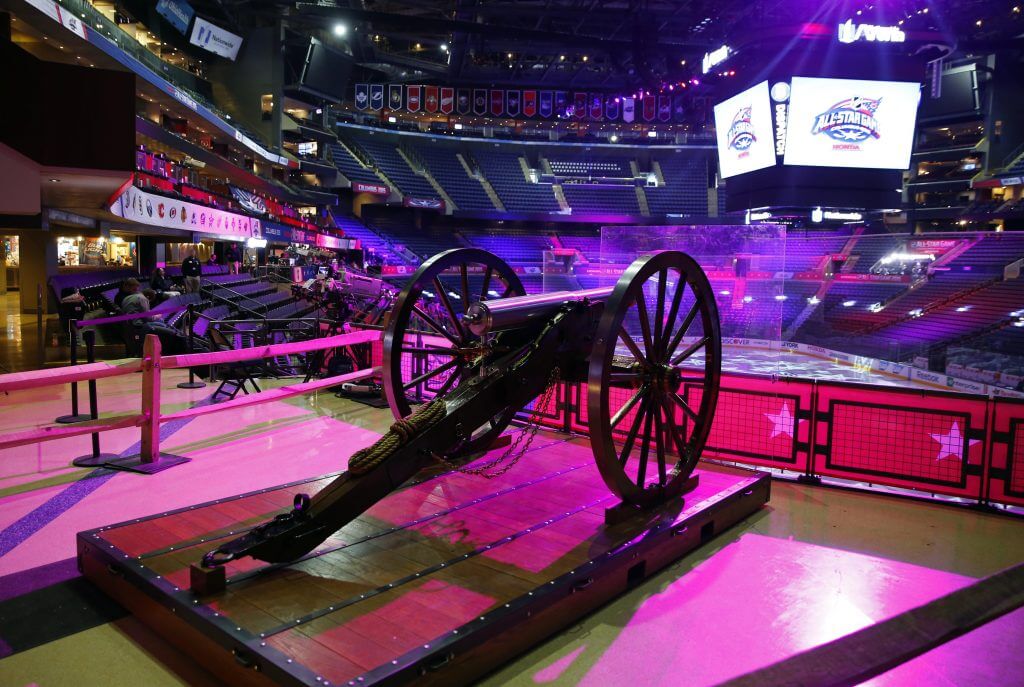
The cannon sits ominously above Section 111 at Nationwide Arena. (Russell LaBounty / Imagn Images)
On Oct. 5, 2007, the cannon fired as the Blue Jackets took the ice for their season opener against Anaheim. The first player to set it off, appropriately, was the franchise’s Mr. Everything, Rick Nash, who scored 6:44 into the game off assists from Sergei Fedorov and David Výborný.
A new era dawned with the franchise, which still had never made the playoffs. The denizens of Nationwide Arena were enthralled, and parents started bringing headphones for their young children, as if they were attending an AC/DC concert.
Within three seasons, the cannon made its way onto the Blue Jackets sweater when the club created a new third jersey with the cannon as the main crest, resting on its caisson and pointing upward to the right of the sweater. It was universally hailed as a strong third jersey.
But there also was a misstep — or a stroke of genius, depending on your position — that coincided with the “cannon” third jersey.
The Blue Jackets’ original mascot is Stinger, a neon-headed, bug-eye insect that looks like a yellow jacket or a hornet, etc.
It was Stinger, both as a mascot and a shoulder patch on the original sweater, that steered fans toward believing that the Blue Jackets’ nickname was based on a mythological insect, and it was widely panned. This, of course, is why the cannon was necessary.
When the Blue Jackets began thinking about using the cannon on the third jersey, they also conceived a second mascot — not to push Stinger aside (we don’t think), but to help drive home the Civil War theme.
That led to Boomer, an upright, inflatable cannon with furrowed brows, a puffy mustache and wheels on each side. There was a hole at the top of his head where Boomer could launch T-shirts at the crowd. But when Boomer was unveiled on Nov. 24, 2010, the mascot’s — well, distinctive — shape drew all of the attention. It spawned a week’s worth of local and national stories, which the club first tried to defuse and eventually came to embrace.
Sadly, Boomer hasn’t been seen since, except on shirts, bumper stickers, online memes, etc. Like several other players through the years, Boomer spent one night in the NHL and hasn’t been seen or heard from since. There are rumors whenever a big event comes to Columbus — the NHL All-Star Game, the Stanley Cup playoffs, the outdoor game in Ohio Stadium, etc. — that Boomer is going to make a surprise appearance, but it hasn’t happened yet. The costume remains in storage in an undisclosed location in Nationwide Arena.
By 2015, the cannon had made its way to every sweater the Blue Jackets wear. In addition to the third jersey, it was now a shoulder patch on both the home and away sweaters. It was also the focal point of the Blue Jackets’ outdoor game sweater.
The cannon’s biggest night, however, was the 2015 All-Star Game held in Nationwide Arena. Perhaps as proof that the hockey gods look kindly upon the cannon (if not the franchise), it was the highest-scoring All-Star Game in history, a 17-12 final.
The Blue Jackets opted not to blast it after every goal, just every goal scored by the club that was selected and captained by Blue Jackets captain Nick Foligno. That meant 12 blasts, although it failed to launch after one goal, so players got a reprieve.
During that weekend, T.J. Oshie, then playing for the St. Louis Blues, made his feelings clear: “It’s the worst thing in hockey,”
Goaltender Roberto Luongo, who was in net for four of those goals allowed, joked that “it got so bad in the second and third period, and guys were so tired of hearing the cannon go off, that they were actually back-checking and defending … in an All-Star Game.”
And on it goes…
“I hate the cannon,” said Claude Giroux, when he was in Columbus with the Philadelphia Flyers.
“I do not like it; I don’t think anyone does,” said Los Angeles Kings defenseman Drew Doughty. “It’s not good when we come here. It scares me still.”
But when players join the Blue Jackets via trade or free agency, it’s often a different story.
“It was always like a double whammy,” said Blue Jackets center Charlie Coyle, who played with Minnesota, Boston and Colorado before he was traded to Columbus last summer. “When you’re on the other team and you hear it, it means you just got scored on, and now you have to hear that stupid cannon, and it’s so loud, just like right in your face.
“Now it’s great. Now you look forward to it, and you’re like, ‘Let’s get that cannon going as much as we can.’ It’s a lot better now. It’s good now.”
When the Blue Jackets played a nationally televised game on Wednesday, TNT’s Paul Bissonnette asked Columbus coach Rick Bowness, who was hired this month, if he had gotten used to the cannon.
“Yes, we shot it off eight times the last game (an 8-5 win over Tampa Bay), and man did I love that,” Bowness said. “We’re not going to do that every night, but man it is hard on the ears, even behind the bench.
“The more I hear that cannon go off, I’m thrilled.”
The NHL Arena Rankings series is part of a partnership with StubHub. The Athletic maintains full editorial independence. Partners have no control over or input into the reporting or editing process and do not review stories before publication.