
Xfinity Mobile Arena was packed for a Tuesday night game in early January. Sure, it had a lot to do with the opponent, but the Philadelphia Flyers had been an upstart team through the first 40 games of the 2025-26 season.
The result that night was a beatdown of the Anaheim Ducks in an emotionally-charged game. At 41 games, the Flyers were one point out of second place in the Metropolitan Division with a 22-12-7 record and 51 points in the standings.
For most of the season, it felt like Flyers fans were guarded with this surprising start. Playoffs were not an expectation across the board. Local and national media weren’t projecting it. The front office wasn’t selling playoffs or bust. But at the halfway point of the season, the vibes felt nearly immaculate. There was real belief the five-year playoff drought would be over in just a few months.
But there was still that internal voice that was telling you to just wait for the other shoe to drop. Not even a month later, and 13 games further into the schedule, the other shoe didn’t drop. It landed with a loud thud.
The Flyers are now 2-8-3 in the last 13 games, and have dropped to 14th among the 16 Eastern Conference teams. They are now seven points back of third place in the Metropolitan Division and nine points back in the wildcard. Those deficits feel almost insurmountable in a league overflowing with parity.
In other words, the writing is on the wall. Forget after the Olympic break and the official trade deadline in March. Another loss season is upon us. The Flyers playoff drought will hit six seasons, barring a total miracle.
This is a playoff drought that is shared by two front office regimes and three head coaches. So lower your pitchforks and torches, because making a change in those areas isn’t going to magically produce a playoff hockey team. This is about roster construction.
And sure, while that falls on the general manager, it also falls on the players in the locker room, to not allow things to snowball the way they have, to not make the same careless mistakes, to not constantly chase the game.
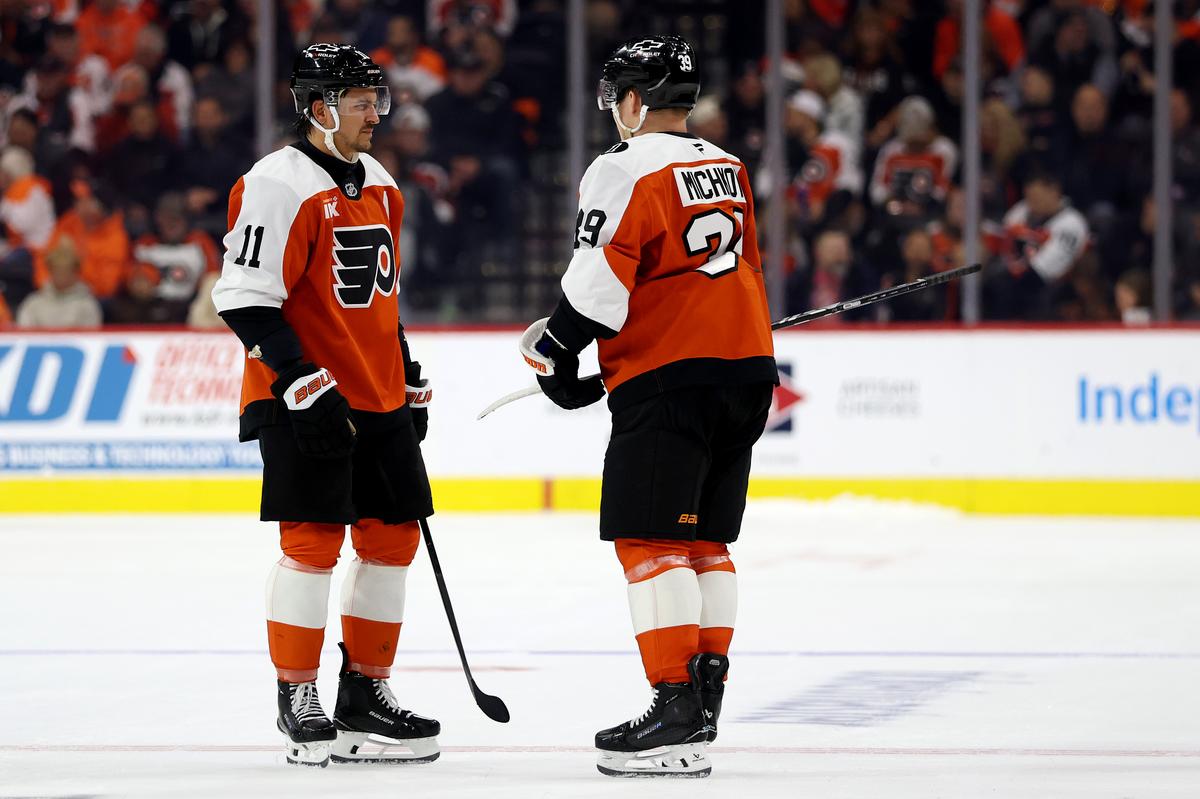
Travis Konecny has been with the Flyers for 10 seasons. He’s been to the playoffs twice, in 2018 and 2020. The Flyers’ alternate captain couldn’t hide his frustration after Thursday’s loss in Boston.
“I’ve been through this so many times. I’m tired of missing the playoffs,” Konecny said. “That’s kind of all I look at right now. Just want to get points for the team.”
Konecny has practically carried the Flyers’ offense through January. He has 17 goals in 28 games dating back to Dec. 3. Konecny is hardly playing a mistake-free game, guilty of as many turnovers and breakdowns as the others, but he’s certainly not the problem with a statline like that.
Konecny is preaching to the choir here. Because the frustration has been mounting throughout the Flyers’ fanbase. Another lost season would mark six straight without making the playoffs. It’s been eight years since fans could attend a playoff game – the 2020 Stanley Cup Playoffs were played in the COVID bubble. A few on-again, off-again playoff appearances go back to 2014. You’d have to go back to 2012 to find the last team that people truly got to experience in person that actually looked poised for a deep playoff run.
That’s 14 years ago. There’s an entire generation growing up with the Flyers being totally irrelevant.
That is what Dan Hilferty, Keith Jones, Danny Briere, and first John Tortorella, now Rick Tocchet, were supposed to be cleaning up. That’s what was supposed to be rectified. And as another lost season looms, it feels like that has stalled.
Why? Because at the same time the vibes were high on the ice and in the locker room and the team was reaching the halfway point in a playoff spot, they extended forward Christian Dvorak. That was the one player that they had on the roster that could stay or go at any moment.
You feel like you’re deep enough into a playoff run that you want to keep him around? Sign him. Things go wrong and you need to pivot to selling? Sell.
Well, now that option is firmly off the table, and the Flyers have little to sell. Rasmus Ristolainen’s name has come up again, but his inability to stay healthy could get in the way. The Flyers could move a handful of low-lineup players if there are takers – think Nic Deslauriers, Carl Grundstrom, or Noah Juulsen – but there won’t be much of a return.
So it’s really best if the Flyers sit this one out, let the season play out as it will, and re-evaluate. Everything. From the top down. Why does this keep happening? Why do they have the league’s worst power-play year in and year out? Why does the talent they draft or acquire not seem to click? Who should really be a part of the future going forward?
Because it’s now evident that, even though it’s a younger roster in the NHL, it’s one that is still not close to good enough. It doesn’t have the talent to compete. And a look at some of the fellow five-year droughts will show you just what the Flyers lack.
San Jose and Chicago have bonafide stars on their hands. Anaheim has a solid crop of young talent. Montreal has established their core through well-executed selections and development. Even Buffalo and Detroit, who didn’t always end up with the best draft picks on paper, are well-positioned to end their long playoff droughts.
And then there are the Flyers, that feel like they are right back where they started.
When Jones and Briere took over, there was plenty of mess to clean up from the previous regime. They spent two seasons trying to do that. The 2025 offseason was supposed to be the last of its kind, trying to find stopgaps, trying to build a team through high draft picks, and spending more time clearing cap space than using it.
So what happened? The free-agent market that the Flyers banked on being there dried up. Trades are always a harder avenue to pursue, especially if you don’t have enough valuable prospects. And the players the Flyers do have on the roster already have answered the question emphatically about how ready this team is for the next step.
When you haven’t made the playoffs in six seasons, you better have something else that gets people excited. Matvei Michkov was that guy going into last season. But his sophomore slump has left more questions than answers that even he can be the elite talent needed. Tyson Foerster is spending the rest of the season rehabbing. Porter Martone won’t be on the Flyers until next season most likely.
A No. 1 goalie is not here, though there are some solid prospects in the pipeline. They still don’t have a No. 1 center, on the active roster or in the system. They don’t have that stud on the blue line that plays in all situations and is as much of an offensive threat as a defensive dynamo.
They feel no further along today than they did when Jones and Briere took over. And that’s where the frustration lies. Because for Jones and Briere, it’s too late to start over and see this thing through. Thus is the shelf life of anyone working in hockey.
So it once again requires creativity. It requires the Flyers to find different ways to acquire the most important and sometimes most elusive parts of a franchise. And it’s going to have to happen fast, for their future, and the overall future of the franchise.
Kevin Durso is Flyers insider for 97.3 ESPN. Follow him on social media @Kevin_Durso.
Philadelphia Flyers Uniforms Through The Years