
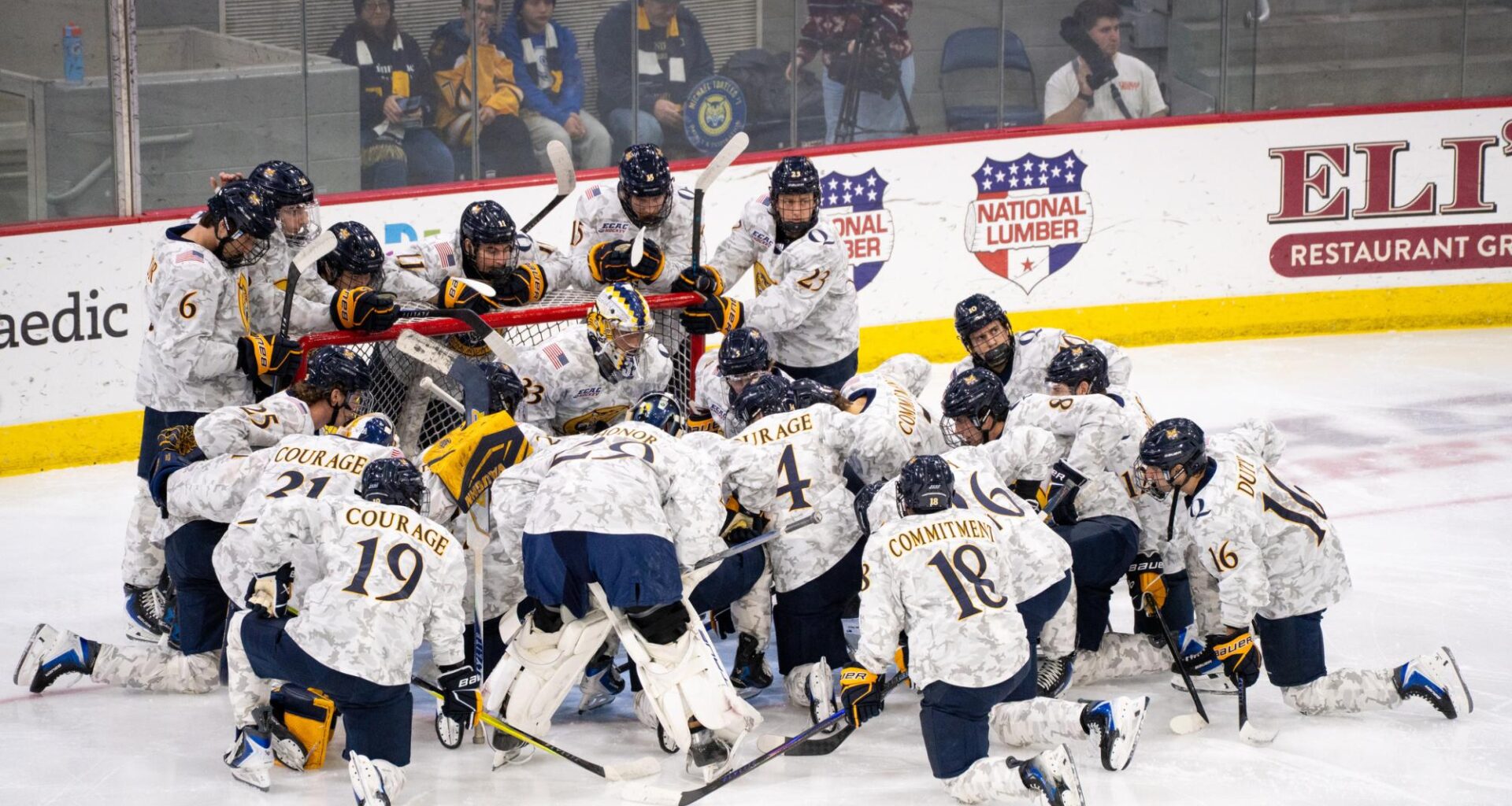
The final stretch is sometimes the most important part of the journey, especially in sports. Teams can start off super strong, yet by the end of the season, begin to slip off their peak. Alternatively, teams can start a season horribly, getting repeatedly slammed, yet pull their game together to finish strong.
For Quinnipiac men’s ice hockey, in the final stretch of ECAC play, it needs to remain strong. How? The Bobcats must build on their strong points while cleaning up the weak spots in their game.
SCHEDULE
The Bobcats started conference play in quite an unusual way for head coach Rand Pecknold’s squad, coming up short against the Yale Bulldogs.
The Bobcats, who had a 17-game win streak dangling over the Bulldogs’ heads, would walk out of Ingalls Rink with a 4-2 loss, losing their opening game of conference play for the third consecutive season.
Since that loss, the Bobcats have held strong in ECAC play, posting a 11-2-1 record. Additionally, they hold an overall record of 20-5-3, dismantling several ranked opponents along the way, such as Boston College, Boston University and the University of Maine.
Quinnipiac ran on a seven game win streak in conference play before losing to Clarkson in a shootout, a squad it beat earlier in the season 4-1.
In the final stretch of play, Quinnipiac will face off against Brown, Yale, Princeton, Cornell, Colgate, Dartmouth and Harvard.
While the Bobcats have had victories this season against the majority of the teams they will face off against, they need to seek revenge against Yale in the infamous “Beat Yale” game to assert their dominance over the conference.
Additionally, the Bobcats are yet to face off against the nationally ranked Princeton Tigers, who currently sit fifth in the ECAC. Quinnipiac will play its two conference games against the Tigers on Feb. 14 and 15.
NEW KIDS ON THE BLOCK
Quinnipiac has seen astounding production from its freshmen class this season, with three freshman landing in the top five point totals of the squad: forwards Ethan Wyttenbach, Markus Vidicek and Antonin Verrault.
Since stepping into Hamden, Wyttenbach has taken Bobcat hockey by storm. As of Feb. 2, he leads the team in points at 41, coming off 15 goals and 26 assists (a category in which he also leads the team).
The Roslyn, N.Y. native knows how to perform in college puck, with clean, sharp passing, quick decision making and readability of the play. Not to mention, he isn’t afraid to use his body to battle for the puck.
“There’s a lot of players at our level that create a lot of offense, create a lot of scoring chances. And then he’s got that next gear and has that ability to finish those chances,” Pecknold said on Jan. 23. “He’s just next level, not just with goal scoring, but the passes and timing.”
Wyttenbach’s strong start at Quinnipiac has earned him Rookie of the Week three times and Rookie of the Month during November, while further earning a Hobey Baker award nomination.
With the final two freshmen on fire, we have Vidicek and Verreault, both coming out of the CHL.
Vidicek sits third in points for the Bobcats with 27, coming off 16 goals (tied for first on the squad with sophomore forward Chris Pelosi) and 11 assists. The Montreal, Quebec native was honored as Rookie of the Week on Oct. 27. Verreault follows him with 27 points on nine goals and 18 assists.
Vidicek and Verreault share common characteristics in their play style, knowing how to generate play and finish at the same time. Their way of seeing the ice and speed at doing so makes them valuable assets to Quinnipiac’s squad.
SCORESHEET
Looking at the score sheets, there are a few outstanding aspects of Quinnipiac’s play worth noting.
Yes, the Bobcats have outscored their opponents 115 to 62, and have outshot their opponents with a .118 shot percentage to the opposition’s .096.
However, the most crucial aspect of Quinnipiac’s score sheets is its ability to spread the wealth, getting multiple Bobcats involved. Currently, Quinnipiac has 15 Bobcats with double digits points, seven of whom are above 20 points.
Quinnipiac’s variety of skaters on the scoresheet demonstrates the team’s ability to get everyone involved, setting up and generating offensive chances.
Focusing on the Bobcats’ special teams is where things get a little shaky. Quinnipiac’s penalty kill unit hasn’t done too shabby, only allowing 14 goals on 86 opportunities from opponents.
Yet, when looking at it’s unit on a national setting, Quinnipiac falls to No. 17 on penalty kill percentage, with many teams it have faced off against, including Union, Harvard, Dartmouth, Sacred Heart, Merrimack, Boston University, New Hampshire and Boston College placing above them.
The Bobcats also average 3.6 penalties a game, a number that should drop slightly, but compared to their opposition’s 4.6 penalties per game isn’t horrible.
Moreover, looking at Quinnipiac’s ability to finish on the power play, it has only found itself finding the back of the net 27 times on 130 opportunities, opportunities the Bobcats need to capitalize on going forward.
With hopes of winning the ECAC for the first time in a decade and punching its ticket back to the NCAA Tournament, the Bobcats need to position themselves as a predator to fear.