
Good teams find ways to win; other teams find ways to lose.
The Senators dominate teams game after game, yet find themselves seven points out of a playoff spot.
And, yes, their recent four-game winning streak was very impressive. They beat two of the best teams in the league in Colorado and Vegas, while swatting away Pittsburgh and New Jersey, allowing just six goals in four games.
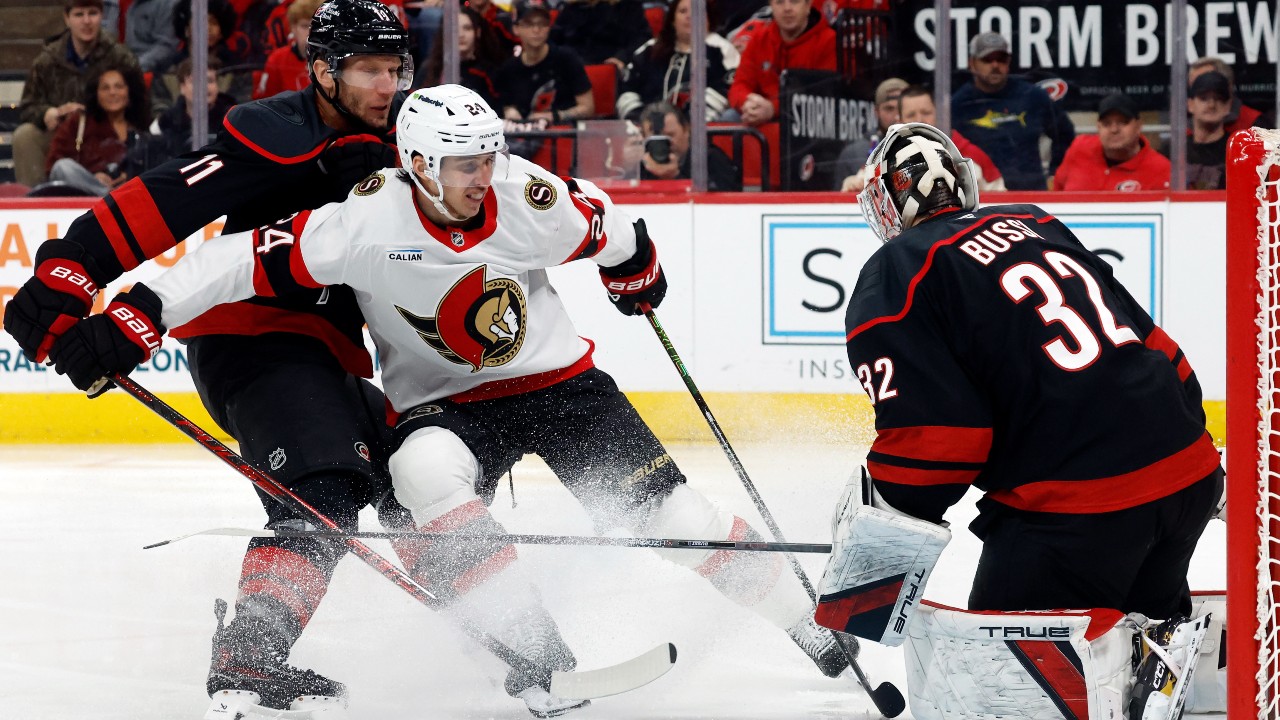
Nevertheless, on Tuesday in Carolina, with the game on a knife’s edge, a pitiful line change sunk them. It was a gutsy effort on the second night of a back-to-back, coming back from two goals down to tie it late in the third.
Effort shouldn’t be questioned.
If they had won, they would have had a 50 per cent chance of making the playoffs. Instead, in defeat, they dropped to 36 per cent, according to Moneypuck.
All the pieces are in place for this team to be a playoff team, but maybe an unquantifiable “it” factor is missing. Add in a combination of poor goaltending, penalty kill, lack of a top-four, right-shot defenceman and, if you can believe it, line changes.
It’s not all doom and gloom, though.
So, let’s analyze how the playoff push may be on, and the hurdles Ottawa faces, too.
Are line changes really a problem?
Yes, and they have been for a while. In two games against Carolina, Ottawa has allowed two goals from inexplicably awful line changes.
Jordan Staal widened Ottawa’s chasm to make the playoffs and exposed its need to work on something as simple as line changes.
I wrote about this same issue multiple times last season.
It’s hard to quantify, but you know it when you see it.
It’s been a wonderful return for Linus Ullmark from his bout with mental health struggles, stopping 40 of 43 shots. This season, the Senators have a .638 points percentage with Ullmark in the net. If the Senators continued at that pace, they’d finish the season with 94 points, which is likely on the cusp of a playoff spot. The bad news is that in Carolina on Tuesday, James Reimer was outduelled by Brandon Bussi. It wasn’t all on Reimer, but a good performance would have earned Ottawa a point and maybe a win, which would have left behind a sweet sugar-cane taste when departing Carolina.
You’re only as good as your goaltender.
Ottawa’s season now rests on Ullmark.
It might be haunting to hear, but the Senators sit top-five in almost every underlying metric other than goaltending. If they miss the playoffs, the 2025-26 Ottawa Senators may be one of the best teams ever to miss the playoffs.
Stutzle has goals in four straight games, five of his last six. He’s on pace for a career high of 40 goals. This season, he’s been held pointless in only 33 per cent of his games. He’s elevated of late, too. In his last 28 games, he’s been held pointless in just five of them.
Excellence was defined thousands of years ago by Aristotle: it’s a habit, not a single moment of brilliance.
“I think it’s nothing new for us,” Senators defenceman Jake Sanderson told Sportsnet.ca about Stutzle. “From the day I came here, I knew he was a stud. With his competitiveness, I think that’s the No. 1 thing, why he’s such a great player. He brings it every day, and he wants to win so bad. And I think that’s great to have on our team. He’s a great leader for us. He’s going to put up 100 points here soon.”
Stutzle is on pace for 87 points. But he has become one of the best 200-foot centres in the world, and he’s only 24 years old. Who knows what heights he will hit in the back half of the 2020s?
Halliday has four goals in his last six games while averaging less than 10 minutes a night. He sits 20th in the NHL in points per 60 minutes at 3.37.
Ottawa has found itself an interesting and productive player with his six-foot-four frame matched with a good shot, quick hands and elite playmaking qualities.
Hockey isn’t an academic exercise, but Cousins has a master’s (practical degree) in the art of a hockey rat.
He’s also one heck of an effective hockey player.
Since uniting on the third line with Shane Pinto and Michael Amadio, the trio has the 10th-best expected goals of any forward or defensive pairing in the league (minimum 70 minutes played).
Senators head coach Travis Green called him an extremely smart player, while affectionately referring to him as “annoying.”
He was voted the most punchable face in the league in an Athletic poll of NHL players last season.
“I think, first and foremost, you have to believe in yourself, right? Or nobody else will,” Cousins said with a wry smile. “That’s probably one of my strengths, to be honest. It’s just my hockey IQ and reading the game.”
Cousins believes this season. He’s played some of his most consistent hockey and sits third in the league with 1.95 expected goals against when he’s on the ice. On Tuesday in Raleigh, Cousins hit the post and twice got robbed by Bussi. Cousins is on pace for the most points in his last three seasons.
Getting away from the game with family as a father of two young kids is important for Cousins. So much so that his teammates doubt whether he even watches hockey away from the rink.
“I don’t know if guys will believe me or not,” Cousins said, joking. “I actually watch a lot of hockey, and I think you can pick up certain aspects of the game, just reading the game and what other guys do.”
Like many of us watching hockey, we tend to love watching the players who remind us of ourselves.
“As much as I hate the guy, I like watching Brad Marchand a little bit,” said Cousins of the league’s future Hall of Fame pest. “I mean, we’re obviously different players. He’s a little bit faster, but just the way he uses his body to protect pucks, and he’s not the biggest guy. But he’s certainly brave and gets into the corner, and he wins every puck.
“It’s a fun guy to watch, as much as I hate the guy. I’m sure he hates me, too.”
So how does one become a rat?
“Honestly, it is something that I’ve always had, like even minor hockey, it was the same way,” said Cousins.
“Junior was probably worse,” Cousins said, laughing. “But it’s also made me pretty effective.
“I’m just super competitive, and I hate losing. I also like to stick up for my teammates verbally. I honestly think it’s just something that’s in my DNA.”
Cousins said he chirps opponents as much to get underneath their skin as to boost himself.
“Sometimes when you’re going into like three games in five nights, and you’re kind of a little sleepy sometimes right away. I just start chirping, but then, when the other team starts chirping me back, it fires me up,” Cousins said.
“I told Giroux this, too. I’m like ‘G, I hope someone chirps me.’”
Claude Giroux himself was notorious for chirping back in the day, as Cousins recalled when they played together in Philadelphia from 2014-17. That includes Giroux’s infamous pigeon call.
“He doesn’t say a whole lot now, but actually, when I was in Philly, he would do a lot of yapping, too.
“(Now) he’s old and grumpy,” Cousins said, joking.
Thankfully, for our entertainment, Cousins is passing down the art form to the next generation. He’s taken Ridly Greig under his wing, a player who’s somehow managed to annoy both Toronto and Montreal already in his young career with an empty-net slapshot and pre-season shenanigans.
“I tell him to be a little bit of a rat because it’s contagious,” said Cousins.
“Like, as much as people don’t like it, I think it drags other people into the fight a little bit, like when he’s doing what he’s doing.”
If the Senators want to get back into the playoff race, they’ll need to win the physical and, maybe most importantly, the mental battle. It doesn’t hurt when you have Cousins amping up the troops.