
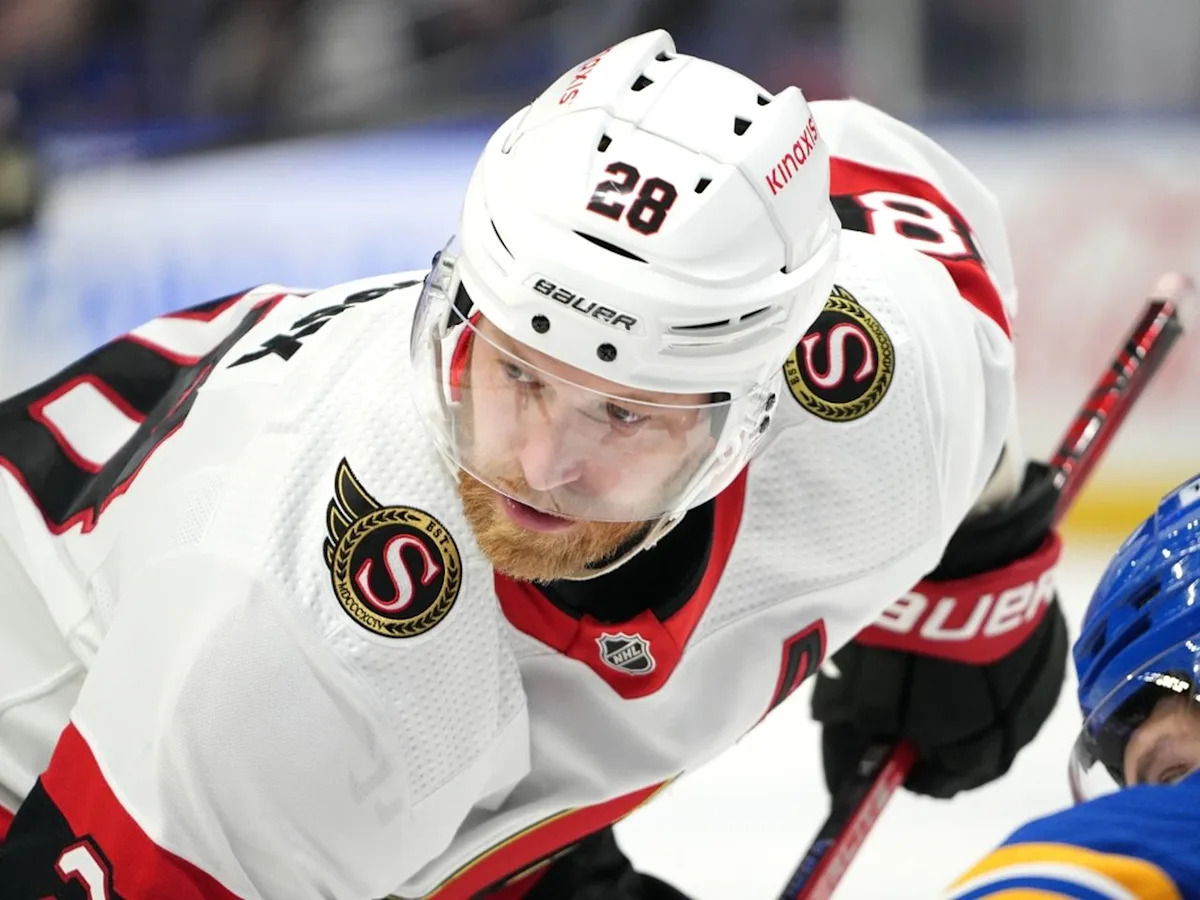
The start of a hockey game looked dramatically different 150 years ago.
When the sport was first beginning to blossom in Canada, many games began with the referee ringing a bell, followed by two opposing skaters performing a “bully” manoeuvre at centre ice. The players would whack their sticks on the ice three times, tap them together once above the puck and then scramble for possession.
Similar procedures, Canadian kids can confirm, remain in road hockey and ministicks to this day but, of course, the National Hockey League has long evolved past the good ole days of “1, 2, 3… Go!”
In the 108-year history of the NHL, faceoffs arguably have been the rule most tinkered with.
Red lines come and go, and enforcement of stick infractions grows more stringent by the decade, but the procedural minutiae involved with dropping the puck has seen myriad alterations.
I’ve read the rulebook so you don’t have to.
The current section on faceoffs is six single-spaced pages long and details 15 potential violations that could result in the centre either being removed from the draw or penalized.
So, how does one find advantages in such a tedious procedure?
Ottawa Senators veteran forwards Claude Giroux and Lars Eller aren’t quite old enough to have taken part in a “bully,” but faceoffs have transformed significantly since each lined up for his first NHL draw.
How have the rules changed?
“Some of the techniques that were utilized that were effective, it’s changed a little bit the last five, six, seven years,” Eller told the Ottawa Citizen. “They took away how some guys would use their hand and try to tie up a stick, guys with their skates over the dot a lot, too … And those big sweeps have kind of gone away, and now it’s about getting over top. Smaller movements, but getting over top of the stick.”
The modifications Eller is referencing are specific rulebook updates in 2012 and 2017. The former prohibited players from batting the puck with their hand to win a faceoff; the latter announced “stricter enforcement” of the starting position of centres’ sticks and skates.
“I’d say it’s more about timing now,” Giroux said. “When your timing is good, I think that’s when you’re successful. Some nights, you just don’t have the timing, and you’ll have a bad night. I wouldn’t say cheating, more just good timing.”
While Eller has played centre since he was a young boy, Giroux’s journey to faceoff wizard started surprisingly late. He was a winger throughout minor hockey and junior, and it wasn’t until 2008 — in his first full season of professional hockey with the AHL’s Philadelphia Phantoms — that coach John Paddock moved him to centre.
Now, over 21,000 draws later and with a career win percentage of 56.5, Giroux widely is recognized as one of the greatest faceoff artists of all time.
And in his 19th NHL season, he has somehow raised the bar even higher.
Giroux currently leads the league with a 64.1% win rate in the dot, the best of his career.
“He’s been around for so long,” Senators centre Shane Pinto said of Giroux. “I just think he’s so smart in kind of feeling out the game and who he’s against and what he needs to do to beat them. His over-the-top move is obviously the best. He’s so strong with it. I try to learn from him. It’s hard to replicate that, it takes a lot of time and experience to kind of get that.”
Success in the faceoff dot at the NHL level, as Pinto points out, doesn’t develop overnight. It takes years just to be able to simply win more than you lose.
Eller didn’t crack 50% until his fifth NHL season. For Giroux, it was his fourth.
Sidney Crosby had a 45.5% win rate in his rookie season back in 2005-06; even Patrice Bergeron, widely regarded as the greatest faceoff taker of the modern era, was stuck at 49.4% in his first NHL season in 2003-04.
How does Giroux do so well in the dot?
Building a repertoire of approaches is mandatory. At bare minimum, centres must have a forehand and a backhand move. But it helps to have more.
Amongst current NHLers, Giroux might have the deepest arsenal. In the past, he has won draws between his legs or spun around to get body position on his fellow combatant.
As a right-handed shot, Giroux’s aforementioned over-the-top move is his go-to backhand play for right-side faceoffs. But if the draw is on the left side of the ice, he has been known to flip his stick over and create comparable leverage pulling the opposite way.
“In my career, there’s a lot of times when I’ve tried different things,” Giroux said. “If I have trouble against a certain player, I’ll try something new. Sometimes it works, sometimes it doesn’t. I think you’ve got to be able to win the faceoff with not just one style.”
Then there is the unique social aspect of the faceoff.
No, not the trash talking and chirping between opposing players — those interactions are ubiquitous at all times.
For centres, relationships with linesmen can be that all-important minuscule edge in the dot. Little conversations lead up to every draw. You’ve got to know when to argue your case and when to shut up.
Though, rookies might be best off simply following orders.
“I think in the beginning of your career, like, I was a guy who would always complain about face-offs,” Pinto said. “And that turns them off against you. It’s a fine line. It’s a little bit of the game, but I don’t think it adds too much of a factor. But you definitely don’t want to be mean to them … They have such respect for (Giroux) and he doesn’t really complain too much.”
Pinto believes Giroux receives the “benefit of the doubt” with some linesmen.
“You’ve got to respect their job and they’ll respect you back,” Giroux said. “But at the end of the day, he’s dropping the puck and it’s two guys trying to win it.”
Winning more draws has been a major point of emphasis for the Sens this season, considering what happened last spring.
Ottawa got bullied at the dot by the Toronto Maple Leafs in Round 1 of the Stanley Cup playoffs, owning a 43.4% win rate — dead last in the post-season. The Maple Leafs scored numerous goals immediately after winning draws.
“Yeah, we sucked,” Pinto admitted. “Coming into this year, we all kind of told ourselves, ‘Let’s have a good year in face-offs.’ Obviously, what happened with Toronto, we lost some key draws and it resulted in some big goals.
“When you get to the playoffs, it’s those little details that matter. I just think it was a new mindset coming in, like, let’s try to really take the next step because we’ve got a bunch of really young guys taking face-offs. And I think we’ve all done our part.”
How good are the Senators as a team at faceoffs?
The Senators’ 54.8% faceoff win rate is second in the NHL this season. (Second only to Toronto, but let’s move past that.)
Ottawa’s success is largely due to Giroux’s league-leading 63.9% and Eller’s 58.9%, but the younger players are pulling on the rope, too.
Every 20-something with 100 or more faceoffs taken this season has a win rate better than that 50%: Brady Tkachuk (57.7), Stutzle (53.9), Dylan Cozens (53.5), Ridly Greig (50.9) and Pinto (50.7).
“They’re just working hard,” Giroux said of his younger teammates. “They take a lot of face-offs after practice … I don’t really practise a lot. It’s more about timing and getting tricks, knowing the player on the other side, what he’s trying to do. When you know what the other guy is doing, I think it’s easier to win.”
Just as all players take part in video sessions breaking down opposing teams’ offensive and defensive structure, centres receive rundowns on their counterparts ahead of a game.
“We have video scouts of all the other centres,” Eller said. “It’s on an iPad, so you go check it out for like five minutes and you see five or six reps against the other centres, so you kind of know if they have a certain tendency. That plays a role.
“Once you get to the best league, the guys are way better at everything … Part of it is experience and part of it is studying a little bit. Studying yourself and studying your opponents.”
Giroux is a human encyclopedia on this area of the game.
“I don’t really have to (study), but it’s good to kind of refresh your memory,” Giroux said. “I kind of know which player tries to do what. I’ve taken a lot of faceoffs.”
Said Stutzle: “I always talk to him about it if I struggle with a certain guy. He always tells me what I can do, what I can do different. He’s been around for so long. He knows all the faceoff guys. … He’s just a really, really smart hockey player. He thinks about everything. He knows about everything.”
And he has done just about everything, too.
Mario Lemieux’s famous faceoff goal
You may have heard this legendary story before.
On Dec. 23, 2002, with 6:51 remaining in the third period of a 2-2 game against the Buffalo Sabres, Pittsburgh Penguins superstar Mario Lemieux lined up for a right-side offensive zone face-off with Chris Gratton.
Lemieux, standing oddly straight, looked to take dead aim at the net as the referee prepared to drop the puck. Gratton, knowing what was coming, made a last-second adjustment to position himself in the way.
With a snap of his wrists, Lemieux shot the puck between Gratton’s skates and through the five-hole of netminder Marty Biron.
Lemieux, ignoring a hug from teammate Alexei Kovalev, raised his arms and looked skyward with a triumphant smile.
As it turns out, he was sending a message to the press box.
Related
No. 66 had a running bet with radio talk show host Mark Madden that if he ever scored directly off of a faceoff, Madden would have to donate $6,600 to the Mario Lemieux Foundation.
Thirteen years and one week later, Giroux, then with the Philadelphia Flyers, lined up for a right-side offensive zone faceoff with San Jose Sharks centre Joe Thornton.
Giroux faked his patented backhand move, dropped to one knee, and slapped the puck between Thornton’s legs and past a stunned Martin Jones.
“I just tried to surprise the goalie,” Giroux recalled. “I got pretty lucky on that one.”
Giroux knew the Lemieux story.
By the end of his career in Ottawa, surely, he’ll have taught the kids that trick, too.