
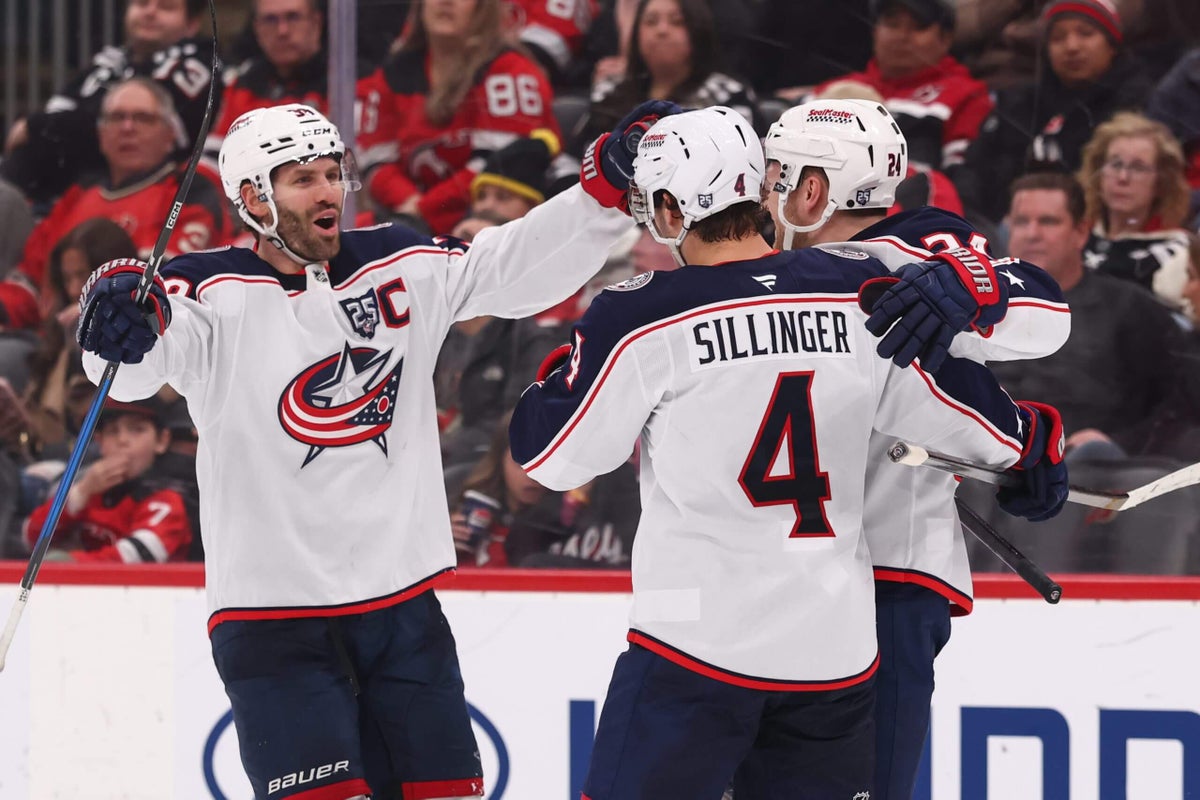
COLUMBUS, Ohio — Rick Bowness said he was drawn to the Columbus Blue Jackets’ coaching job, in part, because he looked up and down the roster and saw a collection of talent that should be performing better.
It was a conclusion drawn mostly from afar, because the only player in the room he’d coached previously was center Sean Monahan, who spent just 34 games under Bowness during the 2023-24 season with the Winnipeg Jets.
Bowness has seen from behind the bench that his belief was correct. The Blue Jackets are 10-1-0 under the 71-year-old, including a seven-game winning streak that has vaulted them to the edge of the playoff line in the Eastern Conference.
Additionally, he’s learned a lot about the group behind the scenes, enough to know, he said, that he made the right decision when he stepped out of retirement on Jan. 12.
“I rely on Monny a lot, but I’ve gotten to know the leadership group very well,” Bowness said after Wednesday’s 4-0 win over the Chicago Blackhawks, the Blue Jackets’ last game before their Olympic break.
“You watch them in practice and you watch them in the meal room … all those little details, I’m watching the groups and everything. You learn a lot about your team in those situations, and I’ve learned that they’re a close group that cares about each other, and it starts with that. If you don’t care about each other, the on-ice product itself is going to be affected.
“They’re a good group, and I really, really, really enjoy working with them. When I was out (retired), I missed that, just working with the players. And I just love this group.”
The feeling, it would appear, is mutual.
What the Blue Jackets have done in less than a month is remarkable, going from a club that was sinking into a lottery-pick abyss to one that is now checking the standings and doing playoff math.
And the really interesting part?
Bowness hasn’t really put his stamp on this club yet. There are several areas, both the coach and players say, where the Blue Jackets can still improve.
Here’s a look at what’s changed under Bowness that has given the Blue Jackets such optimism, along with a few key areas where they can still improve.
What’s changedDefensive indicators
On Day 1 of his Blue Jackets’ tenure, Bowness made it clear that the first fix had to be on the defensive side of the puck. The Blue Jackets were bleeding goals and putting too much pressure on their goaltending.
It was an attitude shift as much as anything: confronting and pressuring the puck, not just defending as it comes at you. It’s obvious that the confidence to play this way took a few games, but it’s there now.
And it may seem counterintuitive to some still, but the best coaches in franchise history have all preached the same mantra: offense comes from defense. That is, checking creates chances. In all of the indicators Bowness mentioned — goals against, shots against, penalty kill, etc. — the Blue Jackets have been dramatically better.
Before BownessSince Bowness
Goals/game
2.91 (21st)
3.91 (7th)
Goals against/game
3.38 (28th)
2.18 (T-1st)
Shots against/game
30.9 (30th)
27.6 (T-16th)
Power play rate
18.8 (20th)
24.0 (13th)
Penalty kill rate
76.4 (29th)
81.3 (13th)
Identity forming
Bowness’ comment after Wednesday’s win over Chicago, that the Blue Jackets are “starting to understand when we can and cannot make plays,” was interesting. Another way to “see” this is that the odd-man chances for opponents, while still an issue, have been greatly reduced.
The directive is for all four forward lines to look exactly the same when the Blue Jackets don’t have the puck, Bowness said. Checking is for everyone. Nobody gets a pass. Responsible creativity is allowed when you have the puck, but a big part of team defense is trust.
These Blue Jackets are big and they can forecheck. It should hurt to play them. And that identity is forming once again.
Regulation wins
The current win streak marks the first time in franchise history that the Blue Jackets have won seven consecutive games in regulation. Even their 16-game win streak in 2016-17 didn’t include seven victories in a row without an overtime or shootout win.
That’s impressive. And important. Not only were the Blue Jackets drifting out to sea before Bowness arrived, but just 11 of their 19 wins had come in regulation. Only Vancouver (10) had fewer. That’s bad on two levels.
First, it means the Jackets, even in defeat, were allowing loser points to spread across the standings. Second, it meant that, even with an improbable run, they couldn’t count on getting any tiebreakers at the end of the season. Regulation wins are the first tiebreaker to determine season-ending standings.
The Blue Jackets’ hot streak, in which nine of the 11 wins have been in regulation, has improved the picture. The Jackets have more regulation wins (20) than Toronto (19), Philadelphia (18) and New Jersey (18), and just two fewer than the New York Islanders.
Third periods
Admit it: you’re no longer stricken with panic when the Blue Jackets carry a lead into the third period.
The Blue Jackets have had a couple of shaky thirds, but they haven’t let any games slip away in almost a month. Moreover, they’ve played, at times, with a late-game authority that had gone missing earlier in the season.
The numbers are worth noting, too. Under Bowness, the Blue Jackets have outscored opponents 14-7 in the third period. Before that, in 45 games, the Jackets had been outscored 63-39 in third periods.
What can improve?Deadline boost
Blue Jackets general manager Don Waddell and his staff, especially vice president of hockey operations Laurence Gilman, will be busy during the break trying to sign pending UFA forwards Boone Jenner, Charlie Coyle, and Mason Marchment, and defenseman Erik Gudbranson, to new contracts.
It would be a massive boost to the dressing room if those deals got done, a proof of commitment to the players on the cusp of what they hope will be a playoff berth and run.
But even if those talks hit a snag, it would be surprising if the Blue Jackets were a lesser team after the March 6 trade deadline. Waddell wants to help this group, who he thinks could be a real threat in the postseason given their size and depth.
If Waddell could find an offensive finisher with existing term, he’d make a move. There could be more moves for depth, too, because that’s what a playoff run requires. The move that might send the fan base over to tilt would be the return of former captain Nick Foligno, who figures to be on the move from Chicago.
Systems work
With the NHL’s schedule compacted to squeeze in the Olympics, Bowness has had no time to really put his stamp on how he wants the Blue Jackets to play. They’ve had only three or four true practices, always with a game the following day.
He’ll finally get a chance to make his tweaks when the players return from their break with an initial practice on Feb. 18.
They won’t practice all eight days between then and their first game back — Feb. 26 vs. the Islanders — but there will be time for lengthy practices to go over any neutral-zone or defensive-zone changes he wants to make.
It does beg the question: is this really the time to tinker?
Eliminating breakdowns
This is hockey. There’s no way to completely eliminate grade-A chances by opponents. But Bowness still sees too many situations, he said, in which opponents are given clean scoring chances and pucks get behind defensemen.
This is a defense-first coach, not dissimilar tactically to previous Columbus coaches Ken Hitchcock and John Tortorella. He has delighted in two of the Blue Jackets games that have been 0-0 after two periods.
On Tuesday in New Jersey, when the Blue Jackets scored three third-period goals and the Devils were the first team to crack, Bowness beamed. But there were still a few chances for New Jersey that he didn’t like.
Clean it up, boys. That’s the message.
Get going
The Blue Jackets are averaging almost four goals per game under Bowness, which is plenty enough in today’s NHL. But, remarkably, the Jackets have some key players who haven’t created much offensively in recent weeks.
Adam Fantilli, Jenner, Cole Sillinger and Dimitri Voronkov each have one goal over the last 11 games. Kent Johnson, back in a top-six role under Bowness, has two goals. Even Kirill Marchenko, who has three goals in that span, hasn’t been his turbo-charged self yet offensively.
The damage has been done, mostly, by Coyle, the third-line center, and, of course, Zach Werenski.
Bowness has had only good things to say about all of the above mentioned, although he has challenged Voronkov and demoted him to the fourth line. But if these guys get going…
Easy travel
The schedule is going to be intense — the Blue Jackets play 17 games in March — but the worst of their travel is behind them.
The Blue Jackets don’t leave the Eastern time zone the rest of the way, and they don’t have a road trip longer than three games, either. There are five back-to-backs on the schedule, but those haven’t been a nightmare like last season.
After beating Chicago on Wednesday, the Blue Jackets are 7-3-1 in the back half of a back-to-back. They’re 7-2-2 in first games, too.
Of the Blue Jackets’ remaining 26 games, 14 are in Nationwide Arena. But the road hasn’t been a nightmare for Columbus this season, either.
The Blue Jackets are 14-12-3 away from Nationwide, on pace for their first winning record on the road since 2019-20.