
The NHL is in a trade freeze, which probably suits Minnesota Wild general manager Bill Guerin just fine. He’s got Olympian-sized fish to fry, watching Quinn Hughes, Matt Boldy, and Brock Faber compete for a gold medal. That break won’t last long, though, and before you know it, Minnesota will be hitting the trade market relentlessly.
Top of the list is — same as it ever was — centers. The Wild need depth down the middle, especially after trading Marco Rossi to acquire Hughes. The available options seem to include swinging another blockbuster for Robert Thomas, a smooth-skating 26-year-old point producer, or going with one of Guerin’s Team USA alums with Vincent Trocheck, with a Plan C of nabbing an older rental like Charlie Coyle.
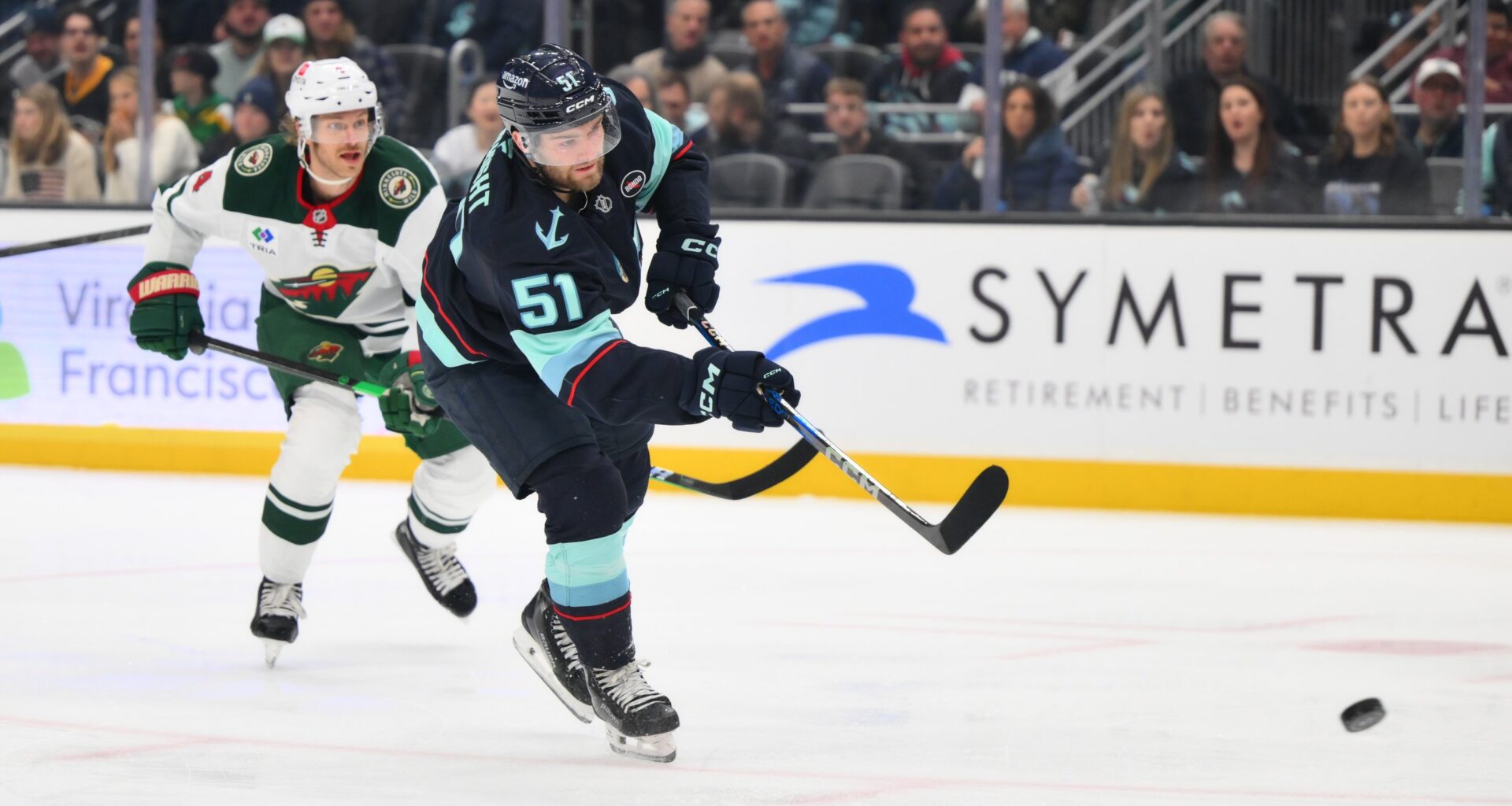
Playoff teams tend to focus on adding veteran experience to their lineups, but there may be an opportunity for Guerin and Co. to go the opposite direction. The Seattle Kraken are apparently dangling center Shane Wright, the No. 4 pick from the 2022 Draft, who would be an unconventional, but fascinating fit for the Wild’s stretch run.
Why wouldn’t a playoff team normally target Wright? For one, he’s in a sophomore slump. After scoring 19 goals and 44 points in 79 games as a rookie, Wright has just nine goals and 20 points through 55 games. Given that he plays in Seattle, he’s never played in the Stanley Cup Playoffs. Like many developing centers, he’s not strong in the faceoff dot.
That stuff probably matters to Guerin, but not as much as this: Wright is a strong fit for the Wild’s top-six who can contribute now and for the rest of Kirill Kaprizov and Quinn Hughes’ primes.
Traditionally, a team’s No. 1 center plays a lot like Kaprizov. They’re the primary puck-transporter into the offensive zone. Once they’re past the blue line, the offense runs through them. Wright is skilled, but he’s not nearly at Kaprizov’s level. But as the Wild have shown, that matters a whole lot less on a line that already has Kaprizov.
The formula to successfully centering Kaprizov has been simple: Work hard, get to the net, and be ready to make a play. Joel Eriksson Ek‘s biggest strength is his forechecking, not his fancy puck skills. It works brilliantly with Kaprizov. Rossi knew how to find the soft spots around the net. Kaprizov helped him score 60 points last year. Danila Yurov was able to thrive in limited minutes following in those two’s footsteps.
That’s a job Wright should be well-suited for. He’s a willing forechecker who can recover pucks for Kaprizov and Mats Zuccarello, or pressure defensemen into making mistakes. While Wright doesn’t shoot the puck often, his shots tend to be right around the net, and he’s second on the Kraken in expected goals per hour at 5-on-5. Wright has also taken a big step in his own zone this season.
This should all sound pretty familiar.
When the Wild spent two years shopping Rossi around the league, insiders like Michael Russo often hinted that the team was looking to find a bigger, faster center. It was a tough move to pull off because few teams are looking to get smaller and slower down the middle.
But if the Wild were to acquire Wright just months after flipping Rossi, they’d accomplish that exact goal in a roundabout way. At 6-foot-0, 193 pounds, Wright isn’t on Evgeni Malkin or Quinton Byfield‘s level of imposing. Still, 6-foot-0 is solid enough. Wright also rates well in terms of game speed. His 105 bursts of 20-22 mile-per-hour skating ranks in the 87th percentile of the NHL.
It can be risky to bet on a change of scenery to fix a player, but it’s hard to find a bigger talent upgrade from Wright’s current situation to Minnesota. Wright’s most common linemates this year are 20-year-old rookie Berkly Catton, Kaapo Kakko, Jani Nyman, and Ryan Winterton. And you thought the Wild had issues in their bottom-six.
Not surprisingly, Wright’s 44-point rookie year came primarily alongside Jared McCann, Eeli Tolvanen, and Andre Burakovsky. Weird! A talented player plays well with other talented players!
All due respect to McCann, a reliable 20-goal scorer who hit 40 in 2022-23, but Kaprizov’s on another planet. Heck, if the Wild wanted to move Eriksson Ek to the top line, Wright would likely play with Boldy, who also outclasses McCann. If there was a team tailor-made to have Wright thrive, it might be Minnesota.
The benefits of trading for Wright aren’t all on the ice, though. Acquiring Wright would also help preserve the franchise’s flexibility going forward. While someone like Trocheck is more of a sure thing, the cost of landing him will surely take a chunk out of the Wild’s already thinning pool of trade assets. If Minnesota moves a Jesper Wallstedt or Charlie Stramel for Trocheck (or a similar player in Nazem Kadri), they don’t have many other moves to make.
That’s not the case if they flip Wallstedt or Stramel to scoop up Wright. The Wild could boost Wright’s value alongside Kaprizov and Zuccarello in the short term, then weigh their options in the summer. If they like Wright, they can attempt to extend him a year before he hits RFA status. But if a big fish hits the market unexpectedly, they have a 22-year-old, right-shot center with a pedigree as a top prospect. That’s a valuable trade chip to throw around.
It would be surprising if the Wild trade for Wright, but Guerin’s front office has already shocked the world once this year. No one thought the Wild needed a defenseman, but there they were, aggressively landing Hughes. Buying low on Wright isn’t something anyone expects Minnesota to do. However, as with Hughes, it makes a lot of sense in the short term and could be a home run in the long term.